Brand equity is the added value a brand holds beyond the product or service it offers. This value shows up in how easily customers recognize, trust, and choose a brand over others.
Brand equity also represents the price premium customers are willing to pay because a brand name is attached to a product.
For example, a plain T-shirt sells for $10, and another similar T-shirt, but with a recognized logo, sells for $150. Brand equity explains why customers accept a higher price for the same product.
This added value does not develop overnight but grows through consistent brand building. Clear and repeated brand exposure makes a brand easier to recognize and trust, which increases its value over time.
Learn how brand building drives long-term growth
What Does Brand Equity Mean in Marketing?
Brand equity in marketing is the competitive advantage a brand has that causes customers to choose it over similar alternatives.
This advantage shifts competition away from price alone, meaning companies with strong brand equity can charge higher prices without losing demand. Customers accept these prices because the brand feels familiar, reliable, and more valuable. This familiarity shapes how people perceive the brand and makes it easier to trust.
Mental availability plays a key role in this process. Brands that appear often are easier to recall, i.e., more mentally available, and stand a higher chance of being chosen when comparing options.
For example, Coca-Cola has built strong brand equity by appearing consistently across ads, campaigns, and retail spaces. This equity makes the brand easy to recognize and easier to choose, even when other drinks offer a similar taste.
How brand marketing shapes customer perception
Why Is Brand Equity Important for Business Growth?

Brand equity is important for business growth because it directly affects revenue, customer retention, marketing costs, and competitive position.
- Increases Revenue
Customers pay more for brands they trust and recognize. Brands with strong equity can charge higher prices and sell more often, leading to higher profit margins.
- Improves Customer Retention
Brand equity builds loyal customers who buy more frequently and spend more per purchase. These kinds of customers are difficult for competitors to poach through price cuts or promotions.
- Reduces Marketing Costs
Loyal customers require less effort to retain, so companies spend less on discounts and promotions to keep them. Strong brand equity also lowers customer acquisition cost because familiar brands convert new customers more easily.
- Strengthens Competitive Position
When customers stay loyal, and marketing costs are reduced, companies maintain steady sales and protect market share over time. This gives the brand a stronger position in the market overall.
How brand performance impacts business outcomes
What Are the Core Components of Brand Equity?
The core components of brand equity are the key factors that define how strong a brand is in the market. These key factors show where brand equity is growing and where it needs improvement.
The four core components of brand equity are brand awareness, brand associations, perceived quality, and brand loyalty.
- Brand Awareness
Brand awareness is how easily customers recognize and recall a brand when making a purchase. A brand with high awareness has an edge over its competitors every time a buying decision is made.
- Brand Associations
Brand associations are the feelings, memories, and ideas customers connect to a brand. For example, Airbnb is connected to a sense of belonging. Clear and positive associations help customers better understand the brand and make it more desirable.
- Perceived Quality
Perceived quality reflects how good people believe a brand’s product or services are, beyond how they actually perform. A brand with high perceived quality can charge higher prices and attract new customers easily.
- Brand Loyalty
Brand loyalty measures how often people choose the same brand over time. Loyal customers buy repeatedly, creating a stable demand for the brand.
For companies to build strong brand equity, these components must work hand in hand. Awareness brings the brand to mind, while associations give it a meaning beyond its usage. Perceived quality builds trust, and loyalty encourages repeat purchases over time.
How brand awareness contributes to stronger brand equity
How Is Brand Equity Built?

Brand equity is built by consistent brand building over time, not from a single launch or campaign.
Brand-building activities like advertising, messaging, and visual identity are inputs that shape how customers perceive and feel about a brand.
With repeated exposure over time, customers begin to recognize the brand, form impressions, and understand what the brand stands for.
This perception influences how customers respond. The brand becomes easier to recall, is judged more positively, and is more likely to be chosen over alternatives.
In simple terms, brand building follows a clear flow. Inputs shape perception, and perception drives outcomes. Consistent inputs over time lead to stronger responses, which build brand equity.
Core brand strategy principles that drive equity
What Are the Most Effective Strategies for Building Brand Equity?
The most effective strategies for building brand equity focus on consistent visibility, clear positioning, and a positive customer experience.
These strategies are outlined below.
- Maintain a Consistent and Distinct Brand Identity
A brand identity that’s unique and used consistently across platforms helps customers recognize and remember a brand quite easily.
Recognition is important because it’s a foundation for building brand equity. If people cannot identify a brand, then loyalty or trust cannot form. Consistency and distinctiveness strengthen familiarity and recognition, which encourages trust and recall over time.
A good example is Coca-Cola. Coca-Cola uses the same red and white color palette, distinct script logo, and contour bottle across touchpoints, making the brand instantly recognizable worldwide.
- Use Consistent Brand Communication
Consistency across messaging, tone, and visual identity is one of the most effective strategies for building brand equity. When a brand is inconsistent, it is difficult for audiences to form a connection or develop positive associations with the brand.
Pick a clear brand message, and stick to it. To build strong brand equity, you must resist the urge to reinvent your brand message with trends or new releases.
Nike has used the same core message of athletic aspiration across every campaign, channel, and market for decades.
- Invest in Memorable Advertising
When customers see a brand more frequently, it is more likely to come to mind when they’re comparing options. Beyond visibility, advertising, when done well, creates emotional associations that people carry long after seeing the ad.
These associations strengthen brand equity by making the brand more recognizable, meaningful, and easier to recall over time.
Dove's "Real Beauty" campaign built strong associations with authenticity and self-confidence by consistently challenging beauty industry norms across every market.
- Deliver a Consistent Customer Experience
Brand equity grows or weakens through every customer interaction. When a brand delivers a consistent and positive experience, customers begin to trust what to expect.
That consistency improves perceived quality and makes the brand feel more reliable. Over time, customers return more often because the experience stays the same.
For example, Starbucks delivers a consistent in-store experience across locations. The layout, greeting, and product quality remain the same.
- Build Strong and Positive Associations
Brand associations are the ideas and feelings people connect to a brand. Clear and positive associations help customers understand what a brand stands for.
When a brand is linked to the right ideas, it becomes more meaningful and more appealing. These associations shape how customers feel about the brand over time.
Brands can build associations through messaging, partnerships, and the values they promote. Red Bull builds strong associations with energy, adventure, and extreme sports through events and sponsorships.
- Encourage Customer Loyalty and Retention
Brand equity grows stronger when customers return to a brand repeatedly. Loyal customers buy more often and are less likely to switch to competitors.
Repeat purchases increase customer lifetime value and create stable demand over time. Loyal customers also recommend the brand to others, helping it grow further.
Sephora encourages loyalty through its rewards program, which keeps customers engaged and returning frequently.
- Focus on Product and Service Quality
Product and service quality shape how customers judge a brand. High and consistent quality improves perceived quality and supports higher pricing.
When customers trust the quality of a brand, they feel more confident choosing the brand again. This confidence builds over time and strengthens brand equity.
Samsung maintains product quality across different device categories, reinforcing customer confidence.
- Measure and Track Brand Equity Over Time
Brand equity changes over time, so brand equity requires regular tracking. Measuring awareness, recall, and customer sentiment helps brands understand how customers feel about them.
Regular tracking identifies weak areas before performance drops while also showing whether current brand-building efforts are effective.
Tools that help execute brand-building strategies effectively
How Does Advertising Build Brand Equity?

Advertising builds brand equity by shaping how people remember and feel about a brand over time.
This process starts by creating memory. When a brand appears repeatedly across channels, people recognize the brand faster and recall it more easily during buying situations. Repeated exposure builds awareness and keeps a brand top of mind.
Advertising also builds associations through creative elements such as visuals, storytelling, and tone. These elements connect the brand to certain ideas and emotions that give meaning and influence how people perceive it.
Attention and creative effectiveness also act as key drivers in this process. Attention determines whether advertising works at all. Poorly executed ads are ignored, no matter how often they appear, while ads that capture attention are easy to process and remember.
Creative effectiveness determines how well the advertising performs once attention is captured. Strong creatives make the message clear and easy to remember, while weak creatives reduce impact even when people notice the ad.
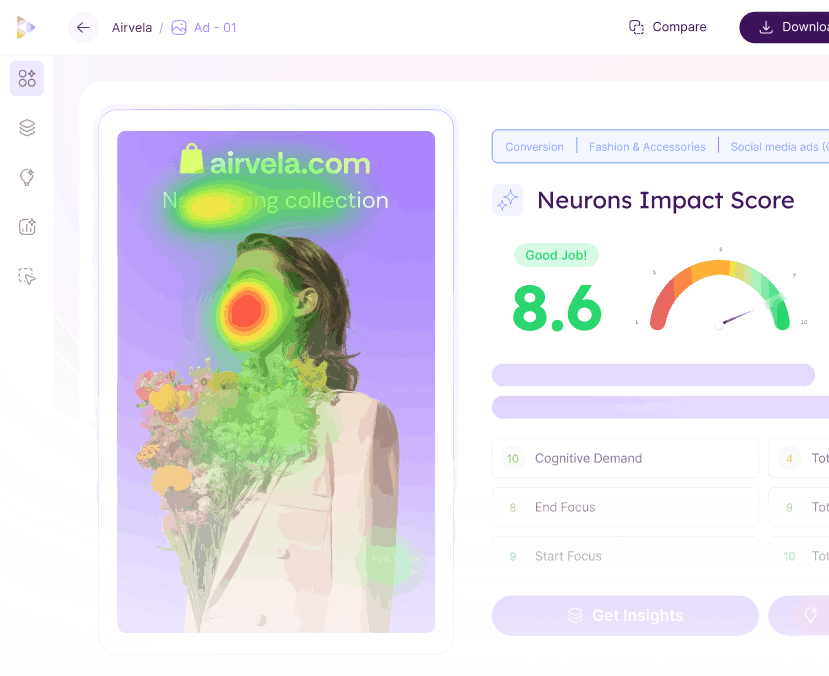
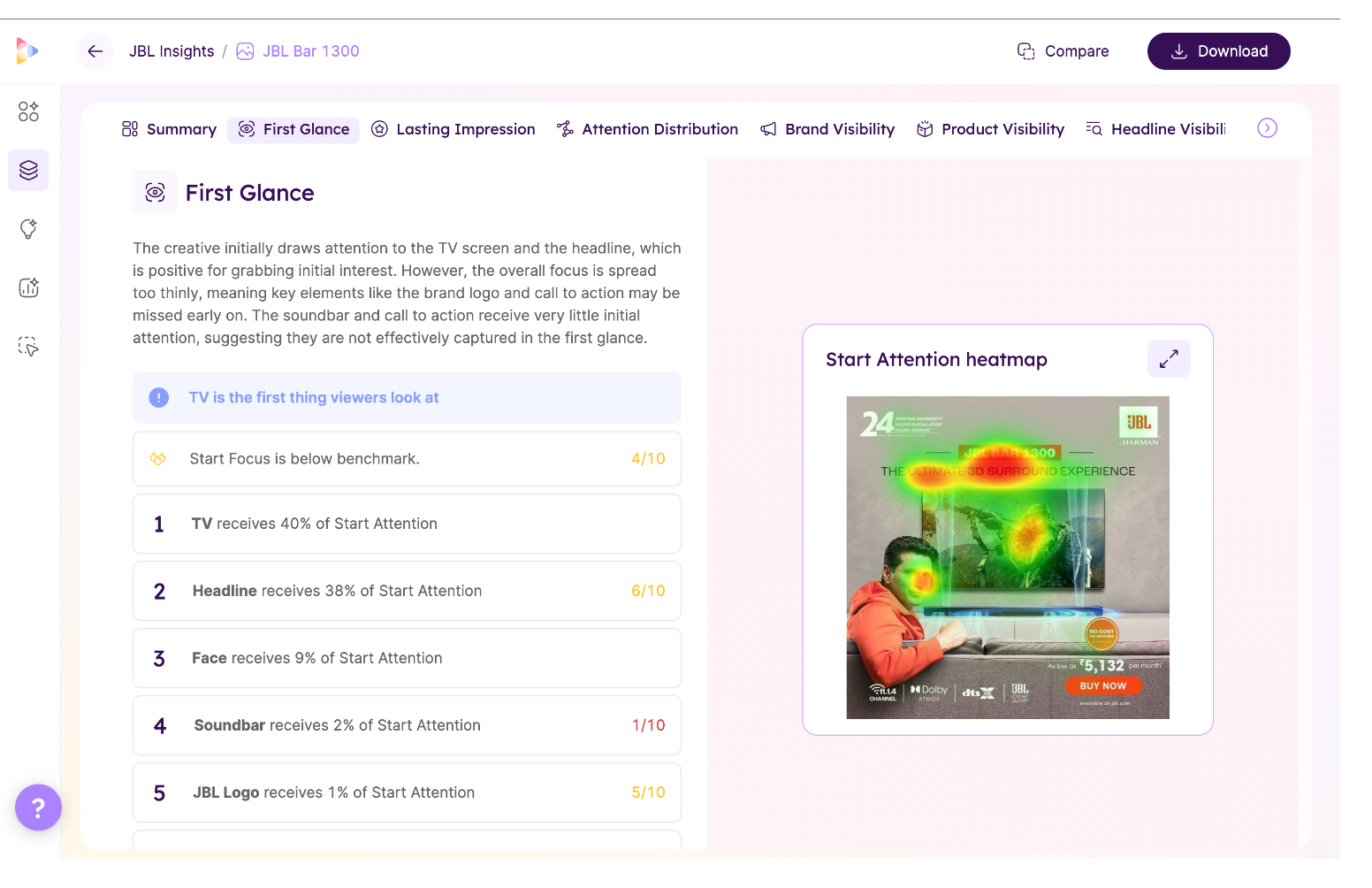
Neurons AI helps predict attention and optimize creatives before any campaign or ad goes live. The platform analyzes how people respond to visuals and identifies which parts of an ad capture attention and support recall. This method helps brands improve creative effectiveness and prevent weak execution.
Strong execution makes advertising clear and memorable, while weak execution reduces impact and fades quickly, even with repeated exposure.
How brand advertising drives long-term equity
How Do You Measure Brand Equity?

To measure brand equity, track both perception-based indicators and performance-based indicators consistently over time. Without measurement, it is impossible to know whether brand-building efforts are working and what areas need improvement.
Perception-based indicators focus on how customers think and feel about a brand. These indicators include brand awareness, recall, customer sentiment, and perceived quality. Perception-based indicators show whether brand-building efforts are truly shaping recognition, memory, and trust.
Performance-based indicators, on the other hand, show how that perception translates into commercial outcomes. Examples of these indicators are retention rate, repeat purchases, branded search volume, and pricing power.
Simply put, perception-based indicators measure what people think, while performance-based indicators measure how they act based on what they think. Both angles are needed to understand brand equity fully.
Brand equity changes over time, so tracking must be continuous. Continuously tracking brand equity helps brands spot changes early and optimize performance over time.
How brand tracking measures brand equity over time
What Metrics Should You Use to Measure Brand Equity?

Brand equity is measured using a mix of perception-based indicators and performance-based indicators. These metrics show how a brand is seen and how that translates into real results.
The key metrics for measuring brand equity are outlined below.
- Brand Awareness
Brand awareness measures how many people in the target audience know a brand exists. Awareness is a reflection of how visible a brand is in the market.
When a company has high brand awareness, there’s a higher chance it comes to mind when buyers are comparing options. Over time, this leads to an increase in sales and stability in demand.
- Brand Recall
Brand recall tracks how quickly a brand comes to mind without any cues. This metric reflects how well the brand is stored in memory. Brands with strong recall get considered first, which drives more conversions without spending more on ads.
- Brand Sentiment
Brand sentiment reveals how exactly people feel about a brand, whether positive, negative, or neutral. A negative sentiment often signals trouble, even before it shows up in numbers, while a positive sentiment improves customer retention and increases referrals.
- Customer Retention Rate
Customer retention rate measures how many customers come back to buy again. Strong retention reflects trust and satisfaction, leading to an increase in customer lifetime value.
- Pricing Power
Pricing power shows whether a brand can charge higher prices compared to its competitors without losing demand. This metric signals the strength of brand equity.
Strong pricing power improves profit margins and reduces price competition.
- Branded Search Volume
Branded search volume tracks how many people actively search for the brand by name. Growing branded search means more people search for the brand on their own, without paid media pushing them.
- Net Promoter Score
Net promoter score measures how likely consumers are to recommend a brand or its products to somebody else. High scores reflect strong loyalty, which is one of the most valuable things a brand can build.
Key brand performance metrics to track
What Is a Practical Framework for Measuring Brand Equity?
A practical brand equity measurement framework monitors the right metrics at the right time and uses the results to make better brand decisions.
The framework below breaks the process into clear stages that any marketing team can follow.
Step 1: Set a Baseline
Start by measuring where the brand stands today. Look at key metrics such as awareness, recall, sentiment, branded search volume, and net promoter score.
This gives a clear starting point. Without a baseline, it becomes difficult to tell whether brand-building efforts are improving results or not.
Step 2: Measure Consistently
Track the same metrics at regular intervals. Performance metrics like branded search and retention can be tracked more frequently, while perception metrics like awareness and sentiment can be reviewed over longer periods.
Consistency matters more than frequency. It is important to use the same method and tools each time so results can be compared accurately over time. This makes it easier to spot trends, not just one-off changes.
Step 3: Identify Gaps
Compare current results with the baseline and look for gaps between perception and performance. A brand with high awareness but low conversion may have a trust issue. A brand with strong loyalty but low awareness may not be reaching enough people.
These gaps show where attention is needed and what to improve next.
Step 4: Adjust and Repeat
Make small, focused changes based on what the data shows. This involves improving messaging, refining positioning, or strengthening the customer experience.
After making changes, measure again using the same metrics. Tracking results over time helps marketers see what is improving and what still needs attention. Brand equity is built through steady improvement, not one major change.
Frameworks for tracking brand equity effectively
What Are the Most Important Brand Equity Models?
The two most important brand equity models are Kevin Lane Keller's Brand Equity Model and David Aaker's Brand Equity Model. Both provide simple ways to understand how brand equity is built and managed over time.
Keller’s Customer-Based Brand Equity (CBBE) Model
Keller’s model focuses on how customers experience a brand. This model shows that brand equity is built in stages, starting from awareness and moving toward strong relationships.
The model follows a progression: awareness → meaning → response → loyalty.
In practice, this means a brand must first be recognized, then clearly understood, then trusted, before customers become loyal.
Keller’s model shows how important it is to build strong awareness, create clear associations, and deliver consistent experiences. These steps move customers toward loyalty over time.
Aaker’s Brand Equity Model
Aaker’s model breaks brand equity into key components: awareness, associations, perceived quality, and loyalty.
Each component represents a part of how customers see and choose a brand.
This means brands must track and improve each area consistently. When a brand is easy to recognize, clearly understood, and trusted, customers are more likely to choose it and keep coming back. Each part supports the next and strengthens the overall effect.
Aaker’s model shows that brand equity works as a system. Improving each component strengthens the overall value of the brand.
How brand strategy frameworks apply in practice
Keller customer-based brand equity model explained
Aaker brand equity model overview
What Is the Difference Between Brand Equity and Brand Value?
Brand equity and brand value differ in what they represent and how they are measured.
Brand equity describes how customers see and respond to a brand. Strong awareness, clear associations, high perceived quality, and loyalty all contribute to this perception. These factors explain why customers choose a brand and stay with it over time.
Brand value represents the financial worth of a brand. This value shows up in revenue, market share, and overall business performance. A brand with higher value contributes more to the company’s financial strength.
Although brand equity and brand value are different, they work together over time. As brand equity grows, awareness, trust, and loyalty increase demand, support higher pricing, and improve financial results.
For example, a brand like Apple has strong brand equity because customers trust the brand and prefer it over alternatives. That strong preference increases demand, which leads to higher sales and contributes to higher brand value.
What Are Examples of Strong Brand Equity?
Examples of strong brand equity include Amazon, Apple, and Nike. These brands are widely recognized, trusted, and consistently chosen over alternatives.
Amazon

Amazon’s strength comes from reliability and habit. People don’t only know Amazon; they default to it.
Fast delivery, consistent service, and a wide selection have built strong trust over time. That trust shows up in repeat purchases and frequent use.
Amazon rarely needs to convince customers to choose it. The brand comes to mind first when people want convenience. That level of recall and repeated use shows strong awareness, trust, and brand equity in action.
Apple

Apple’s brand equity shows through strong preference and demand. Many customers wait for new product releases and choose Apple even when cheaper alternatives exist.
The brand’s clear design, consistent experience, and strong identity have built high perceived quality and trust. That perception drives demand and keeps customers within the brand ecosystem.
Beyond buying, customers believe in what the brand stands for, and that belief shows in a continued cycle of demand and repeat purchases.
Nike

Nike’s strength comes from meaning and emotional connection. The brand stands for performance and achievement, and that message stays consistent across campaigns.
Partnerships, storytelling, and visibility make the brand easy to remember. Over time, this has built strong associations that go beyond the product itself.
Customers connect with the message, not just the product, driving preference, keeping the brand top of mind, and building long-term loyalty.
How leading agencies build strong brand equity
What Are Common Mistakes When Building Brand Equity?

The common mistakes that weaken brand equity over time are outlined below.
- Using Inconsistent Branding
Using different messages, visuals, or tones across channels makes the brand harder to recognize and remember. Weak recognition slows down awareness and reduces trust over time.
- Focusing Only on Short-Term Sales
Prioritizing promotions and quick wins over brand building weakens long-term equity. Customers may buy once but have no strong reason to return.
- Failing to Define Clear Positioning
A brand that does not stand for anything specific is difficult to understand or remember. Without a clear meaning, strong associations cannot form.
- Delivering a Poor Customer Experience
Inconsistent or negative experiences break trust. Even strong awareness cannot compensate for a bad experience, which reduces loyalty and repeat purchases.
- Changing Strategy Too Often
Changing strategy too often prevents memory from building. Recognition and recall require repetition, and constant changes reset that progress.
- Using Weak or Generic Advertising
Ads that lack clarity or distinctiveness fail to capture attention. Without attention, memory and associations do not form, making the brand easy to forget.
Common brand strategy mistakes to avoid
How Can You Improve Brand Equity Over Time?
You can improve brand equity over time by following a simple process built on consistency and continuous improvement. The steps to follow are outlined below.
Step 1: Audit Current Brand Position
Start by assessing where the brand stands today. Review key metrics such as awareness, recall, sentiment, retention, and branded search.
This step helps identify strengths and weaknesses and gives a clear starting point.
Step 2: Define a Clear Brand Strategy
Set a clear position for the brand. Define what the brand stands for, who it serves, and how it should be perceived.
Clarity at this stage guides messaging, design, and overall direction.
Step 3: Execute Consistently Across Touchpoints
Apply the brand strategy across all channels. Use consistent messaging, visuals, and tone in advertising, content, and customer experience.
To make consistency effective, you need to ensure the visuals and messaging capture attention and stay in people’s memory. Tools like Neurons AI help predict this before launch, so you can repeat what is more likely to work.
Over time, consistency builds recognition, strengthens associations, and improves trust.
Step 4: Measure and Improve Continuously
Track both perception and performance metrics regularly. Monitor changes in awareness, sentiment, retention, and demand.
Use these insights to make small adjustments and improve results over time.