Brand advertising is a long-term marketing strategy focused on building awareness, attention, recall, and brand equity rather than driving immediate conversions.
Unlike campaigns designed to drive immediate clicks or purchases, brand advertising is built to shape how audiences perceive and remember a brand.
At its core, brand advertising is about mental availability. It ensures that customers know your brand (awareness), notice and process it (attention), and remember it when in a buying situation (recall).
Brand advertising also strengthens the brand’s perceived value and differentiation (long-term equity) through consistent exposure, emotional storytelling, distinctive creative assets, and repetition across media channels.

Where direct-response campaigns are optimized for short-term actions, brand advertising plays the long game. It shapes future demand, improves conversion efficiency across all marketing activities, and reduces reliance on constant discounting or performance spend.
Brand advertising is not optional for companies seeking sustained growth. It is a foundational component of brand building. Without it, businesses become dependent on transactional marketing tactics that increase cost per acquisition over time.
Brand advertising creates the conditions that make performance marketing work better.
Learn how brand advertising fits into a broader brand-building strategy.
Brand Advertising vs. Performance Marketing: What’s the Difference?

Performance marketing is a results-driven marketing approach focused on generating immediate, measurable actions such as clicks, sign-ups, or purchases.
Both approaches are legitimate and necessary. But they operate differently across objectives, time horizons, and optimization frameworks.
The table below compares brand advertising and performance marketing across different categories.
Brand and performance strategies are complementary, not opposites. Brand advertising expands the top of the funnel and strengthens mental availability. Performance marketing captures demand when it appears.
Without brand advertising, performance marketing becomes more expensive over time because customers are unfamiliar with or skeptical of it. Without performance, brand campaigns lack immediate revenue accountability.
The strongest growth strategies integrate both, allocating budget intentionally across long-term equity and short-term revenue goals.
Explore how brand performance connects to revenue growth.
What Are the Main Objectives of Brand Advertising?
The 6 main brand advertising objectives are awareness, brand attention, brand recall, brand memory, consideration, and preference. Each objective builds on the previous one and connects directly to measurable KPIs.
- Awareness
The first objective of brand advertising is awareness, ensuring that audiences recognize the brand name, logo, or identity.
Awareness is measured through aided and unaided awareness surveys, reach metrics, and branded search volume. Without awareness, no other objective can be achieved.
- Brand Attention
Attention refers to whether audiences notice and process the advertisement rather than passively scrolling past it.
This objective aligns with measurable attention metrics, including viewability rates, visual attention scores, dwell time, and AI-based attention heatmaps. Attention is vital for memory formation.
- Brand Recall
Recall reveals whether people can remember a brand after seeing an ad. This objective is measured through brand lift studies and surveys that test memory after exposure. When recall is higher, people are more likely to choose that brand when they’re ready to buy.
- Brand Memory
Brand memory measures how strongly and distinctly the brand is encoded in long-term memory. Memory strength is measured by how often people see the brand, how easily they recognize its distinctive elements, and whether they can remember it later. When brand memory is strong, the brand comes to mind more easily when someone is ready to buy.
- Consideration
Consideration measures whether consumers would realistically consider the brand as an option. This brand advertising objective is tracked through surveys and audience panels. Consideration bridges the gap between awareness and purchase intent.
- Preference
Preference indicates that consumers favor the brand over alternatives. Preference metrics include sentiment analysis, purchase intent surveys, and brand favorability scores. When people prefer a brand, they’re more willing to pay for it and less likely to switch to competitors, even if alternatives are cheaper.
Learn how brand tracking measures these KPIs over time.
How Does Brand Attention Drive Brand Recall and Memory?
Brand attention is the degree to which consumers actively focus on and cognitively process a brand message.
Simply appearing on a user's screen doesn’t guarantee meaningful attention, and without attention, the user won't remember it.
Research in cognitive psychology shows that attention is the gateway to memory. When viewers look directly at key brand elements such as the logo, product, or tagline, recall increases significantly.
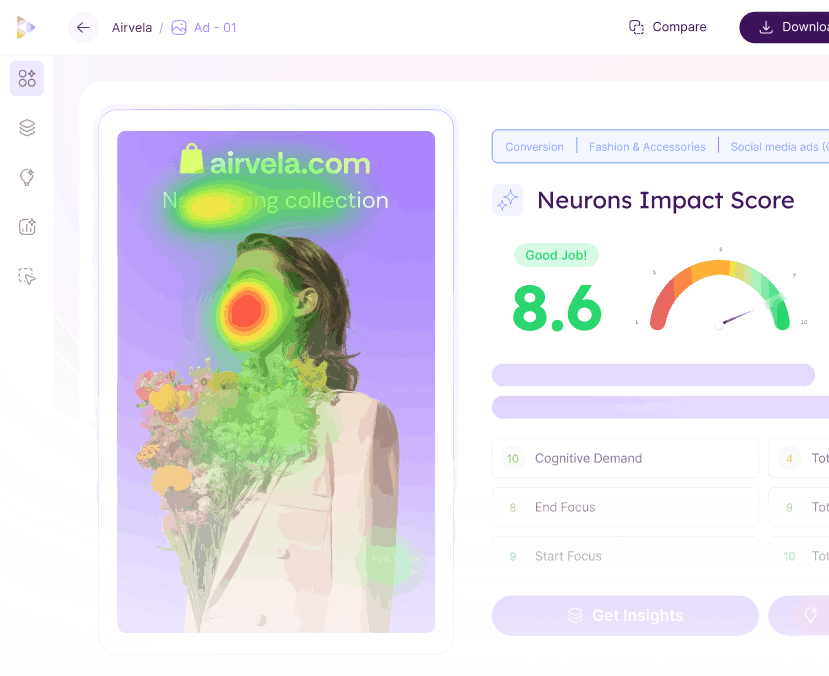
AI-powered attention heatmaps now allow marketers to see where viewers are likely to focus within an ad, how long that focus lasts, and whether branding appears early enough to be noticed. By analyzing these insights before launch, creatives can adjust to improve brand visibility.
Stronger attention leads to stronger recall, and stronger recall drives brand lift. This creates a clear link between creative optimization and measurable brand outcomes.
Discover how Neurons AI measures brand attention and memory.
What Is a Brand Advertising Strategy?

A brand advertising strategy is a structured, long-term plan designed to build awareness, recall, and brand equity through coordinated creative and media efforts.
Unlike isolated campaigns, a strategy aligns audience targeting, messaging, creative assets, channel selection, and measurement into a unified framework.
A strong brand advertising strategy includes five pillars: audience, positioning, creative, media, and measurement.
- Audience
Audience involves understanding who the brand needs to influence. It includes demographic, psychographic, and behavioral insights.
- Positioning
Positioning defines how the brand wants to be perceived relative to competitors. This pillar of brand advertising strategy informs messaging, tone, and differentiation.
- Creative
Creative is the core of brand advertising. This pillar of brand advertising strategy involves developing distinctive assets like visual identity, messaging, and storytelling that reinforce positioning.
- Media
Media is the system that distributes your brand message to the right audience at the right moment through the most effective channels. Media planning determines frequency, sequencing, and cross-channel integration.
- Measurement
Measurement transforms brand advertising from abstract storytelling into a performance-informed system. It includes defining KPIs and using lift studies and attention metrics to evaluate effectiveness.
Consistency builds memory by repeating the same brand cues, like visuals, tone, and messaging, so they become familiar and easy to recognize. Sequencing strengthens this effect by showing those cues in a planned order across different ads and channels.
When people see the same brand elements repeatedly over time, their brains store and reinforce those associations. That’s how brands become easier to remember and easier to choose.
Download our guide on building a memorable brand.
How Do You Build a Brand Advertising Campaign Step-by-Step?
To build a brand advertising campaign step by step, you must have a structured process that aligns objectives, audience, creative, media, testing, and measurement. The 6 steps to building a brand advertising campaign are outlined below.
Step 1: Define Objectives
Before creating a campaign, define the brand objective. Decide whether the goal is to increase awareness, improve recall, or strengthen consideration.
The objective determines what success looks like and which metrics matter. Without clarity, campaigns may generate impressions but fail to build brand strength.
Example: A new fintech startup entering the market sets a target of reaching 60% aided awareness within 12 months. The campaign is measured on reach and brand lift—not immediate app downloads.
Step 2: Map The Audience
Brand advertising is not about reaching everyone. It’s about reaching the people most likely to buy now or in the future.
Audience mapping focuses the budget on high-potential segments instead of spreading it too thin. The goal is a broad reach within the right audience, not random exposure.
Example: A consumer electronics brand launching a new smartwatch targets tech-savvy urban millennials who frequently upgrade devices and influence others’ purchases. Media placements are chosen based on where this group spends time online.
Step 3: Develop Creative Assets
Strong brand creative captures attention quickly and makes the brand clearly visible. Logos, brand colors, taglines, and distinctive assets should appear early and prominently. Emotional storytelling can strengthen impact, but clear brand linkage is essential.
If people remember the story but cannot recall the brand, the campaign has not achieved its goal.
Example: A skincare brand builds its brand advertising campaign around dermatologist-backed credibility. The logo, packaging, and certification badge appear within the first few seconds of every video ad to reinforce recall.
Step 4: Plan Media Distribution
Brand advertising campaigns build memory through repetition. A single exposure rarely creates recall, but consistent exposure over time strengthens brand recognition.
Media planning should prioritize reach and frequency, ensuring that the right audience sees the brand often enough for it to stick. Channel selection matters, but consistency and sequencing matter more.
Example: A beverage brand runs YouTube video ads to build broad awareness while placing high-visibility digital billboards in city centers. The campaign runs in waves to maintain presence over time without overwhelming viewers.
Step 5: Test Before Scaling
Scaling creative without testing increases the risk of wasted media spend. Before investing heavily, confirm that ads clearly communicate the brand and capture attention.
.jpg)
Predictive creative testing and AI attention heatmap tools like Neurons AI reveal whether viewers notice logos, products, and key messages, enabling you to make necessary adjustments before launch. This, in turn, helps reduce the risk of wasting ad spend on ineffective creatives.
Example: A fintech startup tests two ad versions. Attention data shows that one version draws attention to background visuals rather than the brand name. The team revises the layout before launching nationally.
Step 6: Measure Brand Lift and Optimize Continuously
After launch, track awareness, recall, attention metrics, and consideration lift to understand real impact. Then use the results to optimize the campaign. Optimization may involve adjusting frequency, rotating creative, or reallocating media budget toward higher-performing channels.
Tactical example: After six weeks, the skincare brand sees strong awareness growth but only moderate recall. They introduce shorter reminder ads that emphasize the brand name more clearly. Recall improves in the next measurement wave.
A structured brand advertising campaign process ensures that brand advertising becomes repeatable, scalable, and performance-informed, rather than experimental or purely creative.
Watch our webinar on brand building in a performance-driven world.
How Should Brand Advertising Budgets Be Allocated?
Deciding on the right brand advertising budget is one of the most strategic choices a marketing team can make. Spend too little on brand, and performance campaigns become more expensive over time. Spend too much without measurement, and leadership starts questioning ROI.
Outlined below are three of the most common frameworks for allocating brand advertising budget.
- The 60/40 Rule
Popularized in marketing research, this model suggests allocating roughly 60% of the budget to brand-building and 40% to performance marketing. It works best for established brands operating in competitive markets where long-term equity drives pricing power and market share.
- Stage-Based Allocation
Stage-based allocation adjusts the brand advertising budget based on company maturity. Early-stage companies often prioritize performance for immediate cash flow, while more mature brands invest heavily in brand advertising to protect and expand share.
- Test-and-Scale Allocation
Instead of committing to a fixed ratio, some companies allocate dynamically. They use brand lift tests, attention metrics, and predictive modeling to increase or decrease brand spend based on measurable impact.
No framework is universally correct. The right allocation depends on growth goals, category competitiveness, and measurement sophistication.
Brand lift tests and predictive metrics help brands adjust their brand advertising budget based on real results. Lift studies show whether awareness and recall actually improved, while predictive testing helps spot weak creatives before scaling spend.
Learn how brand performance connects to revenue.
What Are the Best Brand Advertising Formats?

The seven most effective brand advertising formats include.
- Video
- Connected TV (CTV)
- Display advertising
- Native ads
- Social media advertising
- Out-of-home (OOH)
- Audio advertising
High-reach formats like video, Connected TV (CTV), and out-of-home (OOH) are effective for building broad awareness because they deliver scale and strong visual impact. Video and CTV also add motion and sound, which help capture attention and strengthen emotional engagement.
For improving recall and reinforcing memory, formats that allow repetition, such as social media ads, displays, and audio, play an important role. These channels help repeat distinctive brand cues like logos, colors, and taglines across different touchpoints.
The most effective strategies don’t rely on a single brand advertising format; they combine multiple channels to create consistent, repeated exposure that builds long-term brand
Explore measurable brand advertising examples.
How Do Video Ads Improve Brand Recall and Memory?
Video ads improve brand recall by engaging multiple senses at once. Motion captures attention, and audio triggers emotional responses through music, tone, and voice. These emotional responses strengthen memory encoding in the brain, making the brand more likely to be stored and remembered later.
Memorability increases when video follows strong storytelling principles: introduce the brand early, build a clear emotional arc, integrate the product into the narrative, and close with distinctive brand cues. This structure helps the brain organize and store the message more effectively.
AI-powered attention heatmaps now allow marketers to analyze video ads frame by frame. These tools reveal where viewers are likely to look, how long they sustain attention, and whether brand elements are visually processed. If heatmaps show that viewers focus on faces or background elements while ignoring the logo, adjustments can be made before scaling spend.
Optimizing video ads with attention insights improves brand recall by aligning branding with high-attention moments. When brand cues appear during peak engagement, encoding becomes stronger.
See how creative attention can be optimized with AI.
What Are the Best Brand Advertising Tips to Improve Recall and Impact?
.jpg)
Effective brand advertising tips are rooted in attention and memory science, not guesswork. The goal of brand advertising is not just to be seen but to be remembered. The following principles are actionable, research-backed ways to improve recall, strengthen brand linkage, and increase long-term impact.
- Show the Brand Early and Clearly
Attention is highest in the first few seconds of an ad. Introducing the logo, brand name, or distinctive brand asset early increases the chances that the message is correctly linked to the brand. Delayed branding often leads people to remember the story but forget who told it.
- Use Consistent Brand Colors, Fonts, and Visual Assets.
Consistency strengthens recognition. When the same colors, typography, tone, and visual style appear repeatedly across campaigns, the brain forms stronger associations. Over time, even partial cues, like a color or sound, can trigger brand recall.
- Integrate the Product Into the Story
The product should not feel like an afterthought. When it plays a meaningful role in the narrative, memory encoding is stronger because the brand becomes part of the emotional experience rather than a separate visual stamp.
- Keep the Message Simple and Focused
Cognitive overload weakens memory. Ads that try to communicate too many ideas reduce clarity and recall. Strong brand advertising focuses on one core message or association per campaign wave.
- Repeat Distinctive Cues Across Campaigns
Repetition builds memory strength. Instead of constantly reinventing creative concepts, build campaigns that reinforce the same positioning and distinctive brand assets over time.
- Test Creative Before Scaling Media Spend
Predictive attention modeling and recall testing help identify weak brand linkage before large budgets are committed. Testing ensures that creative supports memory formation, not just visual appeal.
These branding tips for advertising work because they align with research on how attention and human memory function. Brand advertising improves when it prioritizes attention, emotional engagement, repetition, and consistent brand linkage across every exposure.
Read 15 powerful branding tips for a successful campaign.
Why Should Logos and Brand Colors Appear Early in Brand Ads?
Logos and brand colors should appear early in brand ads because attention is strongest at the beginning, and it naturally declines as the ad progresses. If branding is delayed until the final seconds, a significant portion of viewers may never fully process it. That weakens the connection between the message and the brand, reducing recall.
Early brand cues ensure that even partial ad exposure still reinforces memory. In digital environments, especially, viewers often scroll quickly or skip content. Introducing the logo, brand name, or distinctive color palette within the first few seconds increases the probability that the brand is encoded and remembered, even if the viewer does not watch the entire ad.
Heatmap insights support this: they show that viewers focus most on early frames and high-attention areas. Placing logos and brand elements in those zones increases visual processing, strengthens brand linkage, and improves recall.
Discover how AI heatmaps reveal whether your logo is seen early enough.
How Can Brands Make the Product Part of the Story Instead of Just a Visual Stamp?
To make the product part of the story, practice integrated storytelling. Integrated storytelling makes the product or brand central to the narrative by assigning it a meaningful role. Sometimes this could be solving a problem, supporting a character, or driving the emotional outcome. Integrated storytelling makes it part of the experience rather than an add-on.
In contrast, late logo stamping allows an emotional story to run independently so that the brand appears only in the final seconds. Viewers may remember the story but struggle to remember who it was for.
A weak integration example would be a touching family story followed by a logo and tagline unrelated to what just happened. In recall testing, audiences may describe the ad but fail to name the brand. The emotion is remembered, but the brand linkage is weak.
A strong integration example would show the product actively shaping the story. If a sports brand features its shoes helping a child take confident steps, and the tagline reinforces that theme throughout, the emotional payoff becomes directly tied to the brand promise.
Integrated storytelling strengthens memory because the brain stores experiences through association. When emotion and brand cues repeatedly co-occur, they are encoded together. This builds stronger mental connections.
Late stamping separates the emotional moment from the brand cue, which reduces memory strength. The audience may encode the feeling, but not the brand identity behind it.
Recall metrics reflect this difference. Ads with strong narratives but poor integration often result in lower brand recall. Ads where the product is meaningfully embedded in the story typically produce higher recall and stronger brand lift.
Learn how brand attention predicts recall and memory
Why Should Creative Be Tested Before Scaling Media Spend?
Predictive creative testing uses AI to forecast how a creative will perform before it is launched by evaluating its performance before launch. Using AI and cognitive modeling, marketers can estimate how likely an ad is to capture attention, communicate branding clearly, and drive recall. Instead of waiting weeks for post-campaign results, teams can compare creative variations in advance and choose the strongest option.
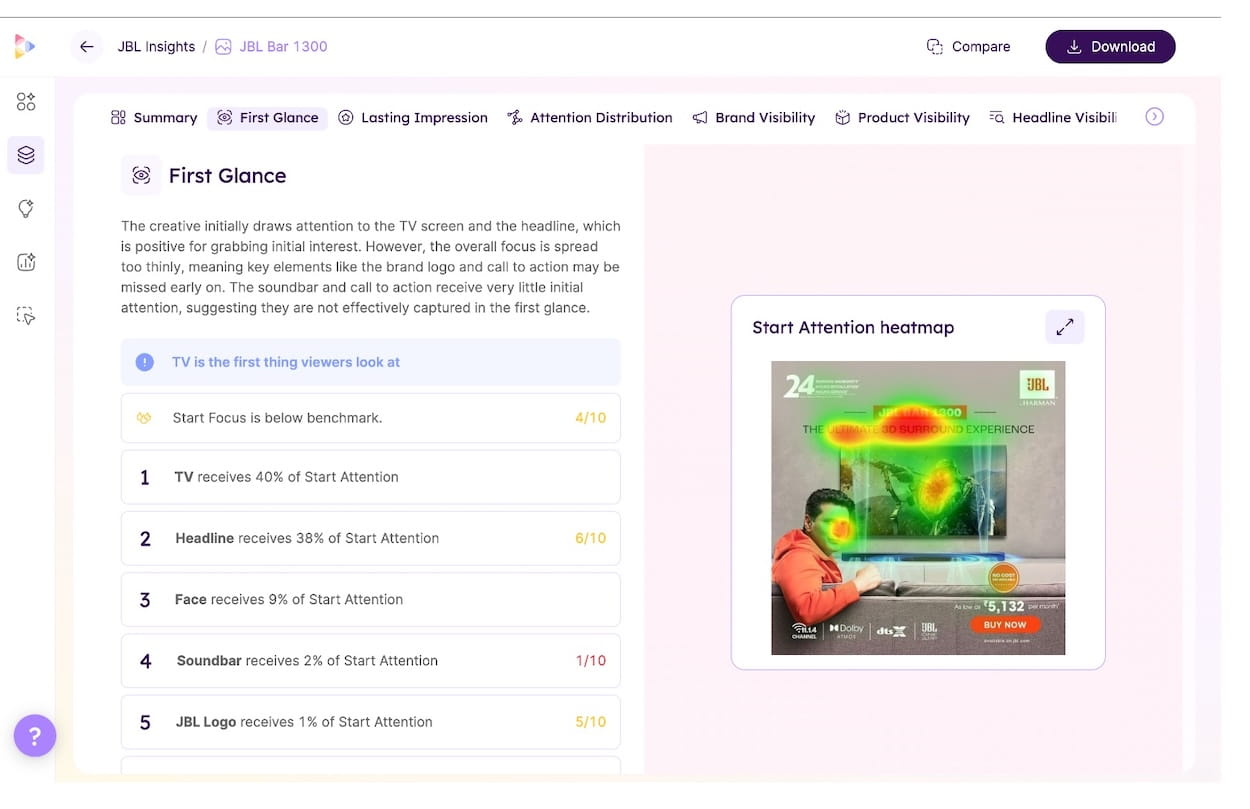
A key part of predictive testing is attention modeling. Attention heatmaps show where viewers are most likely to look within an ad and how long they stay focused. By identifying these issues early, marketers can reposition logos, adjust visual hierarchy, or simplify messaging before spending heavily on media.
Predictive testing also improves brand lift performance. Since lift depends heavily on creative quality, ads that score higher in attention-to-brand and recall prediction are more likely to generate measurable awareness and recall increases once launched. In this way, predictive insights often signal lift potential before campaigns scale.
Ultimately, creative testing functions as risk mitigation. Large media budgets carry financial exposure, and launching untested creative introduces unnecessary uncertainty. Testing reduces that risk by identifying weaknesses before they become expensive problems.
Watch our webinar on brand building in a performance-driven world.
How Do You Measure Brand Advertising Performance?
Brand advertising measurement evaluates whether advertising is successfully building awareness, strengthening memory, improving perception, and increasing consideration. Unlike performance marketing, where results can be tracked instantly through clicks or conversions, brand advertising requires a broader and more structured measurement framework.
Brand advertising performance is measured by evaluating whether campaigns are building awareness, strengthening recall, and improving perception over time. This requires a combination of metrics rather than a single data point.
Attention metrics help determine whether people actually process the ad, while brand lift studies measure the incremental impact of exposure on awareness, recall, and consideration. Surveys track how the brand is remembered and perceived, and passive signals, such as branded search growth, provide additional evidence that demand is strengthening.
Predictive metrics play an important role in early optimization because brand impact takes time to materialize. Tools like attention modeling and recall prediction help identify whether a creative is structured to support memory before large budgets are fully deployed. When attention insights, lift results, survey data, and behavioral signals align, they provide strong proof that brand advertising is generating measurable, long-term growth.
Learn more about brand tracking methodologies.
What Metrics Matter Most in Brand Advertising?
The six most important brand advertising metrics include brand attention, recall, memory strength, awareness, consideration, and sentiment. Together, these metrics form a progression from exposure to long-term growth.
Brand attention predicts recall. If viewers do not process branding elements visually and cognitively, recall will be low. Recall, in turn, predicts long-term growth because remembered brands are easier to choose. Awareness expands the potential audience pool, consideration signals purchase likelihood, and sentiment strengthens loyalty.
Together, these brand advertising metrics provide a structured framework for evaluating brand performance. Rather than focusing on vanity indicators like impressions or click-through rates, effective brand measurement prioritizes metrics that reflect attention, memory, and future demand.
Explore detailed brand tracking metrics.
How Do Brand Lift Tests Prove Advertising Impact?
Brand lift measures the incremental change in awareness, recall, consideration, or perception caused specifically by advertising exposure. It answers one critical question: "Did the ad change how people think or feel about the brand?”
Brand lift tests demonstrate impact through two primary methods of controlled comparison: holdout testing and A/B testing.
In holdout testing, a portion of the target audience is intentionally withheld from seeing the campaign, creating a clean comparison group. In A/B exposure testing, different creative versions are shown to separate audience segments, allowing brands to measure which variation drives stronger lift in recall or consideration.
For example, imagine a campaign designed to improve brand recall. Group A is exposed to the ad, while Group B is not. After the campaign runs, both groups are surveyed. If 48% of Group A recalls the brand compared to 35% in Group B, the 13-point difference represents a measurable recall lift from the advertising.
Predictive attention metrics strengthen the interpretation of lift results. If attention modeling shows strong focus on branding elements and lift results confirm improved recall, marketers gain confidence that the creative structure drove the impact. When predictive insights and lift outcomes align, they create a clear, measurable link between creative quality and brand performance.
Learn how brand lift experiments are structured.
What Are Examples of Successful Brand Advertising Campaigns?
The most convincing brand advertising examples are those backed by measurable results. Rather than relying on creative acclaim or anecdotal success, the strongest campaigns demonstrate clear impact through structured objectives and data-driven evaluation. These examples demonstrate that brand advertising, when executed strategically, produces measurable improvements in awareness, recall, and long-term brand equity.
Each brand advertising example follows a consistent format: a defined objective, a strategic approach, a clear measurement framework, and a documented result. The objective outlines what the brand intended to change, while the approach explains how creative, media, and attention optimization were structured to support that goal.
Measurement details how lift tests, attention modeling, or recall surveys were used to evaluate performance. The result highlights incremental impact, such as increased recall lift, stronger brand linkage, or improved engagement metrics.
How Did Tropicana Brands Group Improve Brand Impact?
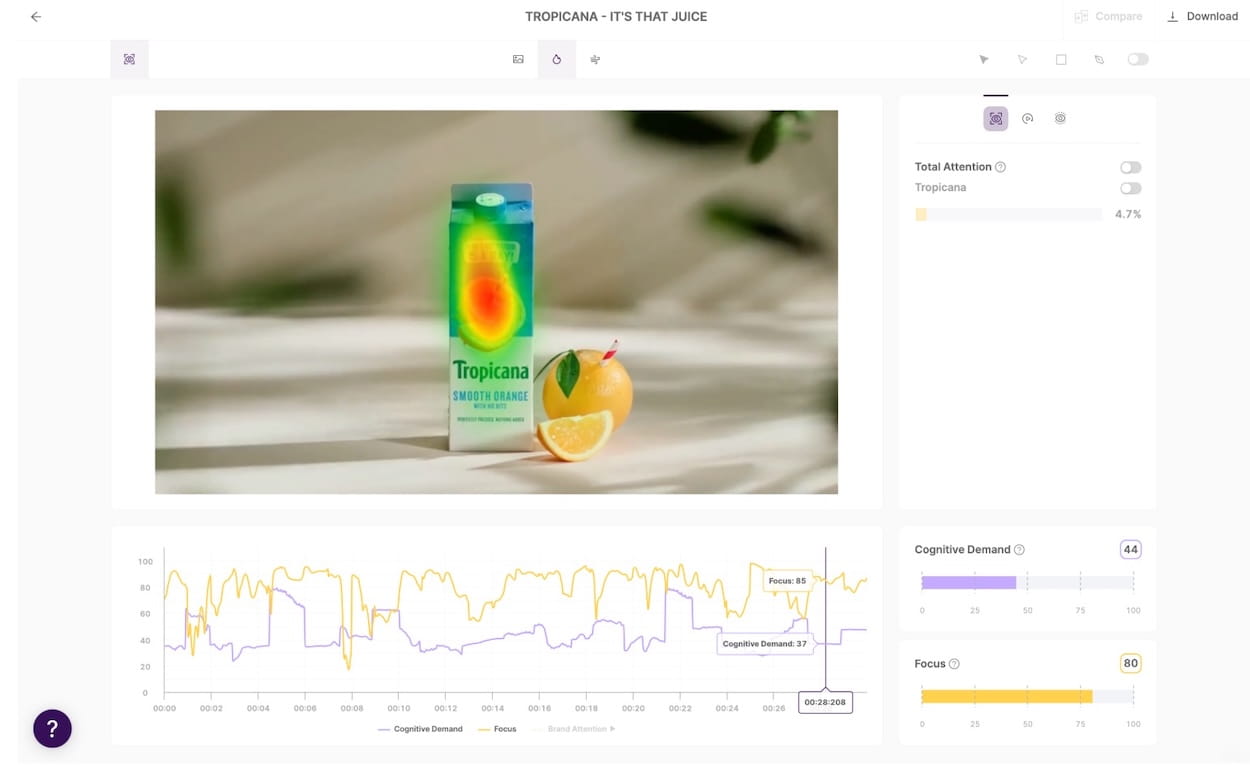
Tropicana Brands Group aimed to strengthen brand awareness and visual impact across its beverage portfolio. The goal was to ensure that campaign assets, ranging from OOH placements to packaging and digital ads, captured attention quickly and reinforced distinctive brand identity in a crowded category.
To achieve this, Tropicana used Neurons AI to evaluate creative before launch. By analyzing visual hierarchy, logo placement, strapline visibility, and focal points, the team identified opportunities to strengthen branding. Adjustments were made to increase attention-to-brand, ensuring that key elements such as logos and messaging appeared in high-attention zones rather than being overlooked.
Results
These optimizations resulted in measurable improvements in brand visibility and engagement. For example, the results from the OOH bus campaign were so impressive that the campaign was extended. Across channels, the refined creative approach supported clearer brand linkage and improved overall impact.

These results weren’t accidental. Tropicana built predictive measurement directly into its creative process, using attention modeling to estimate performance before increasing media spend. By combining those predictions with real campaign results, the brand showed that data-driven creative tweaks can improve recall, boost awareness, and make brand advertising more efficient and measurable
See the full Tropicana case study.
How Did Teads Enhance Brand Visibility and Engagement?
Teads partnered with Konnex and 4B to improve the performance of a multi-channel video campaign using existing raw assets. The objective was to increase brand awareness and boost ad recall across digital and TV environments without producing entirely new creative.
To achieve this, Teads applied Neurons AI’s predictive attention modeling to analyze where viewers focused within the videos. Based on insights, they adjusted logo placement, simplified visuals, improved sequencing, and added branding earlier to increase attention-to-brand and strengthen message linkage.
Results
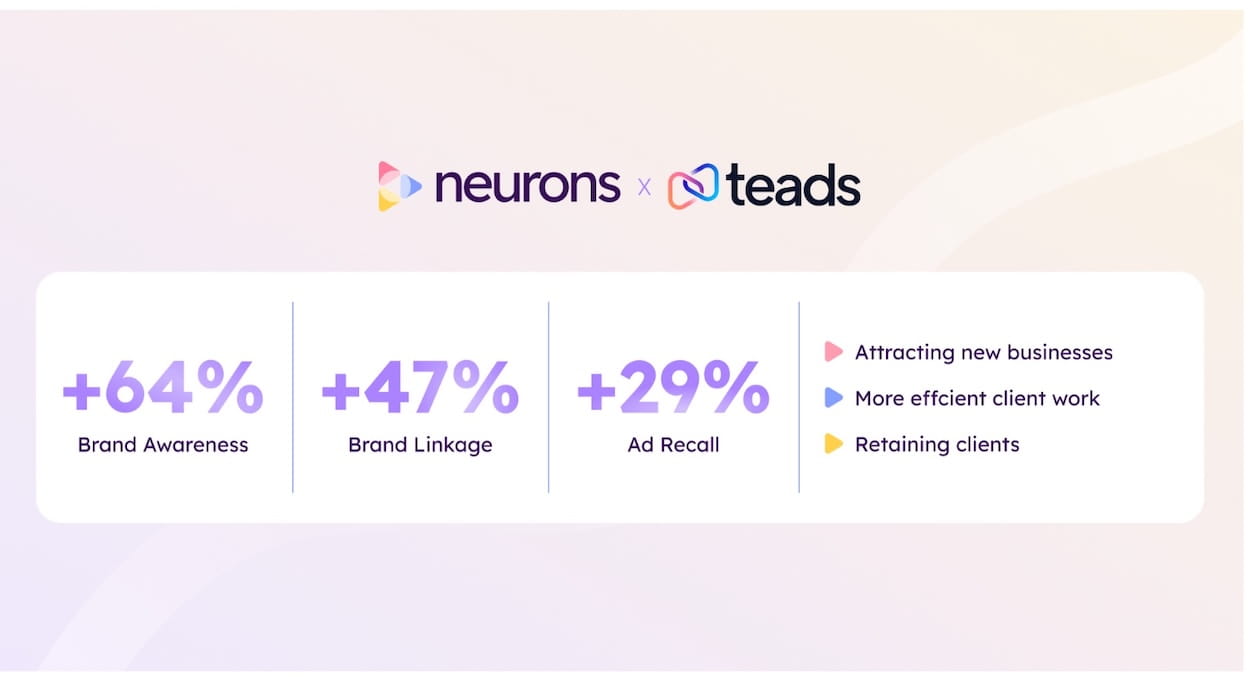
Brand lift testing showed strong results: a 64% increase in brand awareness, a 47% improvement in brand linkage, and a 29% lift in ad recall. Engagement and perceived quality also improved, confirming stronger audience processing of brand cues.
This case demonstrates that optimizing creative with predictive measurement leads to measurable improvements in recall and awareness. It shows that brand advertising effectiveness can be tested, refined, and scaled using data, not just creative intuition.
How Did JDE Peet’s Optimize Brand Recall?

JDE Peet’s sought to improve brand recall for L’OR across global campaigns. The challenge was ensuring logos, products, and key messages were clearly noticed and remembered in crowded digital environments. The team needed objective data to guide creative decisions across markets.
Using predictive attention modeling, JDE Peet’s analyzed whether branding elements appeared in high-focus areas. Insights revealed where logos and product cues were being overlooked, allowing the team to refine visual hierarchy and strengthen brand linkage before launch.
Results
The optimized creative led to stronger brand recognition and improved recall performance in live campaigns. By aligning attention insights with memory modeling, JDE Peet’s increased the likelihood of long-term brand encoding, demonstrating measurable improvements in brand advertising effectiveness.
Read the JDE Peet’s case study.
What Tools and Software Support Brand Advertising?
Modern brand advertising software and tools help marketers move from intuition to measurable performance. However, effective brand measurement relies on three complementary software categories: predictive attention tools, survey and lift testing platforms, and analytic platforms that track behavioral signals.
The first category of brand advertising tools includes predictive creative optimization platforms such as Neurons AI. Neurons AI uses neuroscience-based modeling and artificial intelligence to predict how people will visually process an ad before it launches.
It generates attention heatmaps that show where viewers are likely to look, estimates attention-to-brand scores, and predicts recall and memory strength. By identifying whether logos, products, and key brand cues are positioned in high-attention zones, this type of brand advertising software helps teams refine creative before scaling media spend.
Instead of waiting for post-campaign lift results, marketers can optimize for attention and recall at the pre-launch stage.
The second category includes survey platforms and brand lift testing tools. These platforms measure incremental changes in awareness, recall, consideration, and favorability by comparing exposed and unexposed audiences.
The third category consists of analytics platforms that track passive and behavioral signals. Web analytics tools measure direct traffic and branded search growth, while media dashboards track reach and frequency. Social listening platforms monitor sentiment and brand mentions. When used together, these analytics systems help connect brand exposure to broader business indicators.
Compare leading brand advertising tools.
What Features Matter Most in Brand Advertising Software?
The most effective brand advertising software is built to measure and improve attention, memory, and brand linkage. The features below are critical because they directly influence whether advertising builds recall and long-term equity.
- Attention-to-Brand Measurement
This core feature measures the degree of visual and cognitive focus directed specifically at branding elements, such as logos, products, and brand colors. It ensures that impressions translate into actual brand processing rather than passive exposure.
- AI Heatmaps and Visual Attention Analysis
AI heatmaps simulate eye-tracking to show where viewers are most likely to look within an ad. They help marketers identify whether brand cues appear in high-attention zones or are being overlooked.
- Predictive Recall Scoring
Predictive recall scoring estimates the likelihood that an ad will be remembered before it launches. It allows teams to compare creative variations and prioritize those with stronger memory-building potential.
- Neuroscientific Memory Modeling
This feature uses cognitive science principles to estimate the strength of long-term memory encoding. It helps brands understand whether emotional engagement and repetition are structured to build durable brand associations.
- Visual Recommendations for Creative Improvement
Some platforms provide actionable suggestions such as repositioning logos, increasing contrast, or simplifying messaging. These insights allow teams to refine creative quickly without relying solely on subjective judgment.
Together, these features reduce wasted media spend by identifying weak branding and memory gaps before scaling campaigns. Instead of amplifying ineffective creative across large budgets, marketers can optimize ads in advance, ensuring that paid impressions build attention, recall, and measurable brand lift rather than disappearing unnoticed.
Learn how Neurons AI optimizes brand advertising creative.
What Mistakes Do Brands Make With Brand Advertising?
Even well-funded brands make avoidable mistakes in brand advertising. These errors often stem from applying performance marketing logic to brand campaigns or failing to measure what truly drives memory and recall.
- Over-Optimizing for CTR
Click-through rate measures immediate action, not long-term memory or brand impact. Ads optimized for clicks often prioritize urgency or offers over distinctive brand cues.
Corrective action: Prioritize recall, attention to brand, and lift metrics over CTR alone.
- Ignoring Memory and Recall Metrics
Many brands track impressions and reach, but fail to measure whether audiences actually remember the brand. Without recall data, it’s impossible to know if advertising is building mental availability.
Corrective action: Implement brand lift studies and recall testing as standard measurement practice.
- Inconsistent Brand Cues Across Campaigns
Frequent changes to logos, taglines, colors, or tone weaken memory formation. Inconsistency prevents audiences from forming strong associations with the brand.
Corrective action: Develop and repeat distinctive brand assets consistently across channels and campaigns.
- Measuring Too Infrequently
Annual brand tracking is too slow to guide optimization. Without ongoing measurement, brands miss opportunities to refine creative and improve lift.
Corrective action: Use continuous lift testing and predictive metrics for ongoing optimization.
Avoiding these brand advertising mistakes ensures that brand advertising builds measurable recall, strengthens memory, and supports long-term growth rather than simply generating impressions.
Avoid brand measurement blind spots.
How Can Companies Improve Their Brand Advertising Today?
Here’s a practical 6-step checklist companies can follow to strengthen and improve their brand advertising.
Step 1: Define a measurable brand objective
Choose a specific goal, such as increasing awareness, recall, or consideration, so success can be clearly tracked.
Step 2: Bring brand cues in early and make them obvious
Show your logo, brand colors, and distinctive assets within the first few seconds so viewers link the message to your brand.
Step 3: Test the creative before scaling media spend
Use predictive testing to confirm your ad captures attention and drives recall before you invest heavily in distribution.
Step 4: Run a small brand lift experiment
Compare exposed vs. unexposed audiences to prove whether your ads are actually improving awareness or recall.
Step 5: Track the right brand metrics consistently
Monitor attention to brand, recall, consideration, and sentiment regularly, rather than relying on impressions or CTR.
Step 6: Use results to refine and repeat what works
Improve creative and media decisions based on lift and attention insights, then scale the best-performing assets with confidence.
Brand advertising only becomes powerful when it becomes measurable. If you want stronger recall, better lift, and more efficient growth, start testing your creative, tracking the right metrics, and optimizing for memory, not just impressions.
Book a demo to measure brand impact across your advertising assets.