

Brand Building in a Performance-Driven World
Scale long-term brand growth without sacrificing short-term performance. The science of sustainable branding in a fragmented media world.


Hi, everyone, and welcome to this webinar. My name is Thomas Zoëga Ramsøy. I am the CEO and founder of Neurons, and today we have a webinar about the brand building in a performance-driven world. We will have Adrian Tennant here. I will introduce him shortly. And then, as you probably know already, we have some experts in this chat during the webinar, so you can ask questions along the way, and we will answer on the fly as well. So, welcome again, and welcome to Adrian. Yeah, thanks, Thomas. Yes, I'm Adrian Tennant. I'm the chief strategy officer at Bigeye. We're a strategy-led creative agency based in Orlando, Florida. I will say my path here has been a bit unconventional.
Okay, that's interesting. So, I think that... Can you tell me a little bit about yourself, your story? You're sitting in the U.S. right now. You're obviously not American by birth, as it sounds at least. So, that's an interesting beginning already, I think. Okay. Yeah. Well, you're right. I was actually born in Nottingham, in the U.K., and I lived there for the first 40 years of my life. I actually started my career in television, working in promotion at Discovery Europe, which was back in the early 90s, responsible for creating channel and show launches for Sky's satellite platform. That was really my crash course in understanding how attention works at scale, right?
How you get viewers to notice something new in a really crowded environment. So, I went on to establish one of the U.K.'s first digital marketing agencies in the mid-90s, and after selling it, 10 years later, I moved here to the U.S. permanently. That was over 20 years ago now. Since I've been over here, I've spent my time consulting, spent some time doing biometric-based research, and in leadership positions in agencies, and eventually landed in a role where I think I could bring everything together that I've learned, essentially, that great creative and rigorous strategy aren't really opposing forces, they're truly multipliers. So, today, at Bigeye, I lead our strategy practice, run discovery sessions with clients, conduct primary research, increasingly with AI acceleration, something I think we might talk about, and I also host our agency's podcast, which is called In Clear Focus.
That's been running for six years now, with over 300 episodes recorded, and honestly, Thomas, it's become my way of staying up to date with effectiveness thinking, you know, bringing in really smart folks, including from the Ehrenberg-Bass world, practitioners doing serious work on MMM, creative effectiveness. So, really, the people are actually advancing our discipline. Nice. I appreciate that. So, I think that also means that, the way I see it, is you're bringing a fairly particular way of thinking about approaching branding, advertising. You know, my own background, I definitely am not coming from marketing either, as a neuropsychologist going through neuroscience and that way to understand how the brain and mind work.
So, that's, for me, that's a very specific route as well. But, so, how do you bring that to your everyday, so to speak? And to what extent, you know, one of the things that I'm interested in is this balance between the conscious and the unconscious. So, can you give a little kind of talk about what is your approach on that? Yeah, so I think if I think about where our approach to branding and advertising maybe is differentiated from other agencies, I think it's that we lead with strategy, but we also take the marketing science seriously, right? So, it's not, for us, it's not a veneer. It's the operating logic for how we build strategy. Most agencies will talk about brand purpose or emotional connection in fairly vague terms, we prefer to start somewhere more specific, primarily mental availability, right?
So, we'll ask, for this category, what are the category entry points? Those buying situations and needs that trigger someone to think about this product or category type. And then, which of those CEPs does our client's brand currently own in memory, which are contested and which are wide open. And that frames the whole creative briefing process. We're not trying to make people love the brand. We're actually trying to build and refresh memory structures that make the brand come to mind easily in more buying situations. That's a much more precise target. So, the differentiator, I think, for us is that we pair that strategic frame with actual measurement of whether the creative is doing its job at the cognitive level.
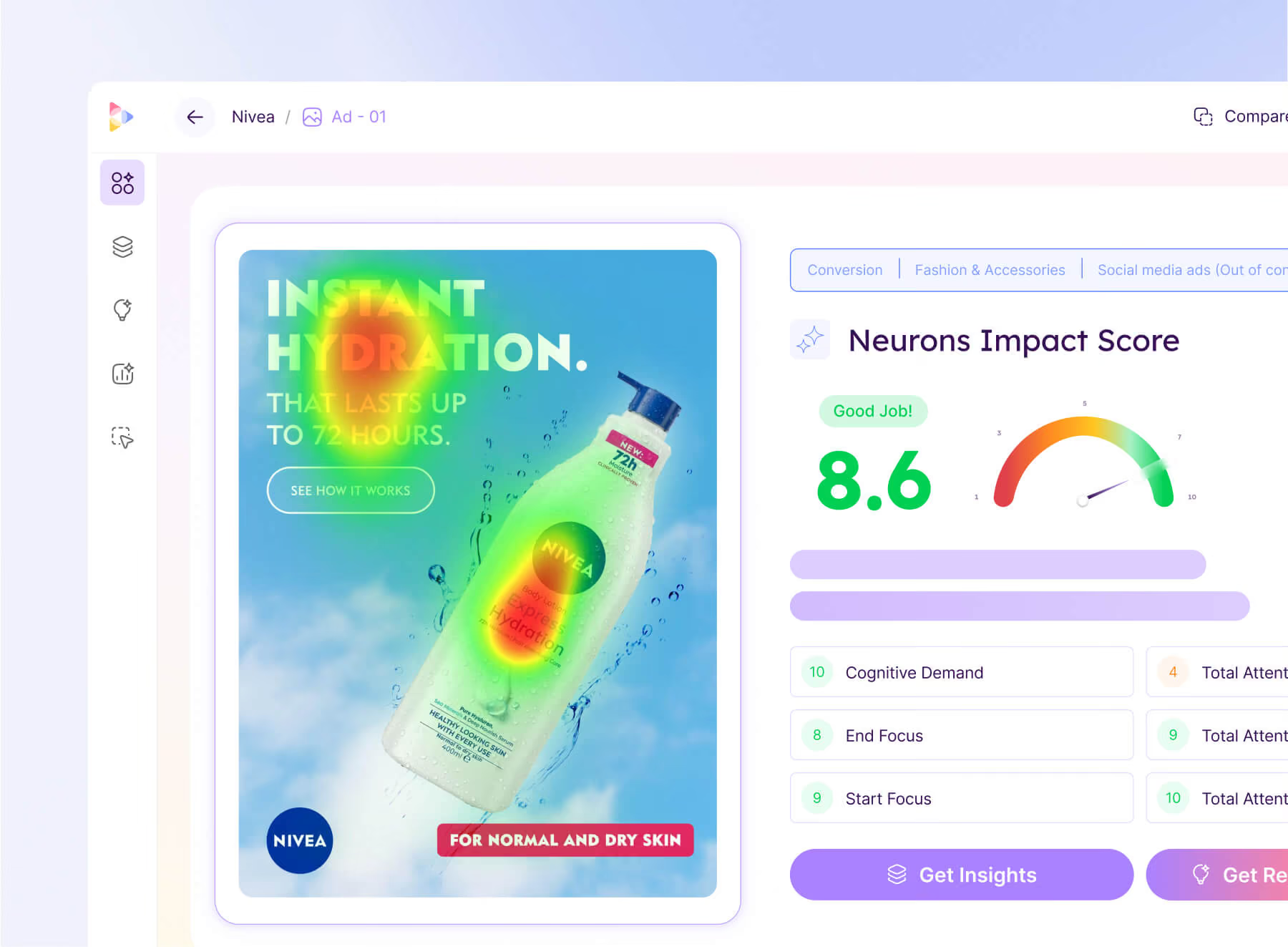
So, of course, that's where tools like Neurons predictive scores have become really invaluable for us because we can test whether our distinctive assets are landing in those attention hotspots, whether we're achieving cognitive fluency or creating unnecessary load, whether we're encoding those brand associations or just entertaining people. So, I think it moves us from, I think this works, to here's what the data shows about how this is being processed. Right. Very different. Interesting. So, can we give a very specific question here? But when I think about toothpaste, I tend to think about Colgate, for example. So, with that kind of association network, is that a good example of some of the things that you mentioned here in terms of, you know, refreshing the memories that people might have for a certain brand?
Is that an example of that? Yes. And Colgate is something that's very much in our collective consciousness, I think, because most of us have seen brand advertising for Colgate since we were kids. Yeah. Right. So, at this point, it's pretty embedded in memory structures, and it can be a habitual choice for people. So, new brands trying to compete have got to disrupt in some ways, and that's where this whole area becomes so interesting for us. Right. Wonderful. I remember that one of the things that we found early on in my research, even academic research, is that there's a positive relationship between the number of associations you might have to a particular asset, especially if they're positive associations.
The more positive associations you can count for a particular brand or an asset, for example, the more you tend to like it, buy it, be loyal towards it. And there's a really kind of aggressive negative trend that the more negative associations to have, it basically kills your interest in the brand. So, it seems that, you know, you really can kind of work hard. You need to work hard for obtaining those positive associations, and you also really need to work even harder to avoid negative associations. I think that's one kind of early learning I had back in the days as well. So, I think one of the things that we see these days that is kind of near and dear to me because we work with so many advertisers across different industries, but there's a common denominator here, is that people tend to agree that the complexity of the media landscape has basically exploded.
So, you know, a few years ago, we had a few kind of handfuls of different media channels. We see now that all of a sudden, there's so many social media channels, and even within different channels, there are sub-channels that you need to consider as well. Now, we see out-of-home becoming programmatic. So, all of a sudden, you can buy as easily out-of-home as you can do social media. So, that gives a, first of all, a tyranny of choice, but also a lack of good data, I guess, these days for driving those creative decisions and how you should optimize for each platform. But how do you see that development over the past 10, 20 years, and how do you address that complexity these days?
Right. That's a great question. But I think what's super interesting is you just brought up Colgate, which says to me that the fundamentals actually haven't changed. We're still, whichever channels we're using, we're still building those memory structures. We're still trying to make brands easier to think of and easier to buy. What has changed dramatically is the execution complexity. If I go back 20 years ago, we could have built a campaign around just three or four major touch points. The attention environment, if you like, was relatively predictable. You could calibrate a TV spot knowing roughly how people would view it. Yeah. Now, right, we're dealing with a radically different attention situation.
The contexts vary, of course, across platforms. And you and I both know that the attention a consumer gives to a six-second skippable pre-roll is going to be qualitatively different from a traditional 30-second TV spot, which is different, again, from a static social placement, which is different, again, from a connected TV environment. And I think adding to that complexity, you know, the same creative performs completely differently across those contexts because the baseline attention is so variable. So I'm just going to say that I think this is really where the hybrid research model becomes, for us at least, non-negotiable. Most of the clients that I work with can't afford to run lab-based biometric studies on every asset in every format.
Think about it. The economics just don't work. But you can calibrate with real human data, then use predictive tools like Neurons AI to optimize those variations at scale. I think that gives you the scientific grounding without the cost and the time penalty of testing everything manually. And so what we've had to build into our process recently is this idea of format fluency, understanding for the creative team, particularly, that you're not just adapting aspect ratios, you're fundamentally re-engineering the attention sequence for each context. So where does the eye land first? How quickly do we need to achieve brand registration? What's the cognitive load tolerance in this environment?
I would argue those are questions we probably couldn't ask, let alone answer rigorously even five years ago. Interesting. So that still feels fairly complex, right? Because it means that, okay, you have three, four, five, ten different channels you want to optimize for. But that also requires you to have data-driven decisions, some feedback loops that are, you know, dramatically faster than they usually would be with, you know, as you mentioned, kind of previous research methodology. So how do you go about, what does that actually entail? What does that mean for you as a team to say, okay, we want to optimize, let's say, three different types of channels.
One is you want to go to Instagram. The second is you want to go to some kind of out-of-home. And the third will be, you know, a TVC or something, for example, that have very different tolerances for duration and where to focus first, for example. How do you go about doing that? Okay, well, I will say that one of the things that we really do consider fairly important in our process now, which we perhaps didn't so much a few years ago, is marketing mix modeling. So in every situation where we can look at that data, that's going to be important to us as well. It's obviously going to be important for us to have some sense of where the brand sits in terms of awareness in the marketplace.
And obviously there are brand trackers that we can access and there's some, again, new tools that have emerged over the past couple of years that are always on brand tracking at very affordable pricing. So that's part of our consideration set. And then, of course, looking at how attention is distributed on those ads, whatever format they may take, using your own tool has become now part of our standard process for doing that. So we do tend to bring together multiple data points to make decisions. But when it comes down to actually looking at the fluency of the creative, then right now, Neurons is our sort of number one tool for that. I appreciate that.
Wonderful. So that's one level of complexity, you know, the number of channels. We could have, we can make it simple for ourselves and say everyone's the same. There's no segmentation. There's no need for ways that we need to, you know, you and I are responding exactly the same. And there's no gender differences. There's no affluence differences. There's no difference because we have experiences with brands differently, for example. But the other extreme version of that is the hyper-personalization that we see so much talk about, first of all, but also being addressed, especially in 26, I would say we'll probably see quite much more of that. So how do you, how do you see the markets changing on that?
And how are you addressing and thinking about that? Okay. So this may be controversial. It's a hot take. Thomas, you know, I know this. We talked about this before, but I think this hyper-personalization push is probably one of the most expensive mistakes that the industry is making, right? I think it's rooted in a fundamental misunderstanding of how brand growth actually works, right? So the premise of this hyper-personalization, which of course AI offers, is that everyone wants something different. So if we as marketers can just find that exact right message for each person, conversions will soar, okay? Sounds logical, but it ignores what the data actually shows about brand growth, right?
So my friends, the Ehrenberg-Bass Institute for Marketing Science has been demonstrating for decades now that brands grow primarily through penetration, that is reaching more buyers, not through increasing loyalty among existing buyers. So that's what everybody knows as the double jeopardy law, right? Small brands suffer twice because they have fewer buyers, and those buyers tend to be slightly less loyal. So the solution isn't deeper personalization to existing customers. It's broader reach to those light and non-buyers. Now, there's also a neuroscience angle here too, which I know you love. Personalization that's too precise often triggers the opposite of what's intended, right?
Because instead of feeling relevant, you now feel surveilled. You've crossed from that sort of system one fluency into system two scrutiny, and people start asking themselves, hey, how did they know this about me? That sort of reactance, I think it's actually corrosive to trust. So what I tend to advocate for instead is what I'd refer to as precision reach. So that's using the data to find the right contexts and the right category entry points, but keeping the messaging itself broadly relevant. So you're still using targeting intelligence, but you're deploying it to maximize reach efficiency among potential category buyers, not to micro-segment into oblivion.
And what I've seen from marketing mix modeling is math that almost always favors breadth over depth. Hmm. That's quite interesting. I think that one of the things that we are debating here as well is this, we call it very often the consumer immune response. So we see that when people are seeing something as an ad, we tend to be faster than ever at discerning, oh, this is classifying something as an ad, and then we tend to skip, basically, right? And we tend to also find that when we are forced to view an ad, we also very often have a negative emotional response to those ads. And that actually has an even negative halo effect over to the brand as well.
So that's what we kind of call it, the kind of immune response, because it leads to avoidance behavior immediately. Or if you can't avoid it, it leads to a negative association going to buy what I mentioned before to the brand experience and the brand association. So that's quite interesting. The other part of that is also we see, you know, you're in the US, I'm in the EU. We see that the EU, they have done quite a lot of regulations, the GDPR, the AI Act, and the next thing in line is what they call digital fairness. And one of the things that they are looking quite much into is this type of advertising, the hyper-personalized ads, for example, which they actually believe might be a negative thing, and they will want to regulate that.
And even to the point of, you know, other things such as they call it dark patterns, for example, and also other things such as influencer marketing, for example, which bypasses the system two, if you like, because, you know, you get familiar with people and things like that. So there are certain things here that might be extremely interesting from a marketing perspective or technology perspective. But as you mentioned, but also as we see both the streams that we see here in Europe, for example, that do tend to be regulatory trendsetters, if you like, seems to be like a pushback that it might have negative effects on people and how people respond, but also how even legislation will work as well.
So I think that's quite interesting. So how do you go about that? So when you have clients, for example, I'm sorry for asking me, I hope it's okay, but if you have clients that say, we want to target, you know, hyper-targeting our clients, what is your recommendation to them? Are you saying basically the same thing you said now, and how do you actually address that? Well, it obviously depends a lot on the specifics of the client ask and what the campaign's goals are. So I don't have one generic response that I would give necessarily. But in general, you know, I think we're radically honest with clients about our perspective on things, but where we can point to data, and this is probably the answer to everything, is we can point to the empirical data, and that tends to speak louder than, you know, my opinion is this.
Let's look at what the data shows us. And that's usually, that usually involves kind of the heat of a too complex debate and gets us to the right path for the client, I'd say, trying to be, trying to put that in the right kind of language. Right, right. So this is a pretty kind of what I see as a different kind of approach to this topic. So how do you feel that that is received these days when you bring this up in different conversations and talks and conferences, for example? Do you see, do people understand it? Does it resonate with people? Or does the vast majority believe that this is the way it's going to go with hyper-personalization? Well, I think we are still, at least in the US, I know things are a little bit different in Europe, but I think we're still struggling somewhat with clients not totally understanding the value of long-term brand building.
Most of the conversation here is focused on conversion, conversion-focused campaigns or performance marketing. And while that remains still a major tension point, it's hard to engage with some of these other kinds of questions that we might have for clients. So it's definitely a journey. And it's a little surprising to me, having come from Europe, that America is not quite on board yet with the combination of brand and performance. A lot of very large companies are, because they have marketing effectiveness teams distributed across the globe. But smaller brands, challenger brands, it's, you know, particularly ones that are in startup mode, you can understand that.
Perhaps the need to generate revenue. But it is surprising to me that we're still having to have this conversation quite often. Yeah. So I think that also means that, so for the way I see is that you have conversion-based campaigns, you have brand building campaigns. What is the ratio these days? It sounds, from what you said, that the ratio seems to be really kind of short-term focused at the cost even at brand building. Is that the case? Do you feel that that's the case right now? Or where are we leaning? Okay, so in general, I'm just going to say, in general, as I look at the market here, I do think it's the case that most advertising is focused on short-term performance.
And if you'd like me to explain why I think that is, I'm happy to do so. Because obviously, again, I reflect on this quite often. The core challenge, it seems to me, is actually that it's an attribution problem, right? That's become, if you like, an organizational pathology. The tension here is that short-term performance marketing produces clean, attributable metrics, clicks, conversions, ROAS. And you can plot all of those things on a dashboard. In comparison, brand building generally produces effects that are more diffuse, they're delayed often, and they're distributed across channels, which makes them genuinely harder to attribute. So when budget pressure comes, and I've been through the cycles now enough times to know that budget pressure always comes, then brand investment loses, because when it comes to a spreadsheet fight, it really can't defend for itself.
So, but what the economic, sorry, what the econometric evidence shows, and I'm particularly fond of James Herman's work on future demand and creative effectiveness, that captures this really well. Brand building isn't soft spending, you know, that's nice to have. It's investment in future demand. So it builds the mental availability that makes your short-term activation more efficient. So when someone's in market, and they already have your brand in their consideration set, it's been shown that conversion costs drop, price sensitivity decreases, and your share of search, for example, is higher. So creative quality and brand strength don't just add to performance marketing returns, they multiply them, right?
So a well-branded campaign with really strong, distinctive assets will outperform the same media spend on generic creative by multiples, not percentages. There was a recent report by WARC called The Multiplier Effect, and it quantified this. They found that switching from a performance-only approach to an integrated brand plus performance strategy delivers a median 90% uplift in revenue returns, right? 90%. That's not a rounding error. That's the difference between real growth and stagnation. So I think the challenge with clients is that we're asking them to believe in effects they can't see in a 30-day attribution window or a 90-day attribution window.
And I think that requires a different kind of evidence and a different kind of conversation, which is what we're having now, which is where I think, in addition to the AI tools, integrated marketing mix modeling, and hybrid research tools, they're giving us the ammunition that we didn't have before. Wonderful. So that's an amazing number to see. I'm sure we can bring that link to the WARC report later on as well as part of this webinar. One thing for me that I see, and I'm interested in hearing your thoughts on, is just going back to the Colgate example, for example, we see that as soon as people think about toothpaste, it's on the top two, typically the top one.
And that also means that, in principle, Colgate could advertise for dental health. Because as soon as people start thinking about that, they will start thinking about Colgate. Because if they're the category leader, it tends to halo over to them as well. And CMOs, for example, and even CEOs love to have strong brands, but they don't seem to invest in it the way I see it. Does that resonate with what happens in the U.S. as well? Kind of this disconnect between having a really strong brand but not really investing in branding? Again, it's hard to talk in generalities because there's the clients we work who tend to be smaller brands, challenger brands, not necessarily parts of global organizations.
I think for global brands, there is just more maturity. There's more understanding of how branding impacts conversion. And if I think about the brands that are really prominent in every category, they tend to be ones that are immediately familiar to you because they are everywhere. They have excellent distribution. Obviously, physical availability is absolutely key for those brands. And they're sort of legacy brands in the sense that we've probably grown up knowing them. Where I think smaller brands have the opportunity to win is we talked a little bit about those category entry points and understanding the situational associations with brands.
That's where you're really understanding those opportunities to be positioned around a particular event, a time of day, somebody's individual behavior that's specific to their family. If they can picture the brand being part of their lives in that moment, then those are opportunities for creative that kind of resonates with people in that moment, in that situation. They can project the brand into that moment of their lives. And I think that's very rich territory to explore. And I don't often see that, but I think that's a really helpful way to think about opportunities for brands. Right. And I think that you have an example from a pet goods example.
So that kind of speaks to that tension from your experience. Can you talk us through that example? Yeah, well, actually, I was thinking about a conversation that we'd had prior to this conversation today. And if it's okay with you, I'm going to actually choose a different category. Sure. Although Bigeye does work a lot with pet brands, I'm going to pick one that's slightly different because I think it tells a little bit more of the story that we've been trying to build here. So we actually have a CPG client where they're primarily going to be found in the baking aisle of the supermarket. And these kinds of tensions that we've been talking about played out very clearly, specifically around their seasonal campaign planning.
So as part of our annual plan, we did what I've just been talking about, which we mapped out their mental and physical availability. Physical availability was reasonably strong. You know, they have very good distribution. But mental availability, we identified as a gap. So what we did was we mapped their category entry points. And we found that they were primarily present in just one, right? Essentially, the routine replenishment trip. They're associated with baking, the baking occasion, holiday entertaining, recipe exploration, you know, even health-conscious ingredient swapping. These potentially higher value CEPs were either unowned or owned by competitors.
So a key tension that emerged was the brand's leadership understandably wanted to concentrate paid media on conversion-focused tactics during the holiday period. And I'm sure it's the same in Europe, but Q4 is really make or break for most products, but baking aisle in particular. So the instinct was, I think, this is when people are buying, so let's capture that demand with performance media. Okay, but that assumes the demand is just there, waiting to be captured. But we know demand doesn't appear from nowhere. It's shaped by mental availability built upstream. So if, as a brand, you arrive at the holiday period, having done really no brand awareness building, you're competing for attention against brands that did.
And, of course, your conversion efficiency is going to suffer. So in this case, the client did understand that. So what we proposed and ultimately executed was a sequenced approach. Okay, we actually used influencer partnerships as a brand awareness driver in the months leading up to peak season. It's really interesting what we're discussing a moment ago, but I would say influencers gave us reach into audiences that we couldn't efficiently access through paid media, right? And, crucially, they delivered the brand message in a context that felt really organic rather than interruptive. And I think that's pretty important when it comes to influencers in general is that it needs to be a believable link, correct?
Correct. Yeah, it needs to be believable. Crucially, that was building mental availability. It expanded those category entry point associations. So making that link from the brand into holiday baking, to entertaining, to recipe creativity. And then having done that, then immediately before the holiday period, we then ran more emotion-driven creative work. So this was designed to build that brand salience and refresh those memory structures right before the peak buying window opened. And then the conversion-focused activation kicked in during the holiday period itself. So did it work? Well, marketing mix modeling actually supported this approach.
When we looked at the performance holistically, the MMM evidence showed that investing more heavily in brand had actually produced higher total revenues. So that's that multiplier effect in action. Brand investment wasn't competing with conversion spend. It was making the conversion spend work harder. And the MMM platform actually recommended a change to their brand-to-performance investment ratio in favor of brand. So I do think that's a good example of how evidence can change the internal conversation. When you're not asking leadership to take brand building on faith, when you're not saying, you know, trust this, it'll pay off eventually, but can instead show them in their own data that the hypothesis holds.
That's a, you know, that's a different conversation entirely. Investment in mental availability upstream amplifies returns on activation downstream. The sequencing matters. The channel mix matters. But the fundamental insight is always the same. You can't harvest demand that you haven't created. No, no. I love that example. I love that. It's probably better than the pet goods example for now, at least. That definitely serves as well. I think one of the things, for me, as a question as well, is that this is, have you seen, for comparable examples, changes in price sensitivity, for example? Do you see that when you do this kind of upfront investment, that, you know, we tend to call that it kind of imbues value to the product beyond the product's assets themselves?
And that also leads to a higher willingness to buy, but also higher willingness to pay. Have you seen that in your data as well? Not precisely for that particular case study. One thing that I do find interesting, just as a generality, which I will share, and again, I don't know if it's the same in Europe, but as I mentioned, we work such a lot with pet care brands. One thing that's endlessly fascinating to me is that, of course, the economy has been challenging for the past several years. And in the US, we're seeing, you know, traditionally high-income consumers moving to dollar stores, not for everything, but certainly being prepared to give up the premium brands in favor of store brands or private label for human consumption.
What's fascinating to me is that I do not see this same behavior playing out when it comes to Fido's dog food, right? Or cat food or cat food or any of the pet categories. It seems to me from what I'm seeing, while they might cut down on the brands that they choose for themselves, for their own family consumption, there's no giving up Blue Buffalo if that's what Fido likes. So, I don't want to take away from that, Thomas, but it seems to us that there's some more resiliency in the pet market, perhaps, than there is in some of the traditional human CPG markets. Right. And it just underlines this, the level of new complexity, so to speak, in consumer behaviors, which I find, which is really fascinating, I have to say.
I think, so, the last question for me is in terms of, now, we've kind of gone through different approaches and different ways of how we are doing brand building in this performance-driven world. I think that when you take this and you want to bring this, and now you've shared quite a lot already, but if you want to kind of take some actionable tips for advertisers that are now trying to balance this strong branding with short-term ROI, what type of tips and actionable items would you suggest? Okay, so knowing that you might ask me this, I've got five, if that's okay. All right, I got five, but I'll make them short. Okay, number one, I think, we didn't talk about it too much, but protecting excess share of voice, or ESOV.
So, before finalizing budgets, I'm going to say it's really helpful, if you can, to calculate share of voice relative to the share of market. So, if ESOV is below share of market, then you're mathematically set up to lose share. Right, that's not a theory, it's just the most replicated finding in marketing econometrics. So, defending that ratio, number one. Number two, I think figuring out ways to make distinctive assets work in both sort of short-term and long-term timeframes. So, logo, colors, sonic identity, characters, you know, whatever distinctive assets you have, they should really appear in every execution, brand and performance alike.
Like, brand campaigns build the memory structures, performance campaigns harvest them. But if the performance creative doesn't carry those same assets, you're not really maximizing that potential to harvest. So, again, every touchpoint should refresh mental availability. I appreciate it. There's a quick one for me as well. Even in the brain, we can see what we call convergence zones. So, there's a couple of convergence zones in the brain that are multimodal. That means that you take all the sensors, all the inputs that you have from a particular asset. That could be the weight of the asset. It could be the sound from it when you hold it. It could be the jingle.
It could also be the visual assets. Anything associated with it from the sensors, they are actually converging at mainly two, three different spots. One is related to memory, so that, like, it strengthens the memory. The second, which is just behind, just over your eyes, just behind your forehead, is related to enjoyment. So, the perceived value, so to speak, of an asset. And that's what we see that the more kind of multimodal associations you have, the more you tend to have stronger memory, but also more positive memories as well. So, that's just a good little extra there. Yeah, the other thing that I've observed for sure is that marketing teams generally get bored with their brand assets long, long, long before consumers ever do.
If consumers ever do. That's just an observation, because we like novelty, right? So, we always want to do a new campaign, where, in fact, the one that we developed three years ago might still have plenty of juice left in it. Okay, so some people listening, I'm sure, will be familiar with the 60-40 rule for brand to performance. That's definitely useful as a starting heuristic, but I think we also know we have to adjust it for context. So, 60% brand, 40% activation on performance, useful baseline, but it's not a law. Les Binet and Peter Field would not want us to feel like that we can't move out of that. So, new brands might need more investment in branding.
Market leaders might be able to skew more towards activation. I'm going to say categories with really long purchase cycles generally need more brand. So, just use the 60-40 as a default, then adjust with reasoning, and, of course, document for stakeholders why you're adjusting. I'll just give a quick shout-out again to that WARC Multiplier Effect research. They gave us some really useful guardrails. They talk about a brand baseline. They set it as a minimum of 30% of spend for the equity building work, with 40% to 60% being best practice. And then they flag what they call a search ceiling, which is if you're spending more than 25% of your budget on search, that's a red flag that you're over-harvesting and under-building, which I thought was kind of an interesting idea.
Okay, two more. Am I allowed two more? Sure, absolutely. Okay, you might like this one. Okay, number four, test creative before you buy media. Okay, so predictive attention tools, like Neurons, are now fast enough and cheap enough that there's not really any excuse to put media dollars behind creative. That hasn't been validated for basic attention and brand registration. So, we talk about it as like a quality control before shipping. You wouldn't skip it in a manufacturing environment, so you don't skip it in marketing either. And then I think the fifth one for me would be thinking about separating measurements by time frame. So, short-term metrics should assess activation efficiency.
So, we talked about ROAS, CPA, conversion rate. Long-term metrics should assess brand health, mental availability, distinctive asset recognition, and category entry point associations. So, when you conflate them, I've noticed short-term always wins because the numbers are often cleaner. If you keep the scorecards separate, report them to the appropriate time frame stakeholders, and then make your resource allocation decisions considering both. And then maybe a bonus six, find your marketing mix modeling evidence, right? If you're in an organization that's over-rotated to short-term, the best ammunition is showing what's happening to your base sales.
So, the demand that exists without marketing. If that base is eroding, you've got a problem. You're liquidating your brand equity to fund activation. So, make that visible with econometric evidence, and the strategic conversation will change. Wonderful. I was actually just about to suggest that sixth one as well. So, that's perfect. Talk about mind reading. I love that. Adrian, this is wonderful. I appreciate this so much. I wish we could, we're hopefully going to do another round as well to keep on going with a new topic. And I really appreciate the time you have taken to walk us through these things. I have to say also that I've started listening to your podcast, In Clear Focus, and I really enjoy it.
So, I hope that everyone that attended this would actually start listening in on that as well. But so much for now. I really appreciate your time. Thank you very much for sharing your thoughts and time with us. Thomas, thank you. It was definitely my pleasure and great to meet you. Wonderful. Wonderful.
Dr. Thomas Z. Ramsøy (Neurons) and Adrian Tennant (Bigeye) on why short-term metrics keep winning the budget, and how to build the brand that makes every performance dollar work harder.
Performance marketing is great at capturing demand that already exists. It can’t create it. Brands that cut brand building to fund this quarter’s numbers end up harvesting a field nobody planted.
In this Neurons webinar, Dr. Thomas Z. Ramsøy, founder and CEO of Neurons, talked with Adrian Tennant, Chief Strategy Officer at Bigeye. Adrian founded one of the UK’s first digital marketing agencies in the mid-90s. At Bigeye, he leads the strategy practice and hosts the agency’s podcast, In Clear Focus.
One line from Adrian sums up the conversation: you can’t harvest demand that you haven’t created. Brand building creates demand, and performance marketing harvests it. Below, we cover why the harvest keeps winning the budget, what a brand should own in memory, a case that shows the two working together, and the six rules Adrian shared for balancing them.
The rules at a glance
| Rule | Why it matters | What to do |
|---|---|---|
| Protect share of voice | Below share of market, you’re set up to lose share | Check excess share of voice before finalizing budgets |
| Keep distinctive assets everywhere | Performance ads harvest the memories brand ads build | Use logo, colors and sound in every execution |
| Treat 60-40 as a default | The right split depends on brand, category and purchase cycle | Adjust from 60-40 and document why |
| Test before you buy media | Untested creative wastes media spend | Pre-test attention and brand registration |
| Separate the scorecards | Short-term numbers win when metrics are mixed | Report brand and performance metrics separately |
Why does performance marketing keep winning the budget?
Performance marketing keeps winning the budget because its results are easier to put in a spreadsheet. Adrian calls it an attribution problem that has become an organizational pathology. Performance marketing produces clean, attributable metrics such as clicks, conversions and ROAS. Brand building produces effects that are diffuse, delayed and spread across channels. When budget pressure comes, and Adrian says it always does, brand investment loses the spreadsheet fight.
The econometric evidence points the other way. Adrian points to James Hurman’s work on future demand and creative effectiveness: brand building isn’t soft spending but investment in future demand. When people in market already have your brand in their consideration set, conversion costs drop, price sensitivity falls and share of search rises. In Adrian’s view, a well-branded campaign with strong distinctive assets outperforms the same media spend on generic creative by multiples, not percentages.
WARC’s The Multiplier Effect report put a number on it. Brands that moved from a performance-only approach to a mix of brand and performance saw revenue returns rise by 25% to 100%, with a median uplift of 90%. The challenge, Adrian says, is that clients are asked to believe in effects they can’t see in a 30- or 90-day attribution window.

He sees the gap most with smaller and challenger brands in the US. Large global companies tend to have marketing effectiveness teams and understand how branding drives conversion; many smaller brands still focus almost entirely on short-term performance.
What should your brand own in people’s memory?
Your brand should own the buying situations that make people think of the category. Instead of talking about brand purpose or emotional connection in vague terms, Bigeye starts with mental availability. For each category, the team maps the category entry points, the situations and needs that trigger someone to think of the category, and asks which ones the client’s brand owns in memory, which are contested and which are wide open. That frames the creative brief. The goal isn’t to make people love the brand but to build memory structures that bring it to mind in more buying situations.
Colgate shows what that looks like at scale. Most people have seen its brand advertising since childhood, so it’s embedded in memory and can become a habitual choice. Thomas noted that a category leader like this could even advertise dental health and benefit, because the category halos back to the leader. Challengers have to disrupt that, and Adrian sees their best opening in situational associations: a particular event, a time of day or a family routine where people can picture the brand in their lives.
Thomas added an early finding from his own research: the more positive associations people have with a brand or asset, the more they like it, buy it and stay loyal. Negative associations work even more strongly in the other direction and can kill interest in the brand.
You also really need to work even harder to avoid negative associations. - Dr. Thomas Z. Ramsøy, CEO & Founder, Neurons
What to do: Map your category entry points and sort them into owned, contested and open, then brief creative against the gaps.
Is hyper-personalization worth what it costs?
Hyper-personalization isn’t worth what it costs, in Adrian’s view, and he’s open that it’s a hot take.
I think this hyper-personalization push is probably one of the most expensive mistakes that the industry is making. - Adrian Tennant, Chief Strategy Officer, Bigeye
His argument rests on the Ehrenberg-Bass Institute’s work: brands grow mainly through penetration, reaching more buyers, rather than through loyalty among existing ones. Under the double jeopardy law, small brands suffer twice, with fewer buyers who are also slightly less loyal. The answer is broader reach to light and non-buyers, not deeper personalization. Personalization that’s too precise can also backfire: people feel watched rather than understood, which moves them from System 1 fluency into System 2 scrutiny and erodes trust.
Adrian’s alternative is what he calls precision reach: use data to find the right contexts and category entry points, but keep the message broadly relevant. In his experience, marketing mix modeling almost always favors breadth over depth. Thomas added the consumer immune response: people recognize and skip ads faster than ever, and when they’re forced to watch, the negative emotion can spill over to the brand. In the EU, he noted, regulators are also looking at hyper-personalized ads as part of upcoming digital fairness rules.
What to do: Use targeting data to choose contexts and category entry points, and keep the message broad enough to reach light and non-buyers.
How do you test creative across this many channels?
To test creative across this many channels, calibrate with real people, then predict at scale. The fundamentals haven’t changed: brands still build memory structures to become easier to think of and easier to buy. What has changed is execution. Twenty years ago, a campaign might have had three or four major touchpoints and a fairly predictable attention environment. Today, a six-second skippable pre-roll, a 30-second TV spot, a static social post and connected TV each get a different kind of attention, so the same creative performs differently in each.
Most of Adrian’s clients can’t afford lab-based biometric studies on every asset in every format. His answer is a hybrid research model: calibrate with real human data, then use predictive tools like Neurons AI to optimize variations at scale. His team calls the skill format fluency. Adapting a creative isn’t just changing the aspect ratio but re-engineering the attention sequence: where the eye lands first, how quickly the brand needs to register and how much cognitive load the environment tolerates.
Bigeye combines marketing mix modeling, brand awareness data from trackers and attention data. For the creative itself, Adrian calls Neurons the team’s number one tool, used to check whether distinctive assets land in the attention hotspots and whether the creative builds brand associations or just entertains.
What happens when you build before you harvest?
When you build before you harvest, total revenue goes up. Adrian shared a case from a CPG client whose products sit in the supermarket baking aisle. Physical availability was strong, thanks to good distribution, but mental availability was a gap. Mapping the category entry points showed the brand was present in just one: the routine replenishment trip. Baking occasions, holiday entertaining, recipe exploration and health-conscious ingredient swaps were unowned or held by competitors.

Leadership wanted to focus paid media on conversion during the holidays, when the baking aisle makes or breaks the year. Adrian’s counterpoint: that assumes demand is waiting to be captured. A brand that arrives at peak season without having built awareness competes for attention against brands that did, and its conversion efficiency suffers.
So the team sequenced the plan. In the months before peak season, influencer partnerships built awareness, reaching audiences paid media couldn’t reach efficiently and linking the brand to holiday baking, entertaining and recipe creativity in a context that felt organic rather than interruptive. Just before the holidays, emotion-driven creative refreshed those memory structures. Conversion-focused activation ran during the holiday period itself.

What the data showed: Marketing mix modeling showed that investing more heavily in brand produced higher total revenue, and the model recommended shifting the brand-to-performance ratio toward brand.
You can’t harvest demand that you haven’t created. - Adrian Tennant, Chief Strategy Officer, Bigeye
For Adrian, the bigger lesson is how the evidence changed the conversation inside the client. Leadership wasn’t asked to take brand building on faith; the hypothesis held up in their own data. Investment in mental availability upstream amplified the returns on activation downstream.
Six rules for your next budget round
Adrian closed with five rules, plus a bonus sixth that Thomas had been about to suggest himself.
Rule 1: Protect your excess share of voice
Before finalizing budgets, compare your share of voice with your share of market. If share of voice is below share of market, you’re mathematically set up to lose share. Adrian calls it the most replicated finding in marketing econometrics.
Rule 2: Put distinctive assets in every execution
Logo, colors, sonic identity and characters belong in brand and performance work alike. Brand campaigns build memory structures and performance campaigns harvest them, but only if the performance creative carries the same assets. Thomas added that the brain combines sights, sounds and even the feel of an asset in multimodal convergence zones linked to memory and enjoyment, so assets that engage more senses build stronger and more positive memories. And don’t retire assets too early.
Marketing teams generally get bored with their brand assets long, long, long before consumers ever do. - Adrian Tennant, Chief Strategy Officer, Bigeye
Rule 3: Treat 60-40 as a default, not a law
Sixty percent brand and 40% activation is a useful starting point, and Les Binet and Peter Field wouldn’t want anyone stuck there. New brands may need more brand investment, market leaders can skew more toward activation, and categories with long purchase cycles generally need more brand. Adjust with reasoning and document why. WARC’s guardrails help: at least 30% on brand building, 40% to 60% as best practice, and more than 25% of budget on search as a red flag that you’re over-harvesting and under-building.
Rule 4: Test creative before you buy media
Predictive attention tools like Neurons are now fast and affordable enough that there’s little excuse to put media money behind creative that hasn’t been checked for basic attention and brand registration. Adrian treats it as quality control before shipping: you wouldn’t skip it in manufacturing, so don’t skip it in marketing.
Rule 5: Separate your scorecards by time frame
Short-term metrics such as ROAS, CPA and conversion rate measure activation efficiency. Long-term metrics should cover brand health, mental availability, distinctive asset recognition and category entry point associations. Mix them, and the short term wins because its numbers look cleaner. Report each to the right stakeholders, then make allocation decisions with both in view.
Rule 6: Use marketing mix modeling to show your base sales
If your organization is over-rotated to the short term, the strongest evidence is what’s happening to base sales, the demand that exists without marketing. If that base is eroding, Adrian says, you’re liquidating brand equity to fund activation. Make it visible with econometric evidence, and the strategic conversation changes.
The thread through all six: brand and performance aren’t competing for the same budget. Brand investment upstream makes activation downstream work harder, and the tools to prove it, from marketing mix modeling to predictive creative testing, now exist.
Five questions before you set next year’s budget
- Is your share of voice at or above your share of market?
- Which category entry points does your brand own, and which are still open?
- Do your performance ads carry the same distinctive assets as your brand work?
- Has every creative been tested for attention and brand registration before media is bought?
- Are brand and performance measured on separate scorecards, reported to the right people?
Watch the full webinar
This article covers the highlights. The full recording on this page goes further, with the complete case discussion and Adrian’s take on brand resilience in the pet care category.
Want to check attention and brand registration before you buy media? Neurons’ AI predicts attention, memory and brand impact in minutes, backed by a database of over 300,000 human participants. Book a demo.
Frequently asked questions
Does brand building reduce price sensitivity?
Brand building reduces price sensitivity, according to the econometric evidence cited by Adrian Tennant, Chief Strategy Officer at Bigeye: when a brand is already in people’s consideration set, conversion costs drop and price sensitivity decreases. He sees a sign of it in US pet care. Consumers have traded down to store brands for their own groceries, but tend to stay with their pet food brand.
Can small brands compete with big brands on brand building?
Small brands can compete on brand building by owning specific buying situations instead of trying to be everywhere. Category leaders win on familiarity and distribution built over decades. A challenger’s opening is a particular moment, such as an event, a time of day or a family routine, where people can picture the brand in their lives. In one Bigeye case, a baking brand used influencer partnerships to reach audiences it couldn’t reach efficiently through paid media.
How do you convince leadership to invest in brand building?
Convince leadership to invest in brand building with evidence from their own data, not with opinion. Marketing mix modeling can show whether base sales, the demand that exists without marketing, are eroding, and what happens to total revenue when more goes into brand. Industry evidence helps too: WARC’s The Multiplier Effect found a median 90% uplift in revenue returns when brands moved from performance-only to brand plus performance.
Speakers

Dr. Thomas Z. Ramsøy
Thomas is a neuroscientist and the founder of Neurons, which he started in 2013. He has spent more than two decades researching attention, emotion and decision-making, and how they shape the way people respond to ads.
Adrian Tennant
Adrian is Chief Strategy Officer at Bigeye, where he leads the agency's mission to grow brands through evidence-based insights and creative strategy. He has more than 25 years of experience across technology, marketing and consumer research, and hosts the IN CLEAR FOCUS podcast.

Decades of neuroscience, built into one platform.
Neurons is a consumer neuroscience company founded in 2013 by Dr. Thomas Z. Ramsøy. Neurons AI predicts what people notice, remember and engage with in your creative – built on years of eye-tracking and EEG research.