
Brand performance is the measurable impact of brand strength on business outcomes, i.e., from attention and memory to revenue and retention.
Strong brand performance covers awareness, recall, consideration, and financial outcomes. It shows up in how well people recognize you, how efficiently you acquire customers, how long they stay, and how much they’re willing to pay.
In this article, we break down brand performance KPIs, measurement methods, tools, benchmarks, and implementation.
Learn how brand performance fits into a broader brand-building strategy
Why Does Brand Performance Matter for Business Growth?
Brand performance directly improves acquisition efficiency and drives long-term revenue growth. When people recognize and trust your brand, they convert faster and with less persuasion, leading to shorter sales cycles and more revenue from the same marketing budget
Strong brand performance lowers customer acquisition cost (CAC). When awareness and recall are high, paid media perform better because the brand has already built familiarity.
Brand strength also improves retention and lifetime value (LTV). Customers who trust a brand are more likely to buy again or upgrade, thereby increasing revenue stability.
Pricing power is another advantage. Brands with strong awareness and positive perception can protect margins by competing on preference, not just price.
For example, Brand A’s advertising efforts improve creative visibility and recall. Eventually, recall lift will drive higher consideration, which improves close rates over time, translating a perception shift into revenue growth.
In another case, Company B increases unaided awareness by 10%, leading to higher branded search and improved paid search conversion. CAC also drops by 12%, while returning customer rates increase by 7%. The overall result? More efficient revenue and improved profitability.
See how brand advertising strengthens long-term brand impact
What Metrics Define Brand Performance?
At the core of any effective measurement system is a clear KPI framework for brand performance. Strong brand performance metrics combine leading indicators (early signals of future growth) with lagging indicators (results that confirm impact after the fact).
Within this framework, brand performance KPIs are grouped into three categories: leading indicators, perception metrics, and business outcome metrics. Together, they provide a complete view of how brand strength translates into financial results.
Explore a deeper breakdown of brand measurement metrics
How Do Leading Indicators Like Attention and Memory Signals Predict Brand Performance?
Brand attention is the degree to which viewers notice and cognitively process your brand assets within an ad. This includes whether they see your logo, register your product visually, or recognize your brand colors.
Time-to-brand-cue, visibility, and dwell time are core metrics for measuring attention. Time-to-brand-cue measures the number of seconds that pass before the brand is visible or mentioned in an ad. Visibility evaluates how clear and prominent a brand element is, while dwell time measures how long a viewer’s gaze stays on branded elements.
Attention directly influences recall, consideration, and purchasing behavior. Once attention is secured, the brain encodes the brand into short-term memory, which is later converted into long-term recall. Strong brand performance depends on this transition, as customers need to recall your brand at the moment of need to make a purchase.
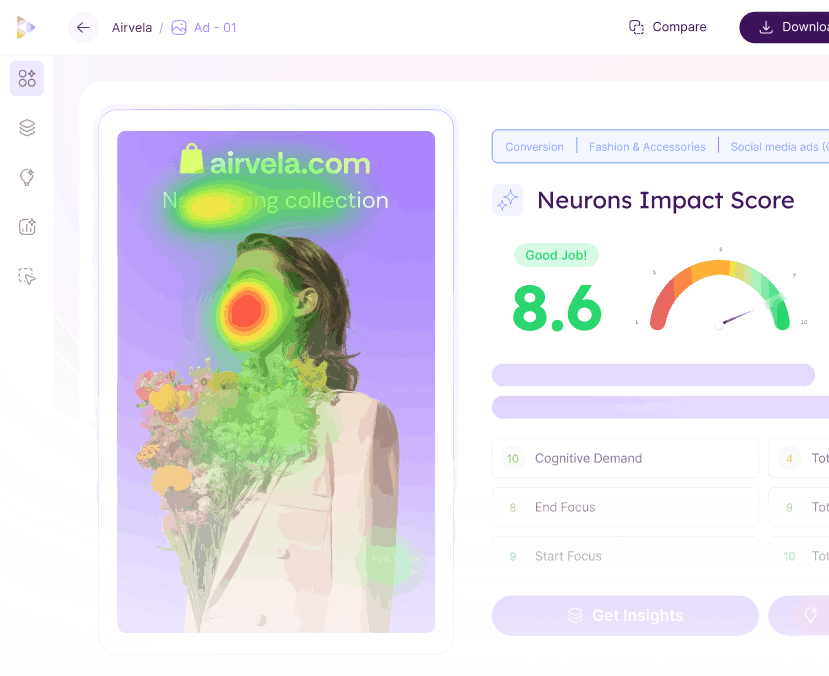
Predictive measurement tools such as AI-powered attention heatmaps and brand visibility scoring simulate how audiences are likely to process an ad before it launches. With this, marketers have data-backed suggestions for improving creatives, therefore reducing wasted media spend and increasing the probability of campaign success.
Discover how AI attention measurement predicts recall and performance
How Do Awareness, Recall, and Consideration Influence Brand Performance?
Awareness, recall, and consideration are core metrics of perception that determine whether brand investment translates into measurable market strength. Awareness exists in two forms: aided and unaided.
- Unaided awareness measures whether consumers can name your brand without prompts, reflecting true mental availability within a category.
- Aided awareness measures recognition when consumers are shown a list of brands.
Recall builds on awareness, focusing on memory. It is also categorized into two types: ad recall and brand recall.
- Ad recall measures whether someone remembers seeing an advertisement.
- Brand recall measures whether they remember the brand in connection with the message
Ad recall is important; however, strong brand performance depends more on brand recall.
Consideration represents the likelihood that a consumer would evaluate your brand as a purchase option. Brand preference goes a step further, reflecting whether consumers would choose you over competitors.
These metrics indicate whether your brand is becoming mentally available before purchase decisions are made.
The reliability of these metrics depends on consistent tracking: using the same questions, audience definition, and sampling methods each time. Changing any of these variables can skew results and weaken data reliability.
Learn how to run structured brand measurement surveys
How Does Brand Performance Connect to Revenue and Efficiency Metrics?

When consumers already recognize and trust a brand, they require less persuasion at the point of purchase. Click-through rates improve, and landing page conversions increase. Hence, the same marketing budget generates more revenue. Also, trusted brands retain customers longer, increase repeat purchases, and make cross-sell and upsell efforts more effective.
When awareness and recall are high, performance marketing becomes more efficient. Branded search traffic increases, paid campaigns convert at lower cost, and reliance on promotional incentives decreases.
A reduction in customer acquisition cost adds another layer of proof, as prospects are more likely to respond to ads from brands they trust. Share of search, the percentage of branded search queries your brand earns compared to competitors, often moves in line with market share. The same applies to organic uplift; more people searching for your brand by name or directly typing your URL usually signals growing demand.
To connect brand strength to financial results, companies need to view brand metrics and sales data together. That means aligning time periods and tracking awareness, recall, and consideration alongside revenue, CAC, conversion rates, and LTV.
Layering data links brand equity and revenue more evidently and measurably, helping companies spot lag time between brand lift and revenue impact.
Understand how brand performance connects to revenue growth
How Can You Measure Brand Performance Step by Step?
To measure brand performance, you need a structured framework that reduces uncertainty and builds confidence before making major budget decisions.
The five stages of brand measurement performance are baseline measurement, predictive testing, campaign execution, lift validation, and continuous tracking.
- Step 1: Baseline Measurement
Start by understanding where the brand stands, measuring core brand metrics like awareness and consideration alongside business metrics like CAC, conversion rates, and revenue. Without a clear baseline, you can’t tell whether changes are real growth or normal fluctuation.
- Step 2: Predictive Testing
Test creative before scaling spend to see if it captures attention and builds memory. This helps eliminate weak assets early and increases the odds of measurable lift once campaigns launch
- Step 3: Campaign Execution
Launch with validated creative and clear KPIs, monitoring leading indicators like attention and engagement alongside reach and frequency. Strong execution keeps creative quality, targeting, and business goals aligned.
- Step 4: Lift Validation
Run structured brand lift tests to measure incremental impact. Compare exposed audiences to control groups to quantify changes in awareness or consideration. This makes brand performance measurable and ties investment to real outcomes.
- Step 5: Continuous Tracking
Keep measuring beyond the campaign window. Ongoing tracking helps detect fatigue, competitive pressure, or shifts in sentiment early. It reveals long-term trends that short-term reporting might miss.
Learn more about structured brand lift testing
How Do You Establish a Baseline and Benchmark Brand Performance?
To establish a baseline and benchmark brand performance, measure where the brand stands today using structured brand tracking surveys to capture awareness, recall, and consideration. Keep the methodology consistent, i.e., the same wording, same audience definition, and reliable sample sizes, so results are comparable over time.
Next, benchmark the numbers. Compare them to your own historical data to see if metrics are improving. When possible, compare against category or competitor benchmarks to understand how your brand stacks up in awareness share, consideration, or branded search visibility.
Baseline clarity makes lift results meaningful, gives data context, and ensures that campaign results are evaluated realistically and strategically.
Set up reliable brand performance benchmarks
Why Should You Use Predictive Testing Before Scaling Campaigns?

Creative pretesting with AI tools reduces wasted spend. They identify weaknesses before creatives scale, thereby preventing brands from investing heavily in assets that are unlikely to perform well.
AI heatmaps and attention scoring tools like Neurons make this measurable. Heatmaps show where viewers are most likely to focus, revealing whether your logo, product, or key message is getting attention. Attention scores turn that into numbers tracking how quickly the brand appears and how long people focus on it.
With these predictive metrics, you can prioritize high-performing creatives and allocate more spend to ads with the potential to produce higher brand lift once live.
See how predictive creative testing improves brand performance
What Is a Brand Lift Experiment and How Does It Validate Performance?
A brand lift experiment measures the incremental impact of advertising on awareness, recall, consideration, or preference.
There are two main methods for measuring brand life: the hold-out method and the A/B exposure method.
The holdout method splits audiences into two groups: one exposed to the campaign and one control group that isn’t. Lift is calculated by comparing the results between the two groups after the campaign.
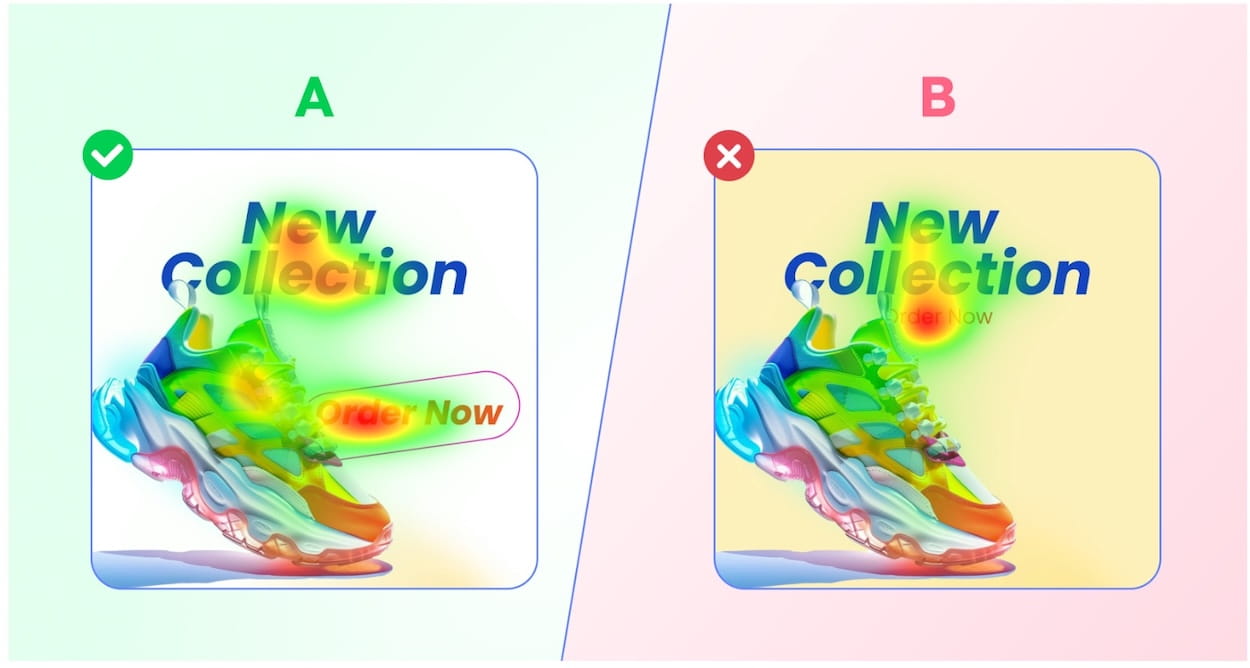
The A/B method also uses two groups, but both see ads. One group sees the original version, while the other sees a tweaked version. This allows marketers to measure the impact of specific creative changes on awareness, recall, consideration, or preference.
For example, in a four-week video campaign, 500,000 users see the ad while a control group does not. If 48% of the exposed group reports awareness, compared with 40% of the control group, the campaign generated an 8-point lift. The same approach applies to recall, consideration, or preference.
Lift results make brand performance measurable. By calculating cost per lift point, marketers can compare the efficiency of channels, audiences, and creative variations and allocate budgets accordingly.
Learn how to design effective brand lift experiments
Why Is Continuous Tracking Important for Brand Performance?
Continuous tracking is important for long-term brand health because brand performance isn’t static. Awareness, recall, and consideration shift gradually. If you only measure once or twice a year, you risk missing early warning signs. Continuous tracking shows trends over time, helping teams see whether brand equity is strengthening, leveling off, or slipping.
The right tracking cadence depends on how fast your category and sales cycle move. In fast-moving consumer markets or high-spend environments, monthly tracking provides quicker feedback and allows faster creative or media adjustments. For B2B brands or longer sales cycles, quarterly tracking is more stable and reliable.
To detect performance shifts, focus on directional trends. Consistent declines in recall, consideration, or search share across multiple periods signal potential issues. Segment analysis can also uncover weaknesses, like declining awareness among specific demographics.
Explore structured brand tracking approaches
What Tools and Software Help Measure Brand Performance?
Brand performance tools are divided into four categories: predictive attention tools, survey platforms, lift testing tools, and dashboard platforms.
- Predictive Attention Tools
.jpg)
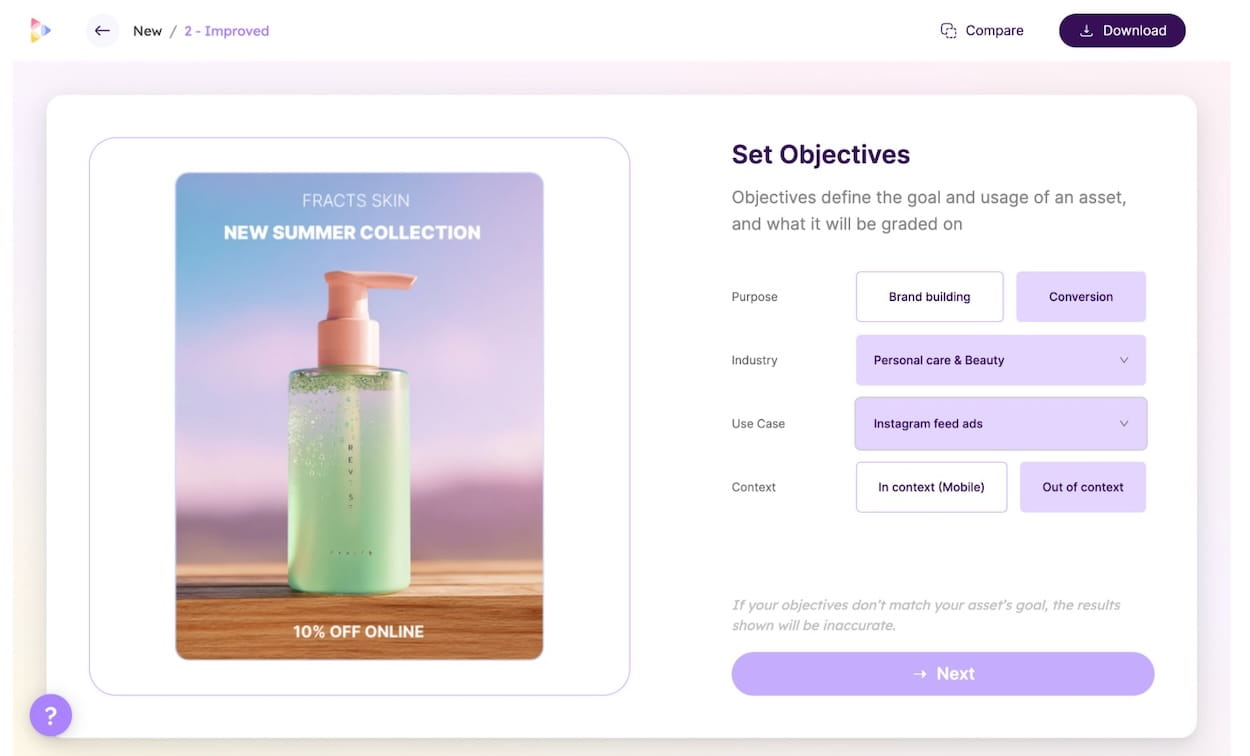
AI-driven attention measurement tools provide leading indicators before campaigns scale. Using heatmaps, gaze modeling, and attention scoring, they predict whether branding elements will be seen and encoded into memory.
- Survey Platforms
Survey platforms measure shifts in perception across awareness, recall, consideration, and preference using consistent sampling and standardized questions. The data from these surveys reveal whether brand strength is increasing.
- Lift Testing Tools
Lift testing tools reveal the impact of advertising efforts on brand equity via controlled experiments, turning brand investment into measurable performance data.
- Dashboard Platforms
Dashboard platforms unify brand metrics with business performance data. This brand performance software offers insight into how changes in perception translate into efficiency and growth.
Compare leading brand performance tools
What Features Matter Most in Brand Performance Software?
The most effective brand performance software focuses on features that connect creative quality, brand perception, and business outcomes.
- Attention-to-brand scoring is a core feature that measures the extent to which viewers focus on branded elements such as logos and taglines. It ensures that ads are not just viewed but that the brand itself is clearly seen and processed.
- AI heatmaps simulate where viewers are most likely to look, revealing whether branding stands out or gets lost in clutter.
- Visual attention analysis evaluates elements like time-to-brand-cue and dwell time to improve creative effectiveness before campaigns scale.
- Predictive recall modeling estimates the likelihood that viewers will remember the brand after exposure, based on attention and creative structure.
- Lift testing integration measures the incremental impact of campaigns by comparing exposed and control groups.
- Automated dashboards centralize attention metrics, survey tracking, lift results, and revenue data into one unified view.
Together, these features cut media waste and improve ROI by linking creative performance to business results. Attention scoring and predictive modeling help improve ads before scaling. Lift measurement confirms impact. Dashboards connect brand metrics to revenue and efficiency. The result is a system that makes brand investment measurable and easier to optimize.
Learn how to build actionable brand performance reports
What Should a Brand Performance Dashboard Include?
A standard brand performance dashboard should follow a layout like the one listed below.
- Trendline KPIs
This section tracks awareness, brand recall, consideration, and preference over time, displaying monthly or quarterly trendlines to reveal directional movement.
Ownership: Brand or marketing strategy teams own this section, ensuring consistency in survey methodology and interpretation.
- Creative Attention Scores
This area displays attention-to-brand scores, time-to-brand-cue metrics, and predictive recall estimates for active creatives. It highlights which ads are most likely to drive memory encoding before large-scale investment.
Ownership: Creative and media teams should jointly manage this section, using insights to refine assets and optimize media allocation.
- Lift Test Summaries
This section presents results from brand lift experiments, including awareness and recall lifts. It should clearly compare the exposed and control group outcomes to demonstrate the incremental impact.
Ownership: Growth, performance, or marketing analytics teams oversee lift validation to ensure experimental rigor and budget accountability.
- Business Outcome Overlays
This portion integrates revenue metrics, such as CAC trends and LTV, alongside brand metrics, revealing how changes in awareness and recall correlate with improvements in efficiency and growth.
Ownership: Performance marketing and finance teams should co-own this view to align brand investment with financial impact.
Learn how to build actionable brand performance reports
What Are Common Brand Performance Mistakes?
If you’re seeing unclear ROI from brand investment, one of the common mistakes listed below may be the cause.
- Measuring Too Infrequently
Tracking brand metrics once or twice a year makes it impossible to spot trends or react early.
Corrective action: Implement monthly or quarterly tracking with a consistent methodology.
- Ignoring Leading Indicators
Relying only on revenue or lift results means you detect problems too late.
Corrective action: Add attention metrics and predictive recall signals before scaling campaigns.
- Inconsistent Survey Design
Changing question wording, audience definitions, or sampling methods distorts trend data.
Corrective action: Standardize surveys and maintain identical structures across tracking periods.
- Siloed Reporting
Separating brand metrics from CAC, conversion, and revenue hides the true performance picture.
Corrective action: Build a unified dashboard that overlays perception and financial data.
Avoid common brand measurement blind spots
How Can You Improve Brand Performance in the Next 90 Days?
To improve brand performance in the next 90 days, follow the practical six-step implementation checklist outlined below.
- Define Clear Brand Performance KPIs
Start by identifying the metrics that matter most: unaided awareness, brand recall, consideration, CAC, LTV, and share of search.
- Set a Baseline
Run a structured brand survey to establish current awareness and consideration levels. At the same time, document key business metrics like CAC, conversion rates, and revenue trends.
- Test Creative Before Scaling
Evaluate your active and upcoming creatives using predictive AI tools like Neurons AI.
- Run a Brand Lift Pilot Campaign
Launch a controlled campaign with a defined budget and run a lift study comparing exposed and control groups. Measure incremental changes in awareness, recall, or consideration. This gives you validated proof of impact before scaling.
- Review Your Brand Performance Dashboard
Consolidate attention data, lift results, and business metrics into one dashboard. Look for alignment between shifts in perception and improvements in CAC, conversion efficiency, or branded search. Identify which channels and creatives drive the strongest results.
- Reallocate Budget Based on Evidence
Move budget toward creatives and channels with strong predictive signals and proven lift, and cut or pause spend on underperforming channels based on data.
Improving brand performance doesn't have to be complex. Simply set a concrete goal, commit to tracking these metrics monthly, review performance at the end of the quarter, and adjust budget allocation based on proven lift.