
Thomas Zoëga Ramsøy (Neurons) and Duncan Southgate (Kantar) test five popular beliefs about creative against the data.
Making ads has never been cheaper. Knowing which ones will work hasn't gotten any easier.
In a joint Kantar x Neurons webinar, Thomas Zoëga Ramsøy, founder and CEO of Neurons, sat down with Duncan Southgate, Global Creative and Media Specialist at Kantar, to put five popular beliefs about creative to the test. Duncan has spent over 30 years in creative and media roles at Kantar, which tests hundreds of thousands of ads predictively and runs tens of thousands of human tests every year. This year, he also judged at Cannes Lions.
Below are the main findings, the data behind them and how to use that data to improve the effectiveness of your ads.. For the full ad breakdowns and the conversation in context, watch the full webinar.
The five myths at a glance
Why the old rules are breaking
Generative AI lets brands produce hundreds or thousands of assets where they used to make a handful. That solves one problem but creates another:No one has the budget to test that volume with human research, so many teams launch everything and wait for platform metrics to tell them what worked.
Duncan sees smart marketers taking a balanced approach to generative AI. Kantar is seeing growth in qualitative research to get the core idea right, steady demand for human pre-testing, and a big momentum in AI-based prediction for screening content at scale. The real question is where each method fits.
Thomas added a useful distinction: not all ads should be treated the same. A brand campaign built to create the right associations deserves deep investment. The 200th variation of a banner ad needs a fast, reliable check before it goes live.
Myth 1: "More attention is always better"

Verdict: Mostly true. But attention only pays off when it lands on the things that matter, especially the brand.
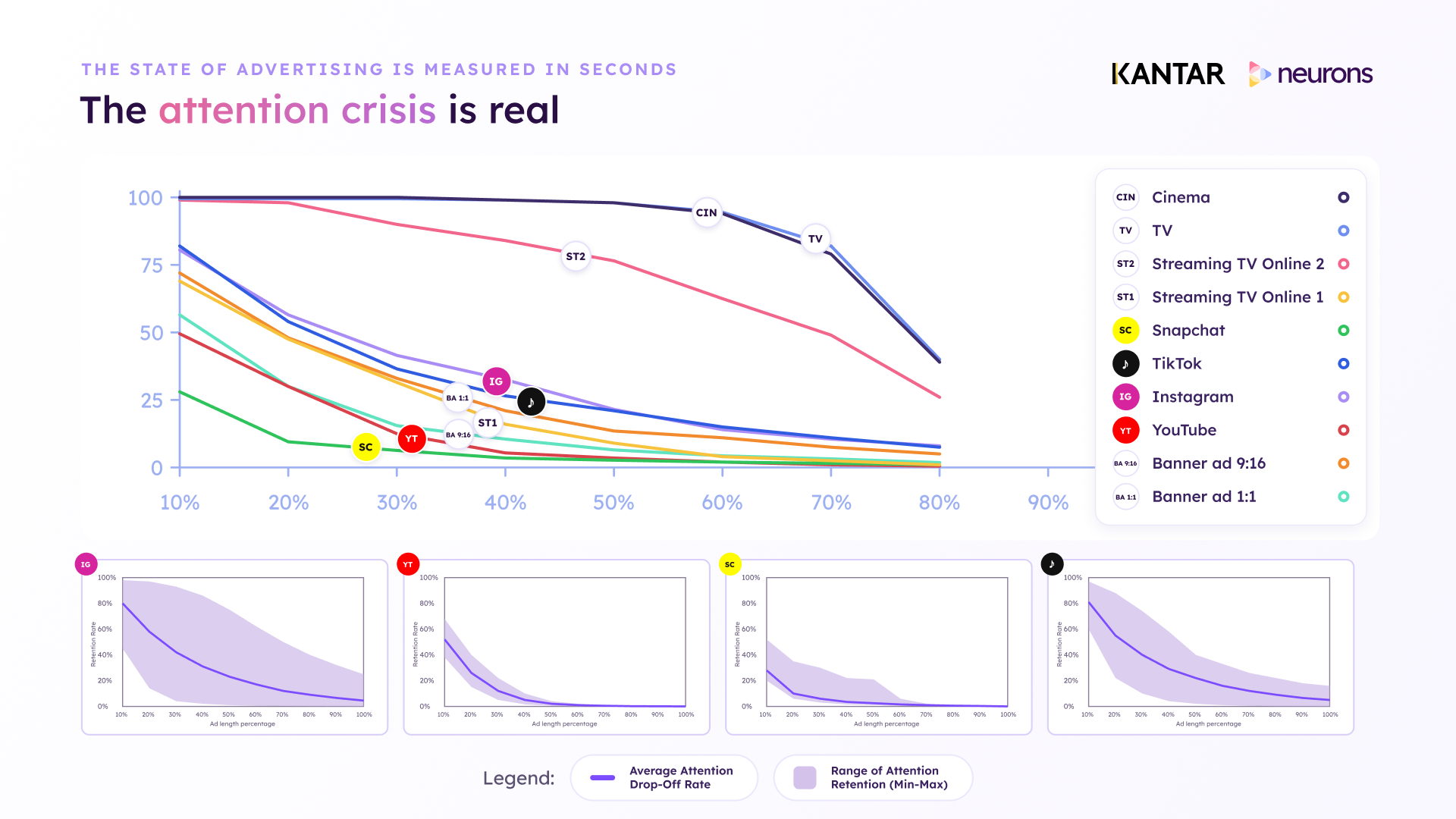
Neurons studied how attention to advertising drops off across cinema, TV, streaming, YouTube, Instagram, TikTok, Snapchat and banner ads. Two findings stood out. First, you have less time than you think. Second, every channel loses viewers at a different rate. Cinema holds attention best, helped by a captive audience. Snapchat loses it fastest, yet can still deliver good brand recall over time, so a shorter look isn't automatically a weaker one.
The bigger finding sits inside each channel. The spread between the best and worst ads is wide, and it's driven mainly by the creative itself and how long you made it. That's good news, because the creative is the part you control.
Thomas's rule of thumb: plan for two to three and a half seconds of attention. Don't assume a 15-second ad gets 15 seconds.
Your brand should be displayed prominently and in the right way
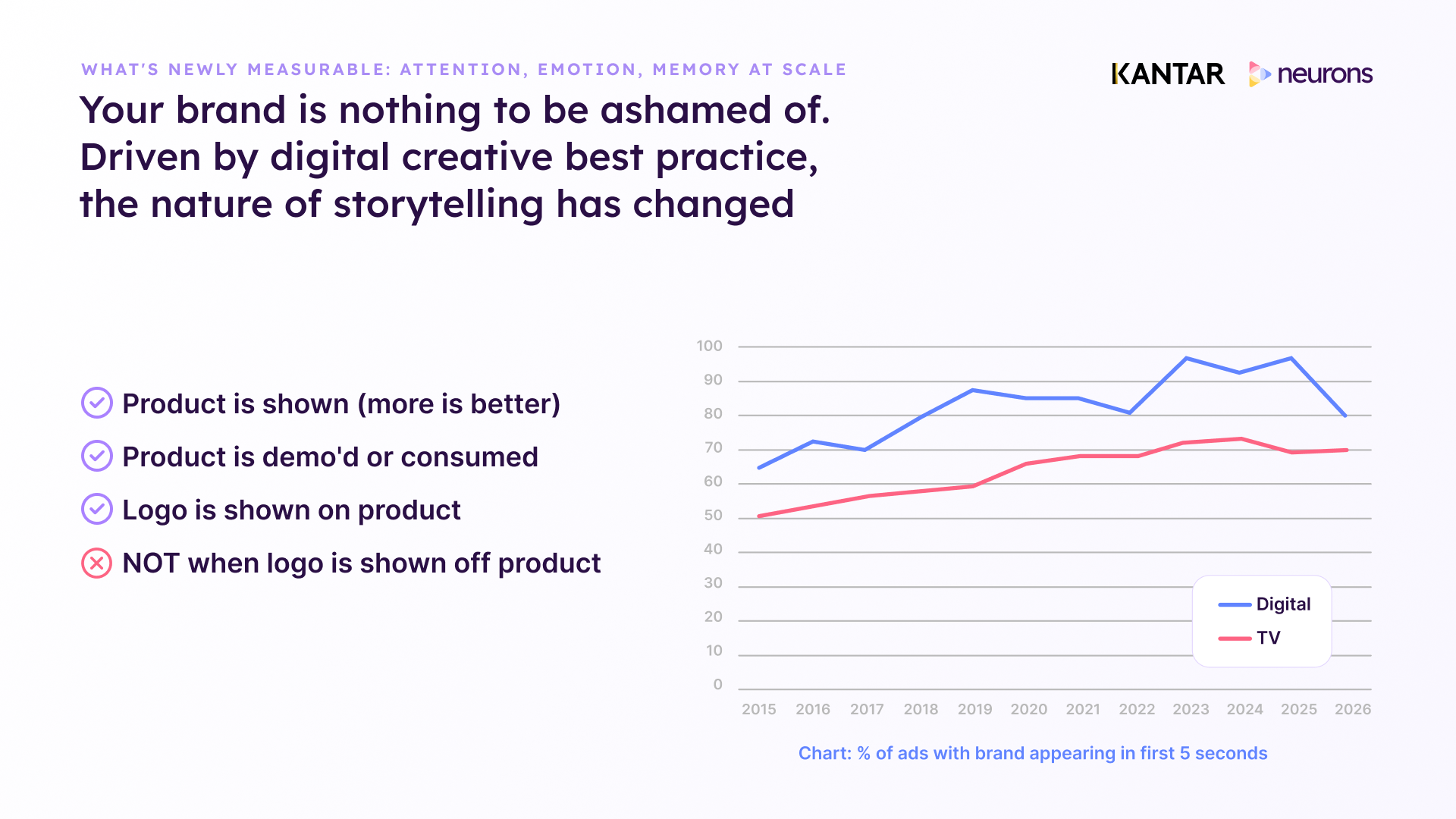
Kantar has tracked what it means to show your brand early on in the ad for a decade. Ten years ago, about two thirds of digital ads showed the brand in the first five seconds, compared with about half of TV ads. Today, it's 80-90% of digital ads and about two thirds of TV ads.
The evidence behind that shift is clear. Showcasing your brand early doesn't hurt. Across Kantar's data, the more the product is featured, and the longer, the better the ad performs overall. Showing the logo on the product helps too.
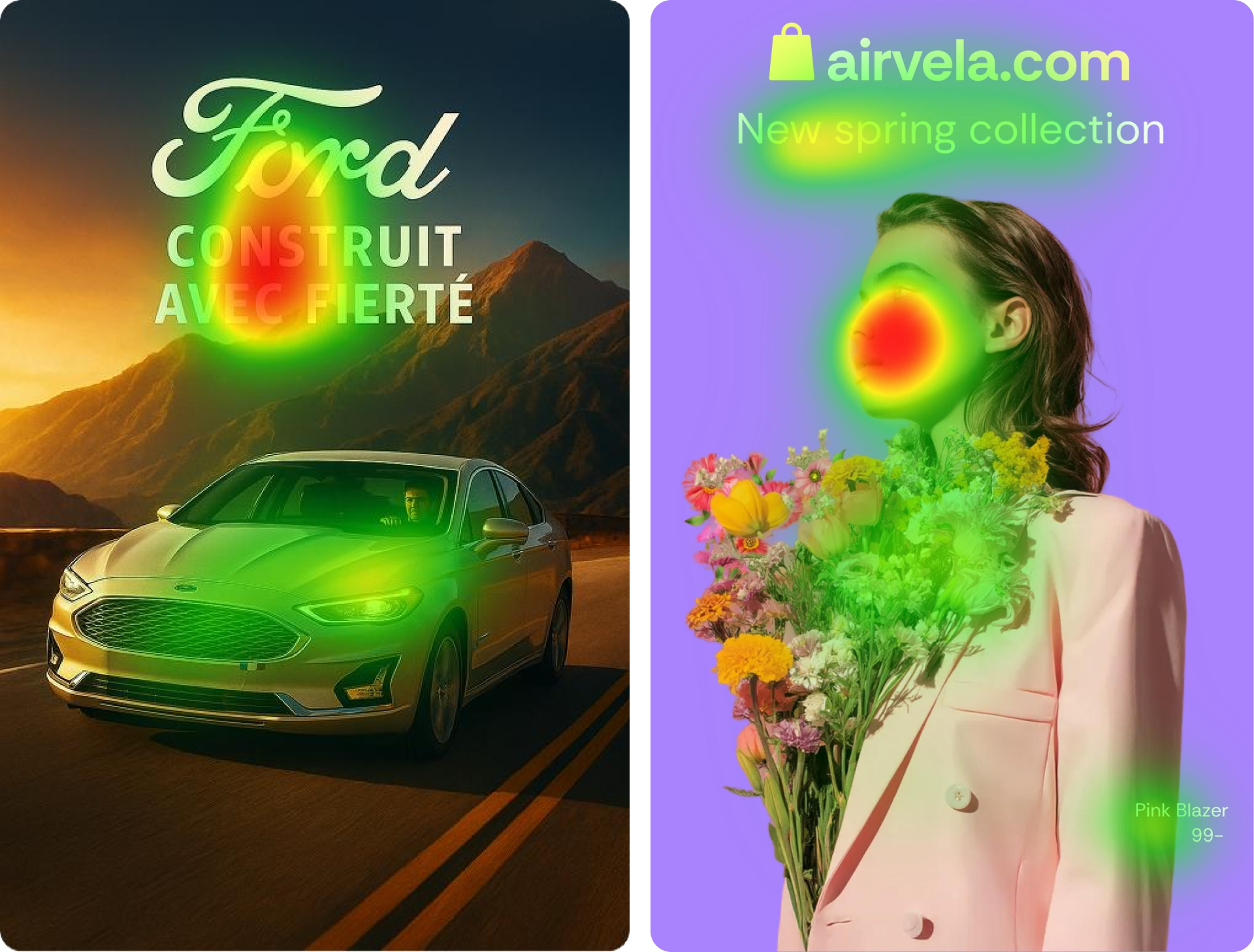
There's a myth within the myth, though: a logo on screen is not the same as branding. Duncan shared strong evidence that a logo tucked into a top or bottom corner, away from the product and the story, does about as much as no logo at all. An Uber Eats ad discussed in the webinar showed both sides. The branded product in the center of the frame drew strong attention. The same logo in the top-right corner drew almost none.
Build the story out from the brand
The strongest work treats the brand as the starting point, not the punchline. Heinz's "Lost in Love: Tennis" by Wieden+Kennedy London was the single best TV ad Kantar researched in the past 12 months, based on its overall score for short-term sales and long-term brand building. It extends Heinz's long-running "irrational love" platform, which Heinz has publicly credited with growing global sales by about 12%. Running it through Neurons AI showed strong attention to the product and the brand, which in Heinz's case are the same thing.

Not every campaign needs lots of attention, either. A simple brand reminder from a well-known brand can work in a glance.
What to do:
- Show the brand and product in the first seconds, especially on skippable formats.
- Integrate the logo into the product or story instead of parking it in a corner.
- Check where attention lands, not just how much of it you get.
Myth 2: "Celebrities are a guaranteed way to capture attention"

Verdict: Closer to a coin flip. Celebrities grab attention, but often for themselves, not the brand.
Duncan's view: a famous face is no guarantee of success. There's almost as much chance of the celebrity distracting from the brand as drawing attention to it.
Thomas described it as a double whammy. The more famous the person, the more attention they take from the product and the value proposition. And the more famous they are, the more the ad tends to be designed around them.
Kantar's data shows how the odds change:
The lesson: a celebrity works best when paired with a branding device and used consistently over time.
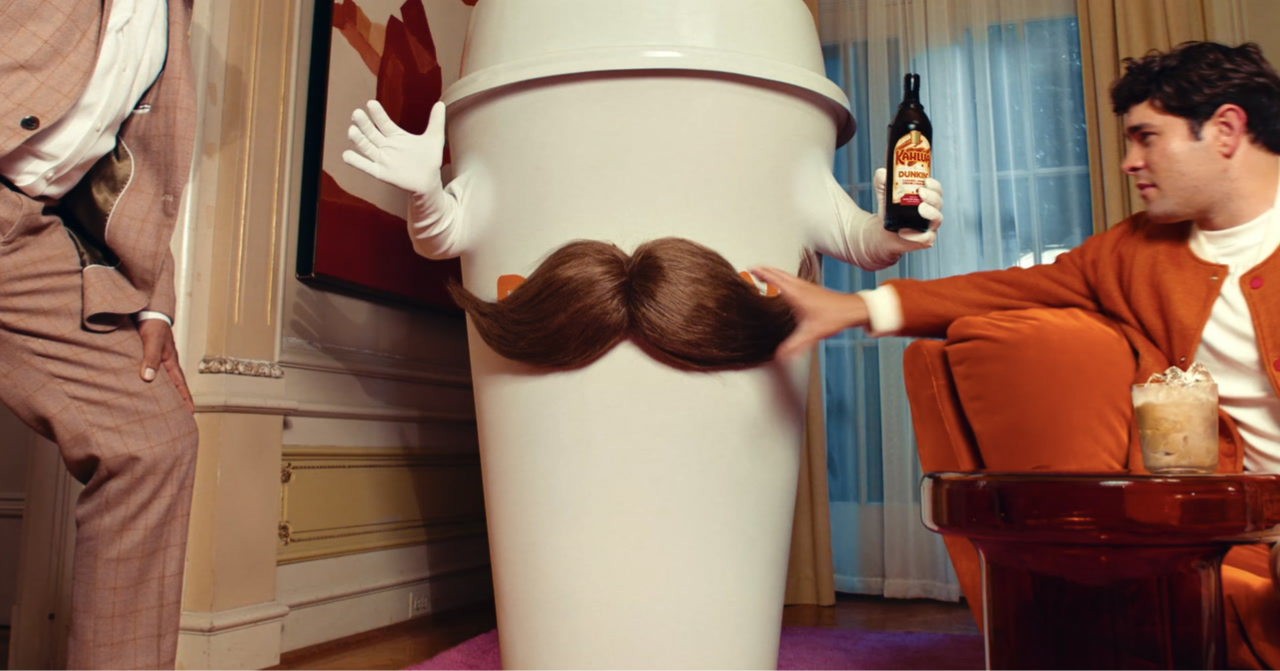
Kahlúa shows how to get it right. Its telenovela-style campaign with Salma Hayek performs strongly in social feeds, where you have seconds to earn attention. The latest execution, "It's Kahlunkin" by Wieden+Kennedy London, is a co-branded partnership with Dunkin' and won Kantar's digital/social category. Co-branded ads are risky because two brands compete for the spotlight. Here, outrageous humor carries both. In Duncan's words, it was never a Salma Hayek ad. It was a Kahlúa ad featuring Salma Hayek.
Nespresso and George Clooney show the long game. The product has always been central to the storyline, never a tagline tacked onto the end. With so much equity built into that partnership, Nespresso is now handing over to a new generation on screen, with Clooney passing the baton to Dua Lipa.

What to do:
- Make the product a natural part of the celebrity's story, not an add-on.
- Pair the celebrity with a consistent branding device and stick with it.
- Check for a believable fit between the person and the brand, and plan any handover carefully.
Myth 3: "High engagement means the ad is working"

Verdict: More no than yes. Engagement and brand impact align only about a third of the time.
Engagement rate usually means likes, comments, shares and clicks per thousand impressions or views. It's measured slightly differently on every platform. The bigger problem is that no brand actually wants engagement for its own sake. They want to build the brand and drive sales.
Kantar compared real in-market engagement rates with brand and sales impact scores across more than 26,000 ads. The two lined up only about one time in three:

An ad can earn huge engagement by being entertaining or polarizing without the brand being linked to any of it. Thomas pointed to Sony Bravia's bouncing balls in San Francisco: it went viral and won awards, yet in testing, brand memory was low.
The industry has been here before. Twenty years ago it was click-through rate. Study after study tried to link clicks to brand impact and found almost no correlation. Engagement is in the same cycle now, mainly because it's free and available for every ad. Duncan called it probably the most beguiling but dangerous metric in digital marketing today.
There's also a cost to letting the platforms decide. The pitch is simple: hand over all your assets and the algorithm will find the winners. But that optimization happens with your money, while you spend it, and it optimizes for engagement. If you screen assets before launch, you can go to the platforms with a clear brief on which assets deserve more budget, based on brand and sales potential.
What to do:
- Stop using engagement as a proxy for effectiveness.
- Screen assets before they go live, and remove the weak ones before the algorithm spends on them.
- Set up campaigns so your strongest brand-building assets get the budget.
Myth 4: "Generative AI will fix advertising"

Verdict: No. It makes more ads faster. It doesn't make them better on its own.
Some brands are doing this well. Duncan highlighted L'Oréal and Coca-Cola, recognized at Cannes this year for producing huge volumes of ads while keeping quality high. But volume adds risk. Kantar's data shows that the more assets a campaign has, the wider the gap between its best and worst ads.
Execution is now easy. Evaluation is not. - Dr. Thomas Z. Ramsøy, Neurons
Thomas summed up the shift: execution is now easy, evaluation is not. The cost of making an asset has been greatly reduced and the number of assets has exploded, but judging which ones will work is as hard as ever.
Many teams are responding by screening everything before launch. Most of Kantar's LINK AI clients are now subscribers, and many are moving to API connections so they can screen all assets in a few hours before deciding what goes live. That raises a practical question about the middle of the pack. Clear winners and clear losers are easy. The ads in between need a decision: a small tweak, or a closer look with human testing.
The biggest challenge is the creative workflow. Digital assets are often ready only days before a campaign launches, so screening can't become a bottleneck. Teams need simple protocols that fit the timeline.
What to do:
- Screen every asset before launch, not after the budget is spent.
- Sort results into go, fix and rethink, and agree in advance what happens to each group.
- Save human testing for big bets and assets the predictions flag as uncertain.
Myth 5: "AI kills creative bravery"

Verdict: Used well, AI only kills weak ideas. Faster feedback means exploring more bold options, not fewer.
On AI-generated content, Kantar's data is mixed in an interesting way. On average, using generative AI in production makes relatively little difference to how people respond. When the AI use is noticeable, responses polarize. Some people are wowed. Others find it off-putting. Duncan's advice: if you're making a big bet with prominent AI technology, put it through human testing. If AI was used in a way viewers won't notice, AI screening is a good fit.
Thomas made the case that fast feedback actually opens up creativity. Under deadline pressure, teams play it safe and stick with the first workable idea. When a prediction takes seconds, trying another route costs almost nothing, so teams experiment more. Neurons' visual recommendations include a "wild card" option that generates unexpected alternatives. Teams use it less to fix the current ad and more to spark ideas for the next round. Publicis lifted creative impact by 18% with Visual Recommendations.
Duncan agreed, with one caution: Twenty suggestions don't help a busy team. Recommendations need to be focused on the job to be done and narrowed down to the one or two must-fixes.
Two ads from the webinar show bravery working in opposite directions:
- LEGO goes all in. Jason Momoa, chaos, constant action. It breaks the usual guidance on celebrity focus and visual complexity, yet works because LEGO bricks are in every scene. You get the message even with the sound off.
- British Airways "Reflections" (OOH) goes the other way. It's calm, understated and implicit, a moment of quiet in a busy feed. Simplicity cuts through.

BA's work points to a real risk. If AI turns creative guidance into a checklist (brand in the first three seconds, a reason to believe, a category entry point, a close), ads become a box-ticking exercise. People still need to judge when enough is enough.
As for spotting originality, Duncan was clear: AI evaluation is good at identifying what's distinctive and new. It has limits, such as some cultural nuances, but some of the most creative ads Kantar has run through AI testing scored very well.
What to do:
- Use fast predictions to test more routes, including the bold ones.
- Use AI recommendations as inspiration for the next round, not just as fixes.
- Treat best practices as guidance, not a checklist every ad has to tick.
Six questions for your next creative review
- Do the brand and product appear in the first two to three seconds?
- Is the logo part of the product or story, or parked in a corner?
- If there's a celebrity, is the product central to their role, and is there a consistent branding device?
- Are you judging success by engagement, or by brand and sales impact?
- Has every asset been screened before launch, with a clear plan for the ones in the middle?
- Did fast feedback help you try a bolder route, or just confirm the safe one?
Watch the full webinar
This article covers the highlights. The full session goes further, with the ad breakdowns, how attention heatmaps work, and Duncan's take on what he saw working for ads when judging at Cannes.
Watch "The New Rules of Creative Effectiveness" on demand.
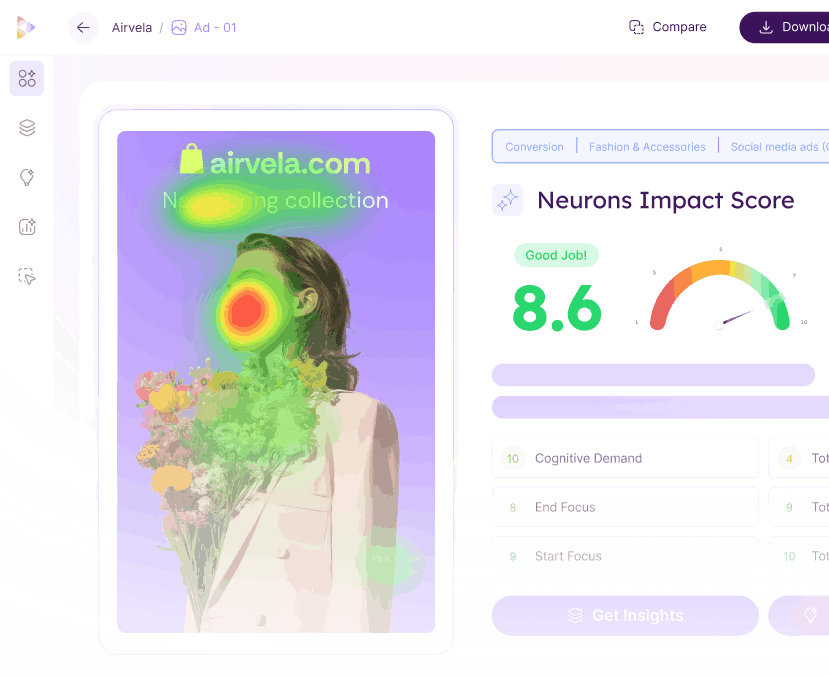
Want to see where attention lands in your own creative before launch? Neurons’ AI predicts attention, memory and brand impact in minutes, backed by a database of over 300,000 human participants. Book a demo.
To learn more about Kantar's approach, read how Kantar validates AI-based creative testing.