Ad creative testing is one of the highest-leverage activities in digital advertising. This is because creative quality directly influences whether a campaign scales profitably or not. Yet many brands either skip the process entirely or rely solely on live campaign data to evaluate performance
The problem with this approach is that weaknesses such as ineffective hooks or distracting visuals are often discovered only after ad spend has been committed. By then, valuable budget and opportunities have been lost.
A more effective strategy is to test ad creatives before launch. Prelaunch testing helps identify creative risk and improve weak creatives early. Live testing then supports the next layer of optimization by adjusting variations, improving performance, and scaling what already works.
This guide explains how to test ad creatives through a repeatable step-by-step process covering methods, metrics, mistakes, tools, and real examples.
Learn how ad testing fits into a complete creative strategy before and after launch
What Is Ad Creative Testing?
Ad creative testing is the evaluation and comparison of ad variations to identify which version drives the highest attention, engagement, or conversions.
Creative testing differs from campaign optimization. Creative testing evaluates the hook, message, and visual direction to show which ad version deserves budget allocation. Campaign optimization adjusts how that ad is delivered through audiences, placements, bids, budgets, or delivery settings.
Many advertisers spend more time adjusting delivery than testing the actual creative. However, better targeting cannot fix an ad that fails to capture attention and drive action.
For example, a brand may keep changing the targeting for a low-performing video ad when the real issue is the opening frame. As a result, the campaign keeps spending without fixing the creative problem.
Why Is Creative Testing Non-Negotiable in 2026?
Creative testing is non-negotiable in 2026 because digital advertising platforms have automated more targeting and placement decisions than before. As a result, creative quality now plays a larger role in campaign performance. This change has made creative testing a core part of campaign success.
The factors below explain why creative testing has become so important.
- Creative Drives Performance Outcomes
The quality of the ad determines whether people engage with the campaign. A weak hook or unclear visual makes the ad easier to ignore, even when the campaign reaches the right audience. Creative quality directly affects attention, engagement, and conversion.
- Untested Creative Bleeds Budget
The impact on performance spreads to the budget. A weak opening frame, unclear message, or poor CTA becomes expensive once the campaign goes live.
- Ad Fatigue Weakens Performance
Leaving weak creatives running for too long leads to ad fatigue, which in turn leads to a drop in performance. Without ongoing testing, marketers have no reliable way to identify the next winning creative before performance begins to decline
- Testing Improves Team Alignment
When done right, creative testing improves stakeholder alignment by reducing reliance on personal opinion. Clear, data-backed results help creative teams, media buyers, and clients agree faster on which version deserves budget allocation.
- Improvements Compound Over Time
Creative testing produces ongoing insights that guide better creative decisions. Over time, small performance gains build up, improving engagement, conversions, and efficiency. This creates a growing knowledge base that makes future campaigns faster and more effective.
Discover why testing ad creatives is essential for improving campaign ROI and reducing wasted spend
Two Smart Ways To Test Ad Creatives
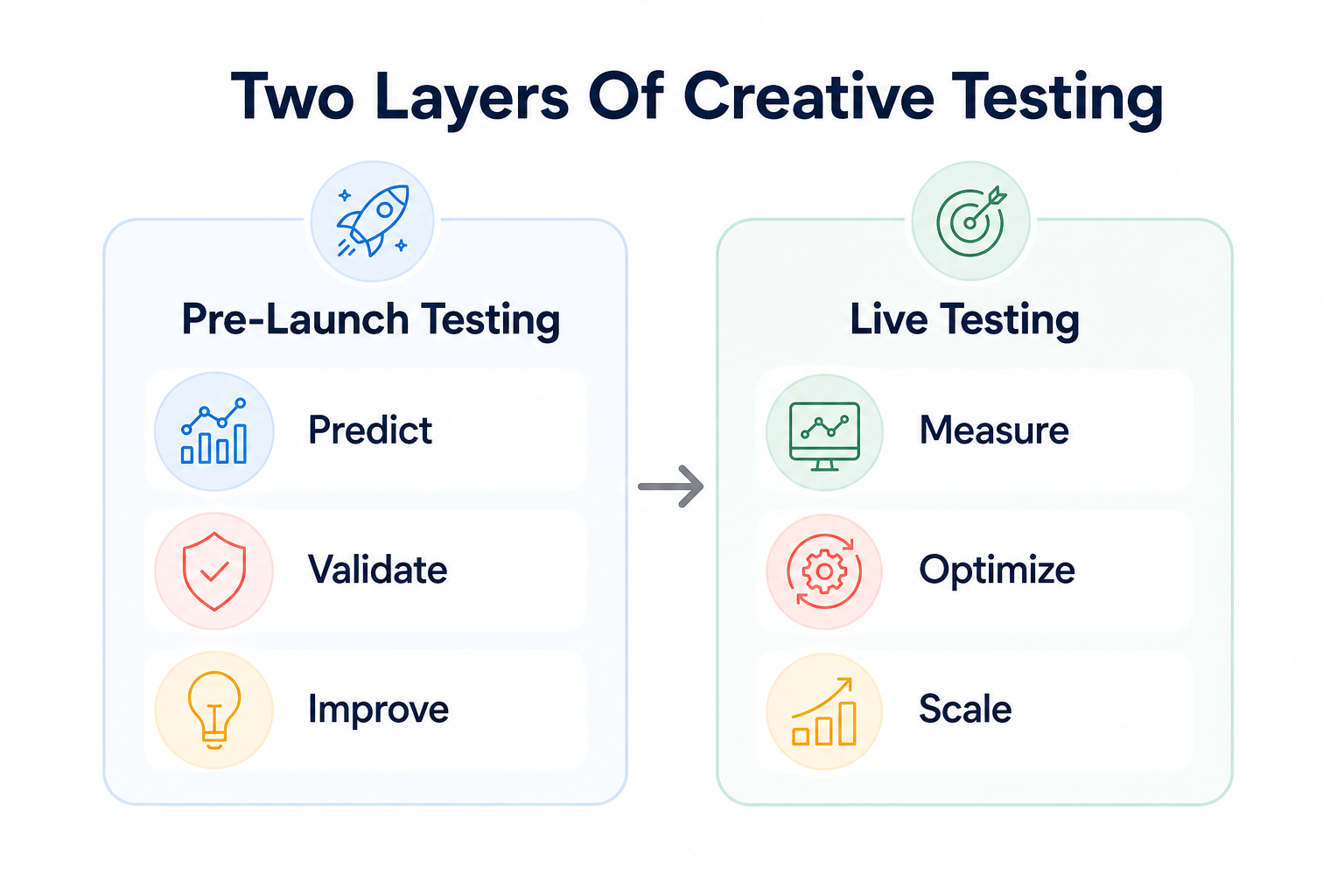
The smartest way to test ad creatives is to use a two-layer approach that starts before launch and continues during the campaign.
Pre-launch testing answers the first question: Is this creative strong enough to launch? This early layer helps teams catch weak hooks, unclear visuals, and low attention signals before media spend begins.
Live testing answers the next question: which version performs best in the market? Once the campaign goes live, teams compare active variations, adjust the budget, and scale the creative that performs best.
Together, both layers help teams avoid weak creative and improve campaigns with real performance data. This strategy creates a more complete ad creative testing process.
For example, a brand uses pre-launch testing to choose the strongest video opening before launch. Once the campaign goes live, the team then tests multiple calls to action to improve conversions without changing the winning opening.
How Do You Test Ad Creatives? A Practical 5-Step Process
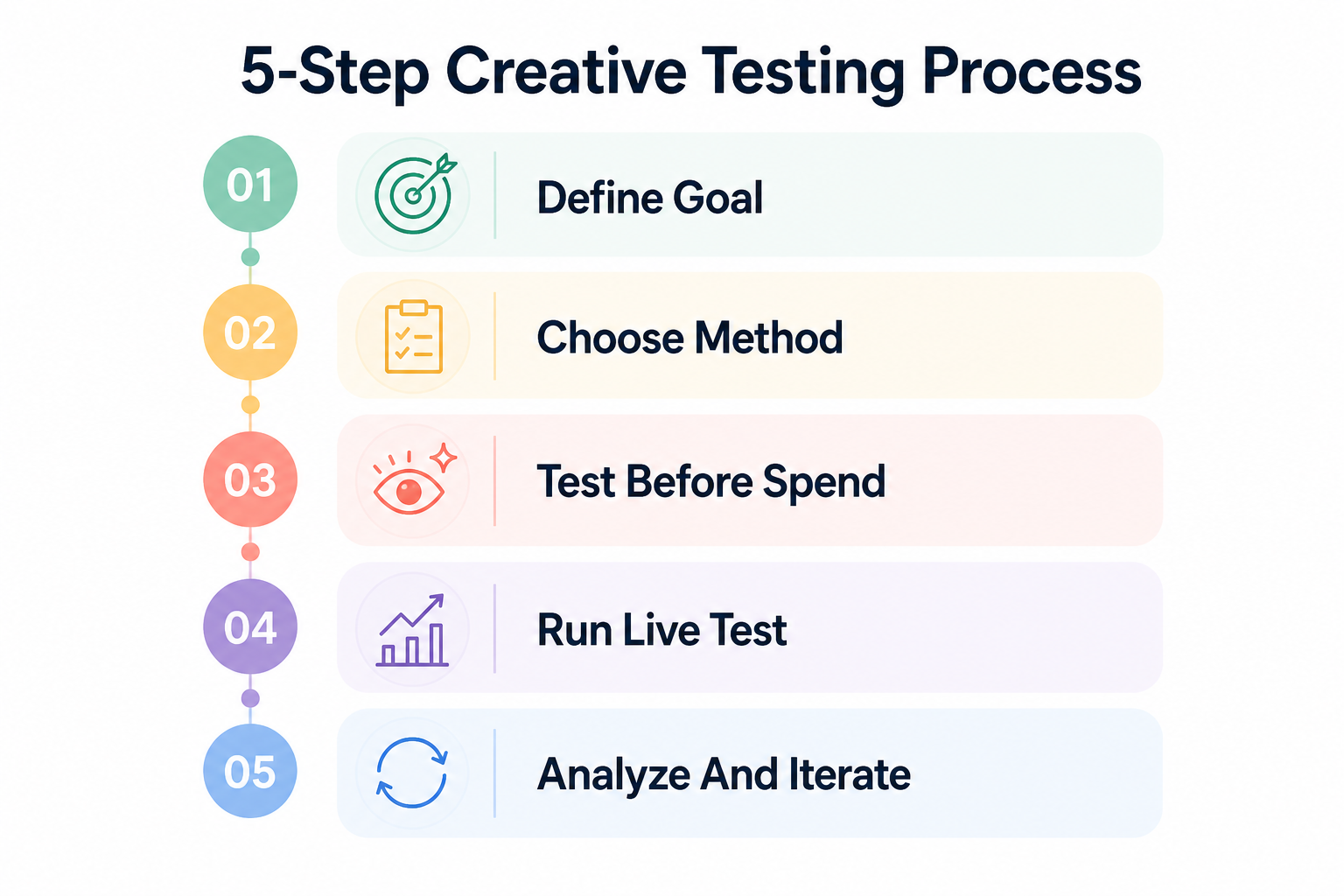
To test ad creatives properly, follow the five-step process below.
- Define your goal and hypothesis
- Choose your ad testing method
- Test before you spend with predictive AI
- Run your live test
- Analyze results and iterate
This five-step framework is a repeatable system, not a one-time exercise.
Step 1: Define Your Goal and Hypothesis
Before testing begins, define the goal, how it will be measured, and what counts as success. This makes the test easier to interpret once the results are in.
Choose a creative element, such as the hook, visual, or offer, to keep the test focused and easily understandable.
After that, choose the key performance indicators (KPIs) that match the goal. Attention-focused tests track metrics like view rate or thumb-stop rate, while traffic-focused tests track click-through rate (CTR). If the focus is on conversions and sales, track conversion rate and return on ad spend (ROAS).
Also, ensure you set a benchmark before launching the test. For instance, if a team sets a CTR benchmark at 1.5%, any result below that level is considered underperforming.
After defining the goal, metric, and benchmark, write a simple hypothesis. A strong hypothesis explains what will change, what result is expected, and why that result should happen.
For example, “Changing the first 3 seconds from a product shot to a customer problem will increase view rate because the opening feels more relevant.” This gives the test a clear reason and makes the result easier to evaluate.
Avoid changing too many variables at once. If the hook, CTA, and visual change in the same test, the team won’t know which element caused the result. The better approach is to test one variable at a time, then use the result to decide the next test.
Step 2: Choose Your Ad Testing Method
Choosing the right method depends on when the test happens and what the team needs to learn. Pre-launch testing and live testing describe the stage, while the methods below describe how the test is done.
The seven main ad creative testing methods are outlined below.
- Predictive AI Testing
For teams that need fast feedback before spending begins, predictive AI testing evaluates creative using attention and behavior data. For example, a team tests multiple video openings to identify the version with stronger attention signals.
Predictive AI gives early direction, but strong creatives still need to be validated with live campaign data.
- A/B Testing
A/B testing compares two ad versions with one changed element, making it useful for testing a headline, hook, visual, or CTA. A practical example is testing two headlines on the same ad to see which one drives more clicks.
In A/B testing, problems arise when several elements change at once because the result becomes harder to attribute.
- Multivariate Testing
Multivariate testing compares several creative elements and combinations, making it useful when teams have enough traffic, budget, and variations. In practice, teams test different headlines, images, and calls to action together to identify the strongest creative combination. The limitation with this method is that each added variable increases the data, time, and setup needed for reliable results.
- Brand Lift Studies
Brand lift studies measure whether an ad changes awareness, consideration, favorability, or purchase intent, especially in brand-building campaigns.
For instance, a brand compares exposed and unexposed groups after a video campaign to measure changes in awareness or consideration. Although brand lift studies provide useful perception data, results usually take longer than standard performance tests.
- Incrementality Testing
Incrementality testing measures the added value caused by an ad campaign and helps teams separate ad-driven conversions from conversions that would have happened anyway. A common example is comparing an exposed group with a holdout group that did not see the campaign.
The challenge with this method is that reliable results need careful setup and enough audience data.
- In-Market Testing
In-market testing measures ad performance while the campaign is live. This helps teams collect real performance data across audiences, placements, or channels. For example, a team compares creatives inside a live paid social campaign to identify which version performs better.
The main drawback is that weak ads spend real budget while the test gathers enough data.
- Surveys And Focus Groups
Surveys and focus groups collect direct audience feedback on ad clarity and response, especially when teams need to understand why people react a certain way. For instance, a brand uses surveys to gather consumer insight on which ad format feels more trustworthy.
The limitation with audience feedback is that what people say does not always match real behavior.
Step 3: Test Before You Spend With Predictive AI
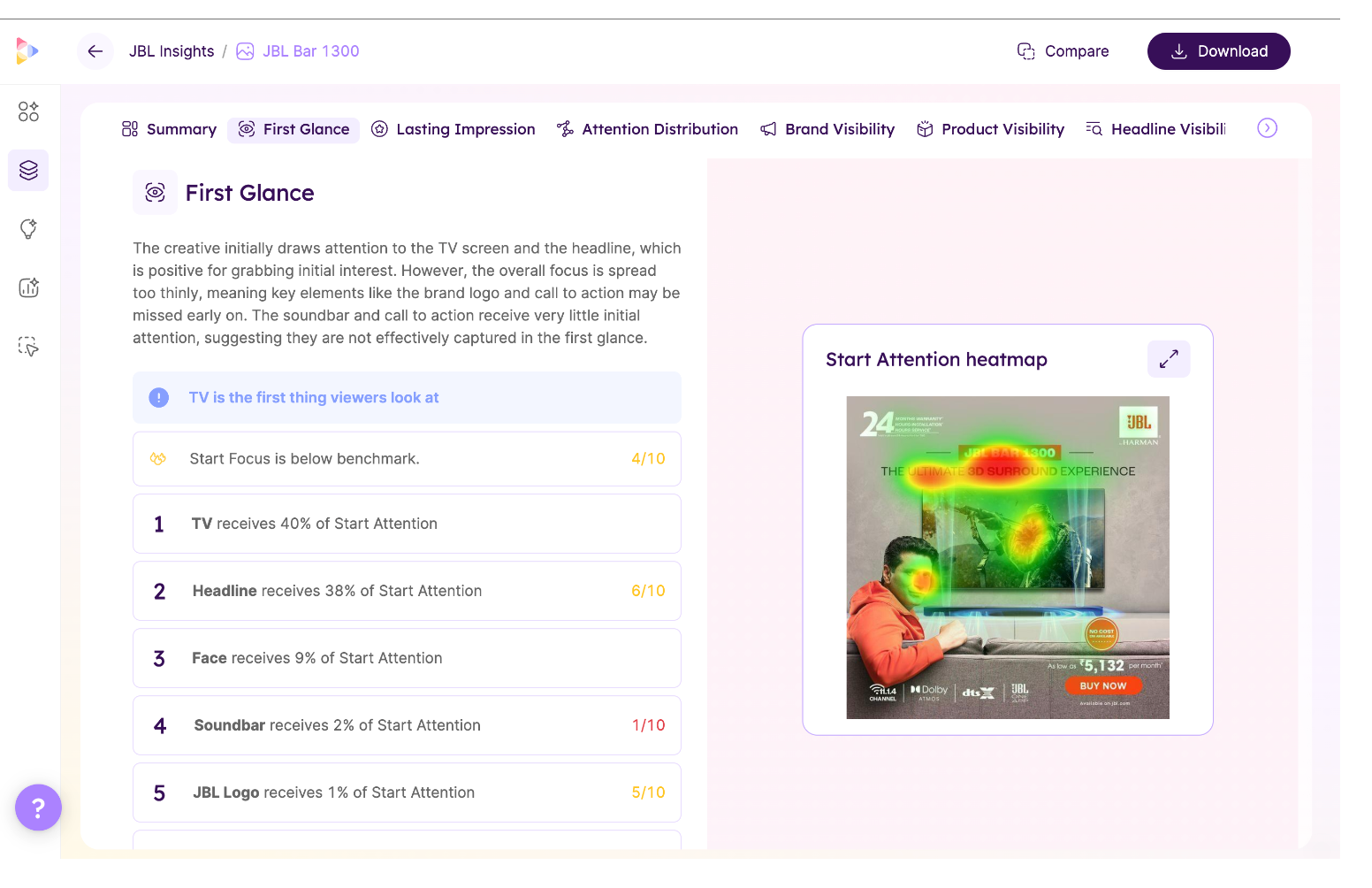
Without pre-launch testing, teams often learn too late that an ad is not strong enough. At that point, issues like a weak opening frame, unclear brand placement, or confusing message have already affected performance.
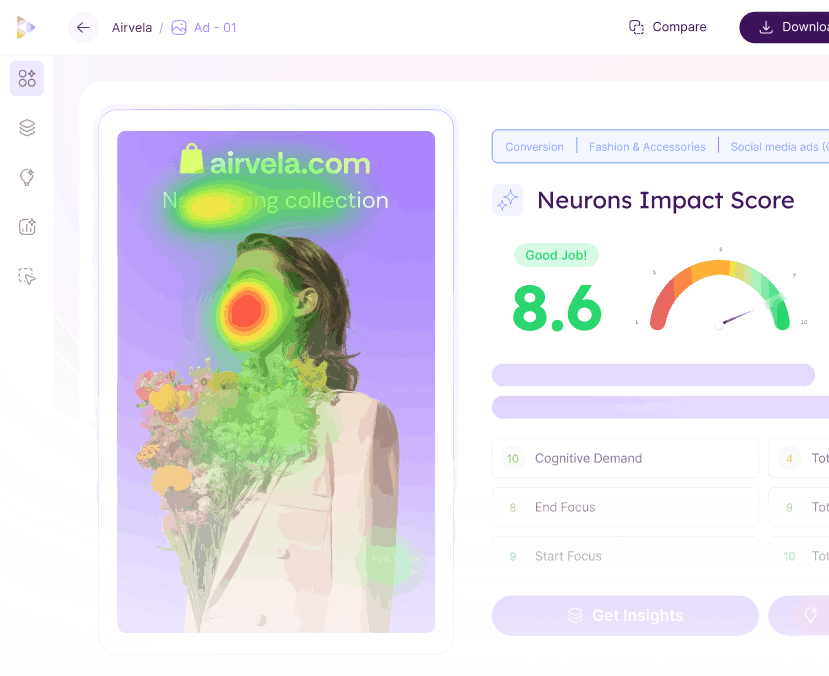
Predictive AI testing with tools like Neurons AI brings these issues forward before the campaign starts spending. Neurons AI analyzes static and video creatives using behavioral scores such as attention, memory, clarity, focus, engagement, and cognitive demand.
These scores show whether the ad is memorable, easy to understand, engaging, or too difficult to process. Predictive eye-tracking heatmaps also show where attention goes first, helping teams see whether viewers notice the brand and key message early enough.
The platform also supports side-by-side creative comparisons through Compare View. Teams compare versions using behavioral scores and heatmaps, then choose the creative with stronger brand visibility.
Once the pre-launch test identifies the strongest creative, the next step is to set up and run the live campaign test. This gives the campaign a stronger creative starting point before live performance data comes in.
See how Neurons AI pre-launch testing predicts ad performance before any media spend
Step 4: Set Up and Run Your Live Test
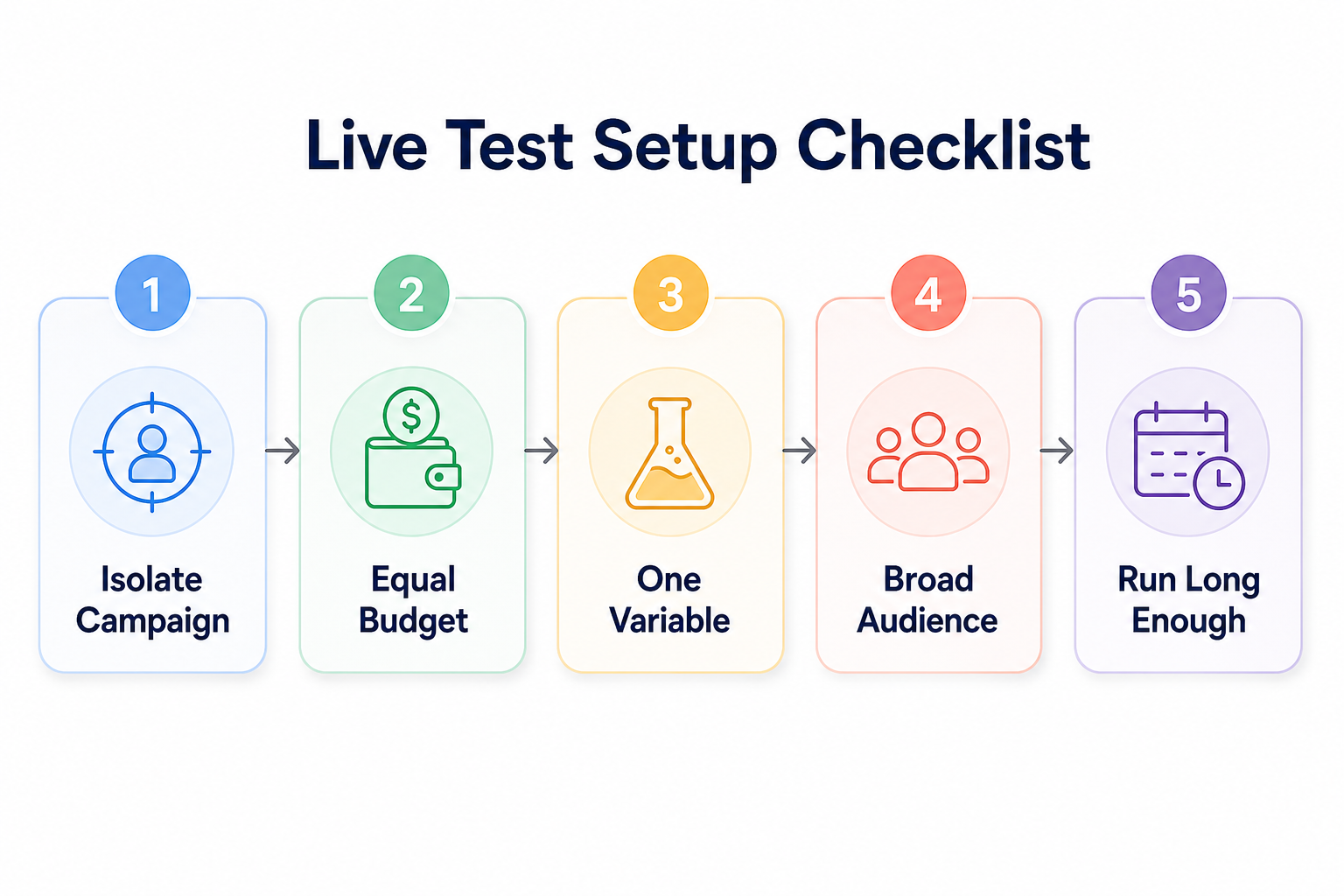
After pre-launch testing identifies the stronger creative, set up the live test to measure in-market performance clearly.
Start by isolating the test creative in its own campaign, ad set, or experiment to keep results from mixing up with other active campaigns.
Next, distribute the budget equally across variants so each creative gets enough spend to prove performance. If one creative gets more spend too early, the platform may favor that version before the test has enough data.
During the test, change one variable at a time, such as the hook, visual, or CTA. This makes it easier to know which creative element influenced the result.
For better results, use a broad audience for creative tests. Narrow audiences can make results look stronger or weaker because of audience behavior.
Finally, run the test long enough to collect meaningful data. Ending too early can make the wrong version appear to be the winner before the campaign collects enough data.
Get the "How to Advertise on Facebook" eBook for a step-by-step guide to setting up ad tests on Meta
Step 5: Analyze Results and Iterate
After the live test runs, read results by funnel stage, from first attention to final conversion, instead of judging only by return on ad spend (ROAS).
A hook rate or 3-second view rate above 30% means the opening is strong enough to get attention. If the number is low, the first frame, opening line, or visual hook needs work.
The hold rate shows whether people keep watching after the opening. Over 15% watching for 15 seconds shows strong continuity. If the hold rate drops early, the ad may need faster pacing or a clearer message.
CTR shows whether the ad creates enough interest for people to click. Conversion rate and ROAS show whether the offer, landing page, and audience match what the creative promised.
Avoid stopping the test too early. Early results often change once the campaign gathers enough impressions, clicks, and conversions.
When one version wins, use that winner as the benchmark for the next test. For example, if one opening performs best, keep that opening and test a new CTA, product shot, or offer.
Over time, this process compounds, making each new test more informed than the last. Every result narrows the next question and helps teams improve without starting over.
See how Neurons AI significantly reduces the hassle of live ad testing
7 Ad Creative Testing Metrics To Track
Ad testing and ad creative testing are related, but distinct. Ad testing evaluates delivery, audience, placement, and campaign performance, while ad creative testing focuses on how the ad itself performs. Still, both rely on some shared metrics as creative quality affects campaign results.
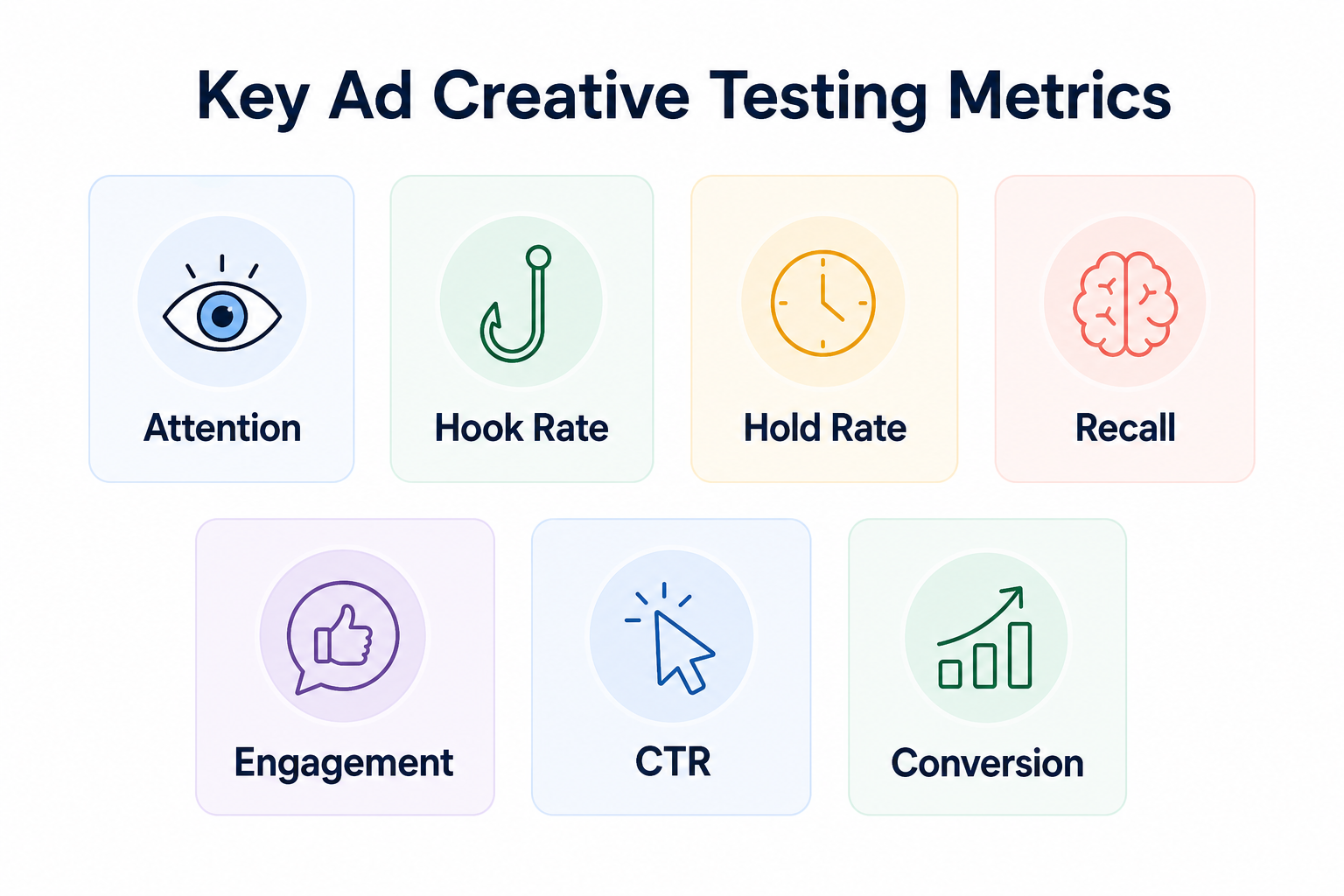
The seven main ad creative testing metrics are outlined below.
- Attention score shows whether the ad attracts visual attention early. This matters because viewers need to notice the ad before the message or offer works.
- Hook rate shows how well the opening earns attention in the first few seconds. A low hook rate implies a weak first frame, slow opening, or unclear visual idea.
- Hold rate shows whether viewers keep watching after the opening. If attention drops quickly, the ad needs stronger pacing, clearer sequencing, or a more relevant message.
- Brand recall measures whether people remember the brand after seeing the ad. This matters when the campaign goal is awareness, memory, or long-term brand building.
- Engagement rate measures likes, comments, shares, or saves. This metric shows whether the creative earns enough relevance for people to interact.
- Click-through rate shows whether the ad creates enough interest to earn clicks. A low CTR may point to a weak offer, unclear CTA, or poor message-audience fit.
- Conversion rate shows whether people complete the desired action after clicking. This metric depends on the creative, offer, landing page, and audience quality.
4 Common Ad Creative Testing Mistakes To Avoid
Ad creative tests fail when the setup makes results unclear or when the insight comes too late to use. The four most common mistakes are outlined below.
- Testing After You Spend: Many teams discover creative weaknesses only after the budget is already committed. By then, weak hooks, unclear messages, or poor visuals have affected performance. To fix this, use pre-launch testing before live campaign spend begins.
- Changing Too Many Variables: Results become hard to interpret when the hook, visual, CTA, and offer all change in the same test. This makes attribution difficult because the result cannot be linked to one specific creative change. To avoid this, change one variable in a simple A/B test or use a structured multivariate test for several elements.
- Cutting Tests Too Early: Early results are misleading because campaigns need enough impressions, clicks, and conversions to stabilize. Fix this by setting a minimum test duration or data threshold before making decisions.
- Only Testing Cosmetic Variations: Testing small design changes that do not affect the core message limits learning, as they don't explain why an ad works. Instead, focus on testing meaningful creative elements, such as the hook, offer, visual direction, or CTA.
Improve your ad creative testing with proven best practices
Tools To Help You Test Ad Creatives
The best tools to test ad creatives fall into two categories: pre-launch testing tools and live testing tools.
In the pre-launch category, Neurons AI leads by helping teams compare creative options through attention, memory, and impact predictions before launch. System1 measures emotional response and commercial potential, making it useful for broader creative benchmarking.
For live testing, Meta Ads Manager supports native A/B testing and dynamic creative testing inside active campaigns. Marpipe helps teams test creative combinations, while VWO connects ad performance to landing page and post-click experience testing.
The strongest testing stacks combine a pre-launch tool with a live testing tool. This gives teams early creative confidence before launch and real campaign feedback once the ad starts spending.
For teams building this kind of testing stack, Neurons AI is a strong place to start because it turns early creative review into measurable attention and memory signals. Book a Neurons AI demo to see how predictive ad testing works before launch.
Explore the best ad testing companies