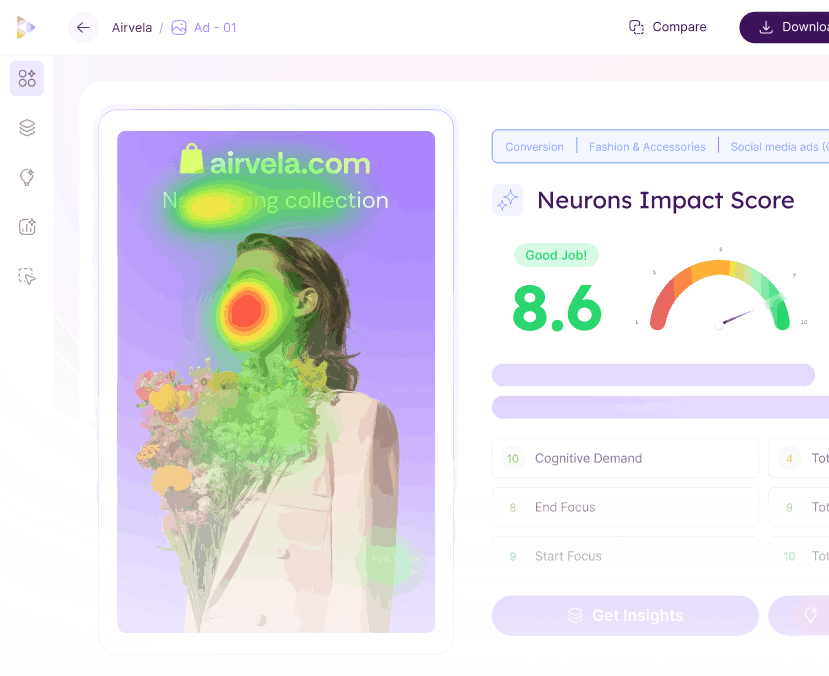
Research by Ipsos revealed that 38% of highly viewable digital video ads failed to deliver business outcomes, wasting about $5.5 billion in ad spend. For a format that requires significantly larger investment than others, poor performance poses a greater financial risk.
Neuromarketing video advertising reduces this risk by showing how viewers are likely to respond before teams commit media budgets. It uses brain, visual, and behavioral data to understand what captures attention, triggers emotion, and strengthens memory.
Employing neuromarketing in video advertising matters because traditional feedback is not always reliable. People can claim to like an ad, even when the video fails to build brand recall or support the campaign goal.
This guide explains how neuromarketing works in video ads, the neuroscience behind high-performing videos, and how brands can use those insights to improve creative decisions.
See our complete guide to neuromarketing in 2026
Dive deeper into the application of neuromarketing in branding, industry, and more
What Are the Neuroscience Principles Behind High-Performing Video Ads?
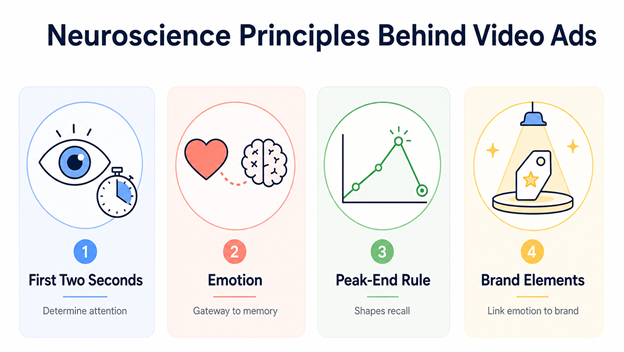
The neuroscience principles behind high-performing video ads explain how people notice, feel, store, and connect an ad to a brand. These four principles are outlined below.
1. First Two Seconds Determine Attention
Viewers decide if a video is worth watching or not within seconds. The brain makes this judgment using an attention gate that filters incoming visual information.
As a result, the opening frame needs to create enough interest to encourage deeper processing. A clear visual hook, like a face, movement, or sharp contrast in the first scene, catches attention and keeps viewers watching.
This is why high-performing video ads usually introduce the main visual idea early. When viewers immediately know what to focus on, the message is more likely to land.
2. Emotion Is The Gateway To Memory
Once a video earns attention, emotion helps the brain decide whether the message is worth storing. This happens because the amygdala and hippocampus work together during memory formation.
The amygdala is the part of the brain that processes emotional significance, while the hippocampus stores experiences. As a result, videos with clear emotional signals are easier to remember than videos that only convey information.
In video advertising, a strong emotional cue gives people a reason to care about the offer, product, or outcome being shown.
3. The Peak-End Rule Shapes Recall
The peak-end rule means people remember the strongest moment and the ending more than the middle of an experience. In video ads, this affects which parts of the message are easiest to recall.
When the emotional peak or final moment feels weak, the ad loses impact, even if the middle explains the offer well.
In practice, both the peak and ending should reinforce the message the brand is trying to pass across.
4. Brand Elements Must Sit Inside Narrative Peaks
When a video creates strong emotion without a clear brand presence, the viewer remembers the story but struggles to connect it to the brand or product. This creates what is referred to as an attribution problem.
Attribution problems happen when video ads lack brand identity elements, such as logos, products, colors, and key messages.
For stronger brand recall, brands should weave these elements into the scenes where attention and emotion are strongest. Doing this connects emotional response with brand recall.
Join top experts in the free webinar: “How Video Advertising Works in 2026”
How Is Neuromarketing Applied to Video Advertising?
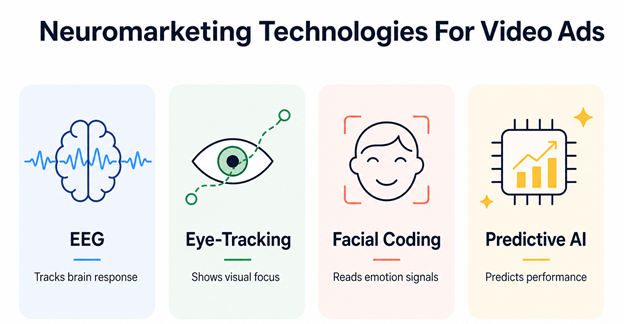
Neuromarketing is applied to video advertising by using brain, visual, and behavioral data to evaluate how viewers respond to a video as it plays. Instead of waiting for post-viewing opinions, teams use these methods to see where attention rises, where emotion changes, and where memory signals strengthen.
The four main technologies used in neuromarketing video advertising are outlined below.
- EEG (Electroencephalography)
Electroencephalography (EEG) measures electrical activity in the brain. In video advertising, EEG shows how viewers respond to scenes, frames, pacing changes, and message shifts.
A video rarely creates one steady response from start to finish, so EEG helps teams study viewer response frame by frame. Attention can rise during a strong product reveal, drop when pacing slows, and rise again when the message becomes clearer.
With this data, brands can restructure video sequences, adjust pacing, and improve emotional arcs before launch. EEG is useful when teams need to understand how the brain responds across the full video, not just after it ends.
- Eye-Tracking
Eye-tracking records where viewers look while watching an ad, helping teams confirm whether the most important visual elements are noticed.
Having the right product shot, logo, CTA, or key message is only part of the equation; where they appear determines whether viewers actually see them. If viewers look elsewhere during those moments, the ad loses a chance to connect the viewer’s attention with the intended action.
By showing natural gaze paths, eye-tracking reveals whether viewers notice the brand early, follow the intended visual story, and reach the CTA with enough context. This is especially useful in mobile video, where small screens make unclear visuals easier to miss.
- Facial Coding
Facial coding analyzes facial expressions and micro-expressions to measure emotional response during a video ad. These signals identify moments of joy, surprise, confusion, frustration, or disengagement.
Teams compare the emotion they intended with the emotion viewers actually show with facial coding. They identify where the video needs improvement by observing if viewers seem confused during a key message or lose interest before the CTA.
For neuromarketing in video ads, this matters because emotion influences memory and decision-making. When teams understand where emotion rises or weakens, they can adjust scenes, transitions, music, or storytelling choices before the final edit.
- Predictive AI
Predictive AI makes neuromarketing faster and easier to use at scale. Instead of running every test in a physical lab, teams use AI models trained on large neuroscience datasets.
These models learn from methods such as EEG, eye-tracking, and facial coding, helping teams estimate how new videos will perform before launch. As a result, brands can test attention, memory, and creative impact in seconds.
This shift is important because traditional neuromarketing takes more time and resources. Predictive AI gives teams a faster way to compare video versions, identify weak frames, and choose stronger creative before media spend begins.
Neurons AI is a leading platform that applies predictive AI to video advertising neuroscience. Built on more than 20 years of research and data from over 300,000 participants, the platform helps teams predict viewer response before launch.
When combined, these methods show how viewers pay attention, respond emotionally, and remember key brand moments in a video ad. EEG tracks brain activity, eye-tracking shows visual attention, facial coding measures emotion, and predictive AI makes these insights easier to apply at scale.
Explore how neuromarketing drives better results across digital advertising
How Do You Use Neuromarketing in Your Video Advertising?
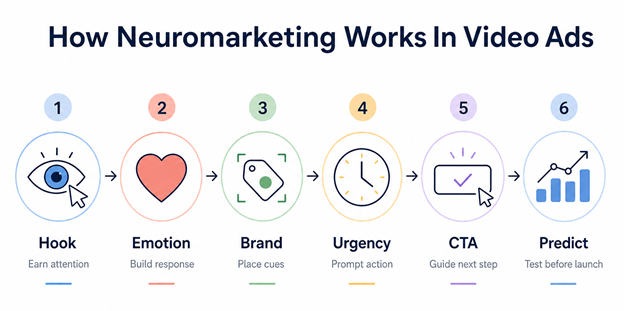
In video advertising, neuromarketing is used to channel audience-response data into better creative decisions. Although understanding the principles is important, those principles only improve results when teams apply them to real creative choices.
The steps below show how top teams use neuromarketing tools to move from theory to execution.
1. Capture Attention in the First Few Seconds

The first frame in every video ad is the attention bid as viewers decide within seconds whether to keep watching. Strong openings use visual cues that trigger involuntary attention, such as faces, motion, contrast, or unexpected elements.
These cues work because the brain responds quickly to human presence, visual change, and anything that breaks a familiar pattern. When the opening frame starts with a clear problem scene, bold movement, expressive face, or visible product use, it catches attention early.
Teams should also avoid slow logo intros, abstract visuals, or delayed product reveals. These make the first few seconds unclear, giving the rest of the video less chance to build interest.
Neurons AI attention heatmaps help teams verify first-frame attention before videos go live. These heatmaps show where viewers are likely to look first, making weak openings, hidden products, and missed brand cues easier to identify.
With this insight, teams can adjust the first frame, improve visual hierarchy, and choose the version most likely to earn attention early.
Download this ebook to learn how to draw, measure, and convert attention in advertising
2. Trigger Strong Emotional Responses

Neuromarketing shows that people do not make decisions based on logic alone. In video ads, emotions shape whether viewers care about the message, remember it, and feel motivated to act.
This happens because the amygdala, the part of the brain that processes emotional importance, helps decide which experiences deserve stronger memory. When a video creates the right emotional signal, the message becomes easier to recall.
Teams build this response by combining emotional cues that support the same feeling. The main elements are outlined below.
- Authentic Facial Expressions: Human faces trigger mirror neurons, making viewers reflect the emotion they see on screen. Video ads featuring authentic expressions, such as a smile, are recognized quickly by viewers due to familiarity. This makes the scenes more believable and establishes emotional connections early.
- Relatable Stories: When viewers recognize a familiar problem, desire, or outcome, the story feels closer to their own experience. This connection stimulates oxytocin, which supports trust and emotional bonding. In video advertising, relatable stories help the audience care about the product because the message feels tied to a real situation.
- Music: Music influences how people react before they process every visual detail. Upbeat tempo activates the brain’s reward system, making the video feel more energetic and positive. Slower minor-key melodies support empathy and reflection and are useful when the message needs a softer emotional tone.
- Color Choices: Colors cue the brain on how to feel before the story becomes clear. Bright, high-contrast visuals like yellow, red, and orange create energy, urgency, or excitement. Softer colors like blue, green, and muted neutrals make a scene feel calmer or more reassuring.
The best approach is to test different combinations before launch. With neuromarketing in video ads, teams identify which mix of faces, story, music, and color creates the strongest positive emotional effect.
Check out this guide on how to test ad creatives
3. Place Brand Elements in the Attention Path

When a video ad creates strong emotion and memory without a clear brand presence, viewers remember the story without linking it to the brand. This happens when brand elements are missing from the moments that attract the most attention.
In that situation, the ad earns attention and emotion, but the brand loses attribution because viewers cannot connect the response to the product, logo, or message.
To prevent this, place brand elements like logos, products, claims, and CTAs in the areas where eye-tracking reveals viewers pay the most attention.
The brand should also be integrated into the narrative rather than added as a late overlay. A product in use, branded packaging, a repeated color system, or a message tied to the story makes the brand feel part of the scene.
This is especially important in sound-off environments, where viewers watch without audio. In these settings, visual brand identity must carry more of the message through colors, product cues, typography, and on-screen text.
Neurons AI helps solve this with Automatic Brand Tracking and AOI Detection. The feature detects logos, products, and selected areas of interest, helping teams see whether brand assets appear where attention is strongest.
When teams validate brand placement before launch, the video has a better chance of turning attention and emotion into brand recall.
See how Neurons' AOI feature lets you track any element in your videos in minutes
4. Create Urgency With Scarcity and Social Proof

When opportunities feel limited, the brain gives them more attention because losing access feels costly. This is why scarcity and urgency make an offer feel more valuable and harder to ignore.
Urgency is time-focused, while scarcity focuses on limited access. In video ads, urgency can be created with limited-time offers, exclusive promotions, countdowns, low-stock messages, or early-access cues.
These elements work best when the viewer understands why acting now is useful. Urgency deadlines should explain what ends, while scarcity cues should show what becomes unavailable.
Brands also pair scarcity with social proof because people trust offers faster when others have used, reviewed, or shown interest in them.
For example, a video can combine a limited-time discount with customer reviews, user counts, waitlist numbers, or testimonials. This helps the offer feel both time-sensitive and socially validated.
Neuromarketing tools help teams validate whether urgency and scarcity cues create the right response. If countdowns increase attention but reduce trust, the team can adjust the framing before launch.
Teams should also test where these cues appear in the video. A countdown at the opening creates quick interest, while a deadline near the CTA strengthens the final push.
The strongest urgency cues are clear, believable, and relevant to the offer. If the pressure looks artificial, viewers will either ignore the message or question the brand.
5. Engineer Clear and Persuasive Calls-to-Action
A video ad can hold attention, create emotion, and explain the offer, only for a weak CTA to make it miss its marketing goal.
Since viewers often remember the peak moment and ending more than the full story, the final prompt needs to guide the next action clearly.
This is why teams should test CTA wording to see which version creates stronger intent. “Book a Demo,” “See How It Works,” and “Start Testing” each create a different expectation, so the best option depends on the offer and audience.
Generic CTAs like “Click Here” or “Learn More” feel weaker because they do not explain the value of the action. A stronger CTA tells viewers what they will get after they click, book, start, or sign up. For example, “See How It Works” sets a learning expectation, while “Book a Demo” signals a more direct sales action.
Placement also affects CTA performance. The prompt shouldn't appear too early, too late, or outside the viewer’s attention path. The best placement connects the next step to the moment when interest is already high.
Another factor to consider is visual treatment. Button contrast, motion, size, and surrounding copy should make the CTA easy to notice without making the action feel harder.
Lastly, teams should check whether the CTA matches the emotional tone of the video. A high-energy product ad might need a direct CTA, while a trust-focused message might perform better with a softer next step.
6. Use Neuromarketing Tools
Traditional neuromarketing is expensive and slow because it requires labs, participant recruitment, specialized equipment, and research teams. For brands working with short production timelines, that process can be difficult to run before every campaign.
Predictive AI makes neuromarketing video advertising easier to apply at scale. Instead of testing every video in a lab, teams use tools trained on large neuroscience datasets to predict how viewers will respond.
A typical workflow starts with uploading the video creative into a predictive AI platform. The tool then analyzes attention, memory, brand visibility, and creative impact, helping teams see where the video is strong or weak.
This step is useful when brands need to test different edits, hooks, or endings without slowing the review process. From there, teams compare versions, identify weak frames, improve brand placement, and decide which creative changes deserve attention. As a result, creative decisions happen earlier, while changes are still easier and less expensive to make.
With predictive tools, brands bring neuroscience into daily creative review and make faster decisions before launch.
Discover how Neurons AI predicts video ad performance with over 95% accuracy
How Does Neurons AI Apply Neuromarketing to Video Advertising?

Neurons AI applies neuromarketing to video advertising by predicting how people will respond to a video before it goes live. Built on consumer neuroscience, the platform helps teams predict attention, memory, and brand visibility before committing media budget.
The platform delivers results in seconds with over 95% prediction accuracy, making it useful for teams that need fast creative feedback. This matters in video advertising because performance depends on how each frame guides the viewer’s response.
Neurons AI is uniquely suited to video testing because it does not simply evaluate the final ad as one asset. The platform helps teams evaluate how attention changes across the video, where brand elements appear, and which version has a stronger predicted impact.
The key Neurons AI video testing features are outlined below.
- Frame-by-Frame Attention Heatmaps

Heatmaps show where viewers are likely to look across different moments in the video. The attention data shows whether focus moves toward the product, logo, message, or CTA at the right time. A team reviewing a product launch video can check whether viewers notice the product during the opening scene or get distracted by background movement.
- Automatic Brand Tracking and AOI Detection
This feature detects logos, products, and areas of interest without heavy manual setup. It helps teams confirm whether viewers notice brand assets during the moments that matter most. Automatic brand tracking reduces the risk of running a video where the brand is technically visible but still easy to miss.
- Manual Video AOIs
Manual Areas of Interest let teams select specific parts of a video for closer analysis. A team can track a product, claim, package, logo, or CTA across selected scenes. This method gives teams more control when they need to measure a specific visual element that automatic detection does not fully capture.
This feature is particularly important for videos because one scene can contain several competing elements. Manual AOIs help teams isolate the exact object, claim, or CTA they want to measure
- Memory Score
Memory Score predicts how likely the video is to be remembered after viewing and whether the final message stays clear after the ad ends. Teams use it to determine which creative version inspires stronger recall. This metric is useful when two videos look similar but differ in pacing, emotional peak, product timing, or final message.
- Attention Score
Attention Score shows how well the creative captures focus, helping teams find scenes with weak openings, unclear hierarchy, or poor pacing. A low attention score indicates that the creative needs a clearer first frame or stronger visual contrast.
- Neurons Impact Score
Neurons Impact Score gives teams a broader prediction of creative performance by comparing variants when teams need one simple view of expected impact. This score is useful during stakeholder reviews because teams can compare creative routes without relying only on personal opinion.
- Side-by-Side Variant Comparison

Side-by-side comparison allows teams to review multiple video versions together, making it easier to choose the version with stronger attention, memory, and brand signals. For instance, a team can compare two edits and prioritize the one with stronger brand visibility during the final CTA.
This comparison is useful when two versions share the same message but use different openings, pacing, or final frames.
A typical Neurons AI workflow is outlined below.
- Upload the video creative or several video variants into the platform.
- Review frame-by-frame attention heatmaps to see where viewers are likely to look.
- Use Automatic Brand Tracking and AOI Detection to check brand visibility across key scenes.
- Add Manual Video AOIs when specific products, claims, packages, logos, or CTAs need closer tracking.
- Compare Memory Score, Attention Score, and Neurons Impact Score across variants.
- Review video insights and recommendations to identify weak frames, cluttered scenes, or missed brand moments.
- Adjust the edit, improve brand placement, or simplify scenes that create too much visual competition.
- Retest the stronger version before launch or compare it against another creative route.
This workflow gives creative, media, and brand teams a shared view of what needs to improve. Instead of switching between disconnected tools, teams review attention patterns, brand visibility, memory signals, and predicted impact in one place.
There is also a clearer view of what to adjust, which assets deserve spend, and whether visibility and recall are strong enough.
For brands considering neuromarketing in video ads, Neurons AI makes predictive creative testing easier to apply. The platform turns neuroscience data into clear, creative actions, helping teams improve video performance before media spend begins and reduce the risk of wasted budget.
See how neuromarketing can optimize your videos; book a free Neurons AI demo today