Brand performance metrics are measurable indicators used to evaluate how effectively a brand builds awareness, perception, engagement, loyalty, and long-term growth. These metrics focus on a brand's long-term strength and influence, rather than short-term marketing performance metrics such as clicks or conversions.
Marketing performance metrics reflect immediate campaign outcomes such as cost per acquisition, click-through rate, and return on ad spend. Brand metrics, on the other hand, measure how well a brand performs in the market using indicators such as brand recall, sentiment, and market penetration.
By tracking brand performance metrics, organizations can better understand how visible their brand is in the market, how consumers perceive it, and how strong their customer relationships become over time.
To comprehensively evaluate brand performance, marketers analyze multiple metrics across the customer journey. These metrics include awareness, perception, engagement, brand health, loyalty, and growth metrics.
They also incorporate AI-driven measurement, which uses predictive analytics to evaluate attention, recall, and the potential impact of creative assets before campaigns are launched.
How brand building drives long-term business growth
Why Do Companies Need Brand Performance Metrics?

Brand performance metrics allow organizations to evaluate the long-term impact of marketing strategies, ensuring that brand-building activities contribute to sustainable growth and a stronger brand.
This is critical because a strong brand fosters deeper customer loyalty and increases market share. Additionally, when a brand is well-established and positively perceived, it can command higher prices because customers associate it with quality and reliability.
With brand metrics, organizations can evaluate brand strength, track shifts in perception, measure marketing effectiveness, detect brand decline early, and guide long-term strategy.
- Evaluate Brand Strength: Brand metrics help organizations determine if their brand is becoming more trusted in the market.
- Track Shifts in Consumer Perception: Monitoring sentiment and favorability reveals how audiences perceive the brand, allowing companies to track shifts and changes.
- Measure Marketing Effectiveness: Brand metrics reveal whether marketing campaigns are improving brand visibility and reputation.
- Detect Early Signs of Brand Decline: Measuring metrics helps brands identify declining awareness or sentiment that may signal emerging issues before they affect revenue.
- Guide Long-Term Brand Strategy: Insights from brand metrics help companies refine positioning, messaging, and customer experiences.
What Framework Should Marketers Use to Measure Brand Performance?
To measure brand metrics, marketers must use a framework that organizes them into strategic stages: awareness, perception, engagement, loyalty, and growth.
These stages correspond with key aspects of the customer journey, helping marketers understand how brand interactions evolve from initial exposure to long-term relationships.
The brand measurement framework can be visualized as a funnel, where each stage represents a deeper level of customer relationship, from awareness to long-term growth
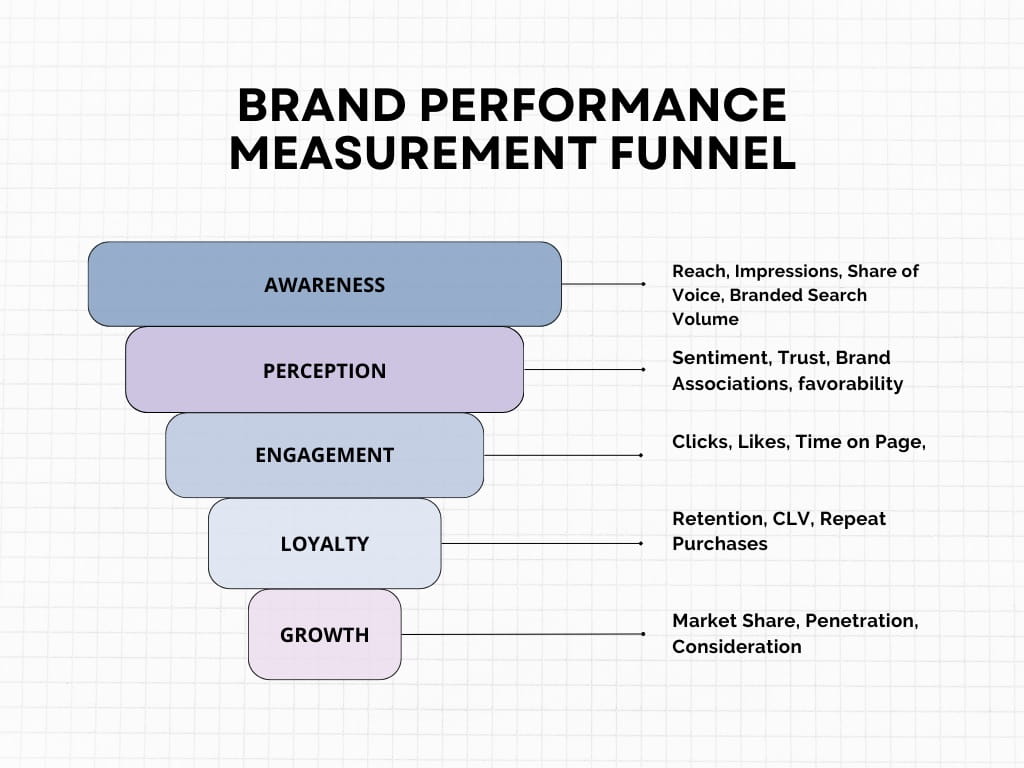
For a complete and accurate understanding of brand performance, marketers must avoid focusing on a single metric or stage in isolation.
What Are the Most Important Brand Metrics Marketers Should Track?
Marketers rely on a range of brand metrics to evaluate performance across the entire customer journey. No single metric can capture the full picture because brand strength is built through multiple interactions over time. Using a combination of indicators helps them understand how effectively a brand is influencing consumer behavior at every stage.
The 11 key brand metrics commonly used by marketing teams are outlined below.
- Brand awareness
- Brand recall
- Brand sentiment
- Brand engagement
- Share of voice
- Brand loyalty
- Customer lifetime value
- Brand consideration
- Brand attention
- Brand lift
- Brand penetration
Together, these metrics form a comprehensive framework for evaluating brand health and identifying opportunities for improvement. In the sections that follow, each of these metrics will be explored in detail, showing how they contribute to a deeper understanding of brand performance.
What Are Brand Awareness Metrics?

Brand awareness metrics measure how visible and recognizable a brand is within its target market. These metrics answer a simple but critical question: Do people know this brand exists?
Awareness metrics sit at the top of the brand funnel, focusing on exposure. These metrics measure how well a brand is seen, noticed, and remembered, which directly affects whether a brand will be considered when making a purchasing decision.
Brand awareness metrics and how marketers measure brand visibility
Reach and Impressions
Reach measures the number of unique individuals who are exposed to a brand or its content over a specific period. For example, if 100,000 different people see a campaign, the reach is 100,000. This metric indicates how many distinct potential customers a brand can connect with.
Impressions, on the other hand, measure the total number of times brand content is displayed, regardless of whether the same person sees it multiple times. If one individual sees an ad five times, that counts as five impressions but only one reach.
Reach and frequency (the number of times individuals are exposed to content) play a critical role in building brand recall. Reach ensures broad visibility, while repeated impressions reinforce memory. Consumers need to encounter a brand multiple times before they remember it.
Share of Voice (SOV)
Share of voice (SOV) measures how visible a brand is compared to its competitors within a specific market or channel. It provides a relative view of brand presence, helping marketers understand whether their brand is dominating or losing visibility in the competitive landscape.
SOV is typically calculated as a percentage of total market visibility, i.e., (Your Brand Activity / Total Category Activity) X 100.
SOV is calculated across advertising, search, and social channels. Marketers tweak the formula depending on the channel involved. For instance, SOV across advertising channels is calculated with SOV = (Your Impressions / Total Category Impressions) X 100.
Branded Search Volume
Branded search volume measures how often people search for a brand name or branded terms in search engines. This metric is a strong indicator of brand interest and demand, as it reflects users' intentional behavior in actively seeking out the brand.
Marketers track branded search volume using SEO tools like Google Search Console, Ahrefs, and Google Trends. These tools provide visibility into search behavior and trends, helping marketers understand how often their brand is actively searched for.
Brand Recognition and Recall
Brand recognition measures whether consumers can identify a brand when they see it. This insight reflects familiarity and is generally easier to achieve.
Brand recall, by contrast, measures whether consumers can remember a brand without any prompts. Because recall requires consumers to retrieve the brand from memory independently, it is considered a stronger and more meaningful indicator of awareness.
Surveys are the primary method for measuring both recognition and recall. Measuring recognition involves showing respondents a list of brands, logos, or advertisements and asking which ones they recognize. Recall, on the other hand, is measured by asking respondents to name the brands that come to mind in a given category, e.g., “Which brands come to mind when you think about skincare products?”
Measuring recognition and recall helps marketers understand not only whether their brand is visible, but also whether it is memorable enough to influence future purchasing decisions.
What Are Brand Perception Metrics?

Brand perception metrics measure how consumers think and feel about a brand. These metrics reveal whether they trust, like, or associate a brand with good qualities.
Understanding brand perception is essential for evaluating both brand positioning and reputation. These metrics help organizations determine whether their intended positioning aligns with how audiences actually perceive and experience the brand.
They also reveal how well a brand is differentiated in a crowded market, the level of value consumers associate with it, and how resilient it remains during periods of crisis or heightened competition.
How marketers measure brand perception and sentiment
Brand Sentiment
Brand sentiment measures the overall tone of conversations about a brand, typically categorizing them as positive, neutral, or negative. It reflects how people feel when they talk about the brand across digital platforms such as social media, forums, reviews, and news outlets.
For example, a surge in positive sentiment may indicate successful campaigns or favorable public relations. On the other hand, an increase in negative sentiment may signal customer dissatisfaction or reputational issues.
Brand Favorability and Trust
Brand favorability measures the degree to which consumers hold positive attitudes toward a brand. It is typically assessed through surveys that ask respondents to rate their perceptions of the brand on a scale from very favorable to very unfavorable.
Brand trust reflects whether consumers believe a brand is reliable, consistent, and capable of delivering on its promises. Trust is built over time through product quality, customer experience, transparency, and communication. Brands with high trust levels are more likely to retain customers, generate referrals, and maintain resilience in competitive markets.
Brand Associations
Brand associations are the attributes, qualities, and ideas that consumers mentally link with a brand. These associations can be functional (such as durability or affordability) or emotional (such as excitement, prestige, or comfort).
Strong and consistent brand associations help differentiate a brand from competitors and reinforce its positioning.
What Are Brand Engagement Metrics?

Brand engagement metrics measure how actively audiences interact with a brand and its content. These metrics reveal whether audiences are paying attention and taking action.
High engagement indicates that content resonates with the audience, encourages participation, and builds stronger connections between the brand and its customers.
Brand engagement metrics that measure audience interaction
Social Media Engagement
Social media engagement is one of the most visible ways to measure how audiences interact with a brand’s content. Metrics such as likes, comments, shares, and saves each reflect different levels of audience interest and involvement.
Likes indicate quick approval or appreciation, while comments suggest deeper interaction and conversation. Shares show that users find the content valuable enough to distribute to others, expanding its reach, and saves reflect a stronger intent to revisit or reference the content later.
Content Interaction Metrics
Content interaction metrics, like scroll depth and click-through rate, measure how well content on websites and other digital platforms captures attention and encourages deeper exploration.
CTR measures the percentage of users who click a link or take action on a call to action, indicating how compelling the content or offer is. Scroll depth shows how far users move down a page, helping marketers understand how much of the content is being consumed. Time on page reflects how long users stay engaged, offering a strong signal of content relevance and value.
Together, these metrics reveal whether content is holding attention and motivating users to interact more deeply.
Video Engagement Metrics
Video engagement metrics indicate how well video content captures and sustains audience attention. Two of the most important indicators are watch time and video completion rate.
Watch time measures the total amount of time viewers spend watching a video, providing a clear signal of overall interest and engagement. Video completion rate is the percentage of viewers who watch the video to the end, reflecting how engaging the content is.
High watch time and completion rates suggest that the video resonates with the audience, maintains their attention, and delivers value throughout its duration.
What Are Brand Health Metrics?

Brand health metrics measure the strength and quality of the relationship between a brand and its customers. These metrics indicate whether a brand is building meaningful, lasting relationships or simply generating short-term attention.
A brand may be well-known and widely discussed, but if customers are dissatisfied or emotionally disconnected, its long-term performance will suffer. Brand health metrics help organizations monitor these deeper dynamics and ensure that customer relationships remain strong over time.
Brand health metrics that measure long-term brand strength
Net Promoter Score (NPS)
Net Promoter Score measures a customer’s willingness to recommend a brand to others, making it a strong indicator of overall satisfaction and loyalty. A higher score indicates stronger customer advocacy and healthier brand relationships.
Customer Satisfaction (CSAT)
Customer satisfaction (CSAT) measures how satisfied customers are with specific interactions or with the overall brand experience. Unlike NPS, which focuses on recommendations, CSAT captures immediate reactions to touchpoints such as purchases, customer service interactions, or product usage. This metric is useful for identifying strengths and weaknesses in the customer experience.
Brand Affinity
Brand affinity measures the emotional connection customers feel toward a brand. While satisfaction reflects how well a brand meets expectations, affinity goes deeper by capturing how strongly customers identify with and feel attached to the brand.
This metric is a powerful indicator of long-term brand strength because emotional connections are harder for competitors to replicate than functional benefits alone.
What Are Brand Loyalty Metrics?
Brand loyalty metrics measure repeat purchase behavior and sustained brand preference over time. These metrics are critical for understanding the long-term strength of customer relationships and the brand’s ability to retain its audience.
Strong brand loyalty reduces customer acquisition costs, increases revenue stability, and drives higher advocacy through word of mouth. By tracking loyalty metrics, organizations determine whether they are successfully converting first-time buyers into repeat customers and long-term brand advocates
Brand loyalty metrics that measure customer retention
Customer Lifetime Value
Customer lifetime value (CLV) measures the total revenue a customer is expected to generate throughout their relationship with a brand. Rather than focusing on individual transactions, CLV provides a long-term view of customer value.
A higher CLV indicates that customers are making repeat purchases, staying with the brand longer, and contributing more revenue over time. This makes CLV a crucial metric for evaluating the effectiveness of retention strategies and customer experience initiatives.
Repeat Purchase Rate
Repeat purchase rate measures the percentage of customers who return to buy from the brand more than once within a given period. It is one of the most direct indicators of brand loyalty.
When customers repeatedly choose the same brand, it signals satisfaction, trust, and preference. High repeat purchase rates suggest that the brand is consistently delivering value and meeting customer expectations.
Retention Rate
Retention rate measures the percentage of customers who continue to engage with or purchase from a brand over a specific period. It reflects the brand’s ability to maintain long-term customer relationships. High retention rates indicate that customers are satisfied and see ongoing value in the brand, while low retention rates may signal dissatisfaction or stronger competition.
What Are Brand Growth Metrics?
Brand growth metrics measure whether brand-building efforts are translating into increased market presence and business expansion. These metrics are essential for determining whether a brand is gaining momentum, outperforming competitors, and successfully converting awareness and engagement into tangible business results.
Brand growth metrics used to measure long-term brand expansion
Market Share Growth
Market share growth measures the increase in a brand’s share of total sales within its industry or category over time. It is a key indicator of competitive performance, showing whether a brand is gaining or losing ground in the marketplace.
Brand Penetration
Brand penetration measures the percentage of consumers within a target market who have purchased or used a brand during a specific period. It indicates how widely the brand is adopted across the market.
If, for example, 1 million consumers exist in a market and 200,000 have purchased the brand, the penetration rate is 20%.
Higher penetration suggests that the brand is reaching a broader audience and successfully converting awareness into actual usage.
Brand Consideration
Brand consideration measures whether consumers include a brand in their set of potential choices when making a purchase decision. It sits between awareness and actual purchase in the customer journey.
A consumer may be aware of many brands but only consider a few when deciding what to buy. High consideration indicates that the brand is perceived as a credible and relevant option.
How Can AI Measure Brand Performance More Accurately?
zAI has improved brand performance measurement by making it predictive rather than reactive. Traditional methods like surveys and focus groups rely on post-campaign feedback, while AI analyzes behavioral patterns, attention, and cognitive responses to predict how audiences will respond before campaigns launch.
By combining machine learning with neuroscience insights, marketers can evaluate and optimize creative earlier, reducing wasted spend and improving campaign effectiveness.
Neurons AI platform for measuring brand attention and advertising impact
Brand Attention Metrics
Brand attention metrics measure how much cognitive focus an ad captures, specifically whether people notice key elements like the logo, product, or message. AI tools predict viewer attention by analyzing factors such as layout, contrast, and motion, often using heatmaps to simulate eye-tracking and highlight where focus is likely to go.
Brand Recall Metrics
Brand recall metrics measure how likely audiences are to remember a brand after exposure to its advertising. These models assess factors like the prominence of brand elements and the clarity of messaging to predict which ads are likely to leave a lasting impression.
The Neurons Impact Score

The Neurons Impact Score is an AI-driven, neuroscience-based metric that evaluates how effectively creative assets capture attention and drive brand impact. It combines data on visual attention, cognitive engagement, and memory formation to provide a predictive score of advertising effectiveness.
How Do Marketers Track Brand Performance Over Time?
Marketers track brand performance over time through brand tracking, a continuous monitoring and analysis of key brand metrics.
Brand tracking programs measure core dimensions like awareness, perception, and loyalty at regular intervals, such as monthly or quarterly, depending on the organization’s goals and resources. Tracking these dimensions regularly provides marketers with a holistic understanding of how the brand is performing across the customer journey.
Continuous brand tracking also provides the insights needed to make informed, data-driven decisions and ensures that brand strategy remains aligned with changing market conditions.
How Should Marketers Choose Which Brand Metrics to Track?
With many brand metrics available, choosing the right ones requires a structured approach. A 5-stage step-by-step framework to achieve this is outlined below.
- Define Clear Strategic Goals: Identify what the organization aims to achieve so metrics align with business priorities.
- Map Metrics to the Brand Funnel: Match metrics to each stage of the customer journey to ensure full-funnel measurement.
- Prioritize a Focused Set of Metrics: Select a small number of key indicators that drive the most valuable insights.
- Ensure Consistency in Measurement: Track metrics consistently using the same methods over time to enable accurate comparisons and trend analysis.
- Connect Metrics to Business Outcomes: Link brand metrics to outcomes such as revenue, retention, and market share to demonstrate impact.
At its core, choosing the right brand metrics is about alignment and consistency. When metrics are tied to strategic goals and tracked over time, they become powerful tools for guiding brand strategy, optimizing marketing investments, and driving long-term growth.
How brand strategy determines which brand metrics matter most