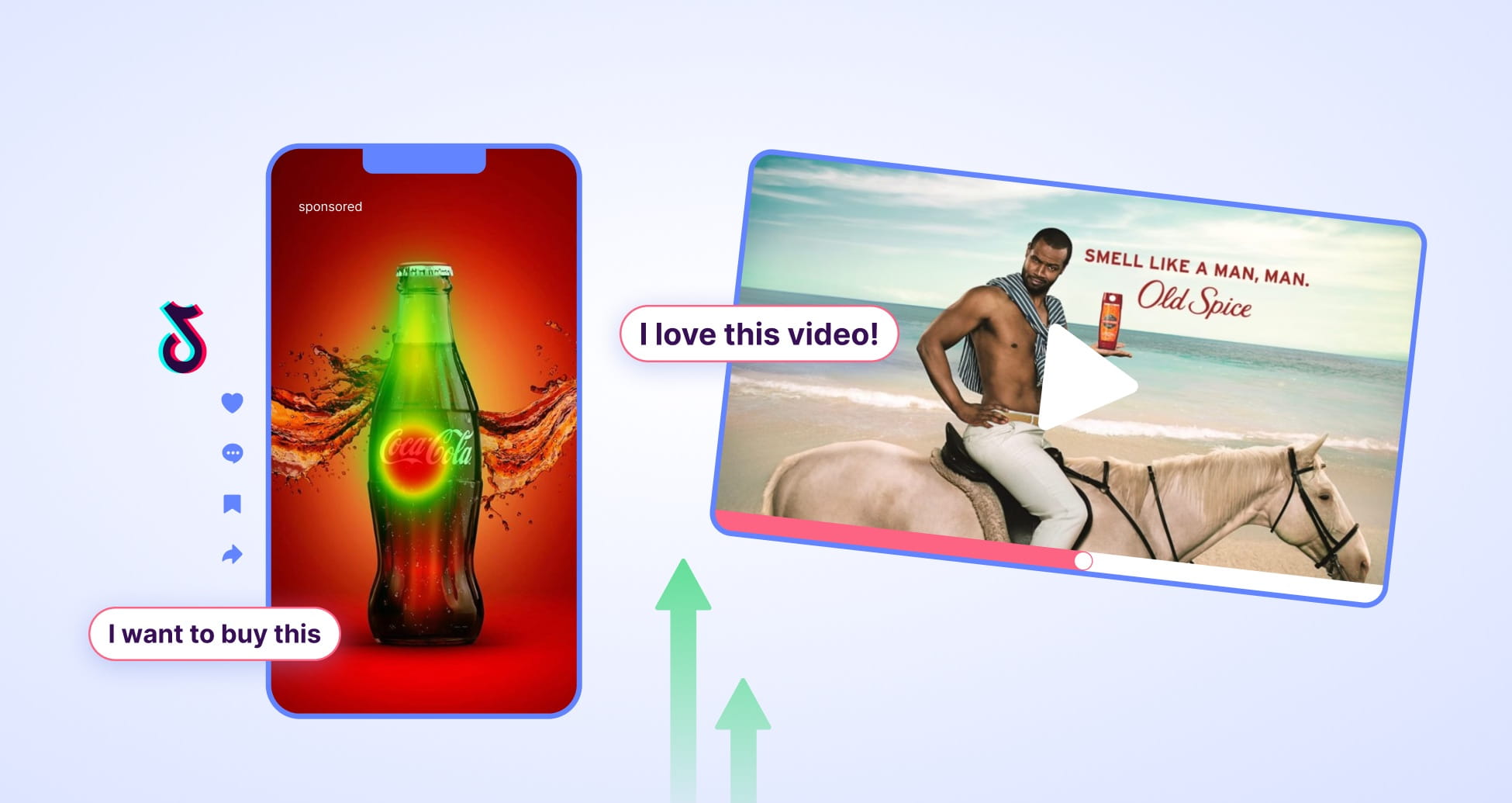
Producing a high-quality video ad takes time, creative effort, and a significant media budget. Without testing, brands risk committing major media investments before knowing how audiences will respond.
Testing video ads helps brands identify critical creative issues before campaigns go live and validate performance with real audiences afterward. This approach reduces creative risk, improves decision-making, and increases confidence before scaling campaigns.
This guide explains how to test video ads in six simple steps, from planning and pre-launch validation to live testing, results analysis, and campaign optimization.
Read our complete guide to ad testing
Why Do You Need To Test Video Ads?
You need to test video ads to identify the creative that captures attention, drives engagement, and achieves your campaign goals.
The main benefits of testing video ads are outlined below.
- Improved Click-Through Rate (CTR): Testing different hooks, messages, visuals, and calls to action shows which version gives viewers the most persuasive reason to click.
- Higher Completion Rates: Testing reveals where viewers lose interest before the video ends, helping teams fix slow openings, unclear scenes, weak pacing, or message gaps.
- Better Conversions: Testing helps confirm whether the offer, product benefit, proof point, and call to action (CTA) support the campaign goal.
- Stronger Cost Efficiency: Testing gives teams clearer evidence before increasing spend, making it easier to allocate more budget to ads with stronger signals.
Without testing, you rely on opinion, stakeholder preference, or past campaign assumptions, making performance harder to judge. Since video costs more to produce than static creatives, poor performance also wastes a larger share of the budget.
Testing, therefore, gives you evidence to support stronger creative decisions while reducing costs.
Discover the costly psychology mistakes in advertising
What Makes a Video Ad Effective?
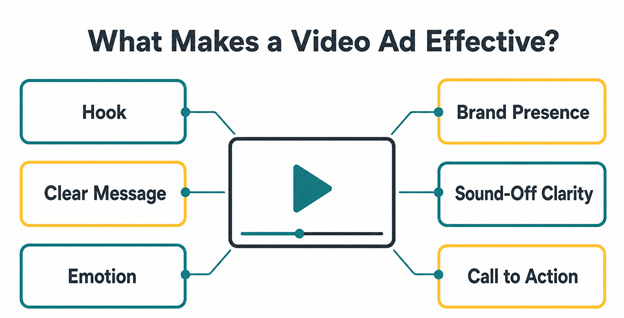
An effective video ad captures attention quickly, communicates a clear message, and motivates viewers to take action. These foundations should be in place before testing begins.
The 10 key elements of an effective video ad are outlined below.
- Attention-Grabbing Hook
Capture attention within the first few seconds. An unexpected visual, intriguing question, or bold statement encourages viewers to keep watching.
- Clear Value Proposition
Tell viewers what you’re offering and why it matters. A clear value proposition gives audiences a clear understanding of the benefit.
- Emotional Connection
Use emotions such as curiosity, excitement, humor, or empathy to make your message more memorable. Emotional storytelling increases engagement and recall.
- Benefit-Driven Messaging
Focus on how the product or service improves the viewer’s life instead of simply listing features. Audiences respond better when they understand the value.
- Strong Visual Storytelling
Support your message with purposeful visuals that guide viewers through a clear narrative. Every scene should reinforce the main idea.
- Sound-Off Viewing Elements
Many users watch videos with the sound off. Captions, text overlays, and on-screen graphics help communicate the message even without audio.
- Compelling Call-to-Action
End with a clear next step, such as visiting a website, signing up, or making a purchase. A strong call-to-action gives viewers a clear direction after watching.
- Brand Integration Without Disruption
Introduce your brand naturally throughout the video instead of relying only on an ending logo. Consistent branding improves recognition without interrupting the viewing experience.
- Proper Length and Pacing
Keep the video concise and maintain a steady pace. Every second should support the campaign objective.
- Cultural Relevance and Audience Fit
Adapt your messaging, visuals, and tone to your target audience. A video that reflects audience preferences, language, and cultural context resonates more and drives better results.
Learn how to improve your ad creatives with data-backed strategies
How Do You Test Video Ads?
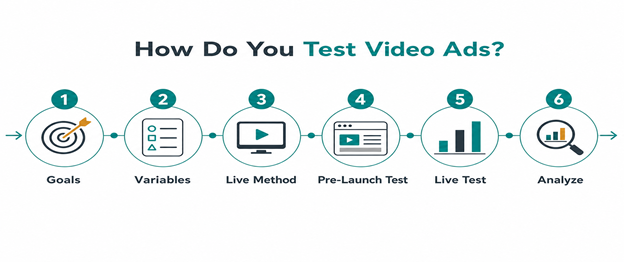
To test video ads properly, you need a sequence that connects creative goals, test variables, pre-launch validation, live testing, and optimization. The six steps below provide a repeatable framework for testing video ads before and during a campaign.
1. Set Clear Goals and Hypotheses
Clear goals define what the test needs to prove and which results the team should measure.
To do this, start by defining the campaign objective. For awareness, monitor reach, video views, brand recall, or hook rate. If the objective is generating traffic, track click-through rate (CTR) and landing page visits. For conversions, monitor purchases, sign-ups, demo bookings, cost per acquisition (CPA), or return on ad spend (ROAS).
After the objective is clear, set a clear and testable hypothesis. A strong hypothesis states what result should improve, the expected level of improvement, and the reason behind the prediction. For example, “Adding on-screen captions will increase the average watch time by 12% among mobile users because many viewers watch videos without sound.”
A simple template to follow is: “Changing [test variable] will improve [metric] by [expected result] because [reason].”
This structure keeps the test connected to measurable business goals. Instead of judging the ad by internal opinions, the team can objectively measure whether the creative supports awareness, traffic, or conversions.
Watch our webinar on data-driven video advertising
2. Determine What You’re Testing
Determining what you're testing beforehand prevents the test from becoming too broad and makes the result easier to interpret.
The main video ad variables include the hook, first frame, video length, call to action (CTA), captions, text overlays, music, sound, product framing, and offer. Each variable affects a different part of ad performance, so the test should focus on the one that directly influences the campaign goal.
The hook and first frame shape early attention, while the CTA, offer, and product framing influence clicks and conversions.
Each test should focus on one major variable at a time. Changing multiple variables at once makes it hard to detect what caused the result change. Instead, start with the top-priority variable, then test the next one after the first result is clear.
When using a multivariate test, keep the combinations limited for easier result interpretation
3. Choose Your Live Testing Method
Next, choose the live testing method that aligns with the goal, budget, audience size, and confidence level.
The main live testing methods are outlined below.
- A/B Testing: A/B testing compares two versions of a video ad with one major difference, such as the hook, call to action (CTA), or first frame. Use this method when you need a clear comparison between two creative variations. The results are easy to interpret, although additional tests are needed to evaluate other variables.
- Multivariate Testing: Multivariate testing compares several variables or creative combinations in one test. Teams with enough traffic, budget, and creative volume get broader learning from this method. The limitation, however, is that each additional variable increases the amount of data required for reliable results.
- Platform Split Testing: Platform split testing uses built-in tools on platforms such as Meta, TikTok, YouTube, or LinkedIn. This method is best suited for live platform comparisons because the ad runs in its real delivery environment. However, algorithmic delivery may influence results if the setup is not controlled.
- Brand Lift Testing: Brand lift testing measures changes in awareness, recall, consideration, or purchase intent. This method provides deeper insights into brand impact, although it requires larger audiences, more time, and higher budgets.
- Incrementality Testing: Incrementality testing measures whether the campaign caused results that would not have happened without the ad. Major budget increases are the best time to use this method. The value is stronger proof of effect, but reliable results need careful setup, control groups, and enough conversion data.
4. Test Your Video Creative Before Going Live

Pre-launch validation is an important part of an effective ad testing strategy. At this stage, the goal is to identify weak creative signals before media spend begins.
Traditional qualitative methods, such as surveys, focus groups, and interviews, help teams understand audience opinions, message clarity, and overall response before launch. However, these methods take longer, cost more to run at scale, and rely on self-reported feedback.
Modern predictive tools make pre-launch validation faster by analyzing likely audience response before an ad goes live. This approach lets teams review attention, memory, clarity, and brand visibility while changes are still easier to make.
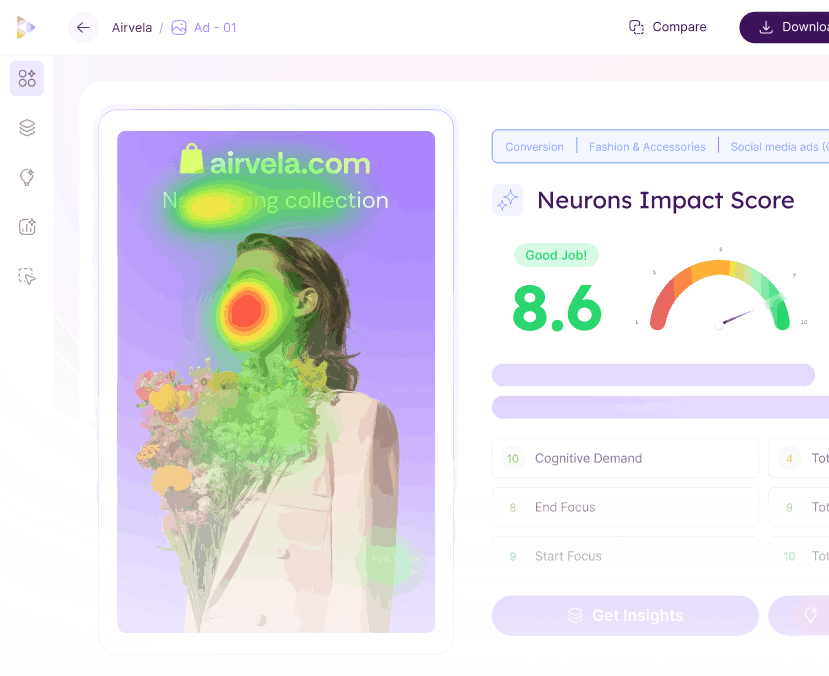
Neurons AI is a leading neuroscience-based predictive tool. The platform analyzes static and video ads using behavioral data to identify weak hooks, unclear messages, poor brand placement, and high cognitive demand.
Compared with traditional methods, Neurons AI delivers faster feedback and reduces the cost of testing multiple creative versions.
By identifying creative issues before launch, pre-launch validation gives live testing a stronger starting point and supports more confident creative decisions.
Get frame-by-frame attention insights with Neurons AI
5. Run the Live Test
This stage reveals how the video performs with real audiences, placements, delivery systems, and auction conditions. To produce reliable results, the test setup should match your campaign goal, selected variable, and target audience.
Allocate enough budget to reach a meaningful sample size and run the test long enough to collect reliable data. At the same time, keep targeting, placements, bidding, and delivery settings consistent so you can attribute performance differences to the creative instead of changes to the campaign setup.
Once the test is live, keep monitoring performance without interfering too early. Avoid changing budgets, audiences, or creatives until enough data has been collected. Early adjustments can reduce confidence in the results.
See how ad testing works across digital platforms, including YouTube, Meta, and TikTok
6. Analyze Results and Optimize
After running your live test, analyze the results to identify the strongest creative and uncover opportunities for further optimization. Learning how to test video ads effectively also means interpreting the data correctly and applying those insights to future campaigns.
Start by comparing your results against the goals and success metrics you defined before testing. To identify a true winner, look for meaningful improvements across multiple metrics instead of relying on a single result. This approach gives a more complete picture of creative performance.
Once you identify a winning creative, keep testing by comparing it against a new challenger. This approach uncovers improvements and builds stronger creatives over time.
Finally, scale winning creatives gradually while monitoring performance as budgets increase. Document each test by recording the hypothesis, creative variations, audience, metrics, and results. This creates a knowledge base that strengthens future testing and helps teams avoid repeating the same mistakes.
Explore how to measure ad impact reliably without digital tracking
What Are the Key Metrics To Track When Testing Video Ads?
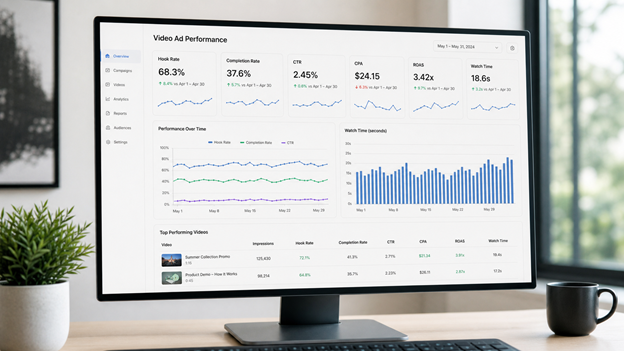
The key metrics to track when testing video ads include hook rate, view rate, hold rate, completion rate, and engagement metrics, among others.
These metrics are outlined below.
- Hook rate measures how many viewers continue watching after the opening seconds. A higher hook rate indicates a stronger first impression.
- View rate shows the percentage of impressions that become video views. Higher view rates suggest the creative captures initial interest.
- Hold rate measures how well a video keeps viewers watching after the hook. Strong hold rates indicate that the content maintains attention.
- Completion rate measures the percentage of viewers who watch a video to the end. Higher completion rates reflect stronger storytelling and pacing.
- Engagement metrics include likes, comments, shares, saves, and clicks. These interactions show how audiences respond to the creative.
- Brand lift and ad recall measure changes in brand awareness and how well viewers remember the ad. Both metrics help evaluate long-term campaign impact.
- Conversion metrics include return on ad spend (ROAS), conversion rate (CR), and cost per acquisition (CPA). These metrics show whether engagement leads to business results.
- Average watch time measures how long viewers watch a video on average. Longer watch times usually indicate stronger audience interest.
- Quartile completion tracks the percentage of viewers who reach 25%, 50%, 75%, and 100% of a video. These milestones reveal where viewers begin to drop off.
The table below summarizes the performance benchmarks for the key video ad metrics.
Download the ultimate guide to smarter ads and higher CTRs
How To Use Neurons AI To Test Video Ads
Traditional testing alone is no longer enough in 2026 because video teams need faster, cheaper, and more accurate creative feedback. Surveys, focus groups, and live tests still have value, but they are often slower, costlier, and harder to scale.
Neuroscience-powered AI like Neurons changes this process by predicting how viewers are likely to notice, understand, and remember a video before launch. This helps teams test more versions faster, reduce research costs, and make creative decisions with stronger behavioral evidence.
To use Neurons AI to test and optimize video ads, follow the steps below.
- Upload the video creative.
- Review predictive scores for attention, memory, clarity, focus, engagement, cognitive demand, and brand visibility.
- Check frame-by-frame attention to see where viewers look, drop off, or miss key elements.
- Compare different hooks, edits, product shots, endings, calls to action (CTAs), or pacing choices.
- Turn the results into creative improvements.
- Retest the improved version before launch.
After the scores are reviewed, each result should translate into a specific creative action. A weak attention score may require a stronger opening, high cognitive demand may point to an overloaded message, and weak brand visibility may mean the logo, product, or key message needs earlier placement.
Neurons AI is a vital component of every complete ad testing framework. The platform helps teams improve the creative before live testing begins with a stronger, clearer, and better-validated video ad.
Schedule a free demo and optimize your next video ad
Common Mistakes to Avoid When Testing Video Ads

Even a well-planned test can produce misleading results if mistakes go unnoticed. The examples below are the most common.
- Assuming One Creative Works Everywhere: A video that performs well on one platform or audience may not perform the same elsewhere. Test creatives across different audiences and placements before scaling.
- Ignoring Mobile and Sound-Off Viewing: Most social media videos are viewed on mobile devices, often without sound. Optimize videos with captions, text overlays, and mobile-friendly framing.
- Skipping Hook Testing: The opening seconds determine whether viewers keep watching or scroll away. Test multiple hooks to identify which one captures attention most effectively.
- Relying on Intuition Instead of Data: Creative opinions can be helpful, but testing should guide final decisions. Always use performance data to validate assumptions before increasing media spend.
- Testing With Small Sample Sizes: Small audiences can produce misleading results because performance may reflect chance rather than genuine trends. Wait until enough data is available before choosing a winning creative.
Avoiding these mistakes helps produce more reliable testing results and stronger creative decisions. Explore Neurons AI to validate your video ads before launch with neuroscience-based predictive insights.