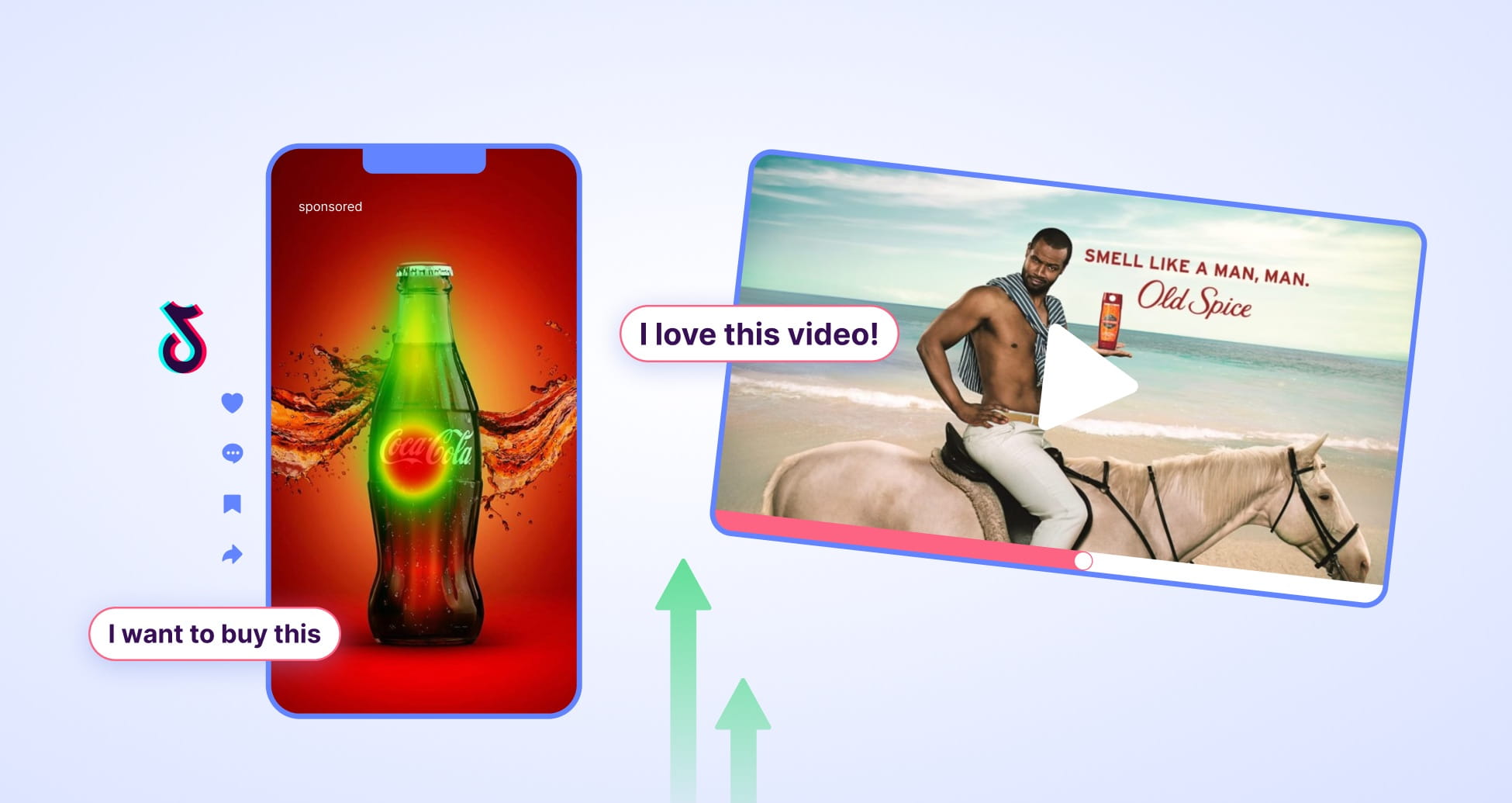
Research published by Kantar revealed that creative quality contributes nearly 50% of media impact, making it one of the biggest drivers of campaign performance. Yet many brands launch social media ads without testing whether the creative is clear, memorable, or strong enough to earn attention.
Since performance changes quickly on social platforms, weak ads waste unnecessary budget before teams can identify the creative element that needs improvement. Social media ad testing reduces this risk by helping teams validate creative ideas before and during live campaigns.
This guide explains how to test ads for social media in eight simple steps, covering creative development, validation, live testing, and scaling.
Explore the full range of ad testing approaches used by modern marketing teams
What Is Ad Testing?
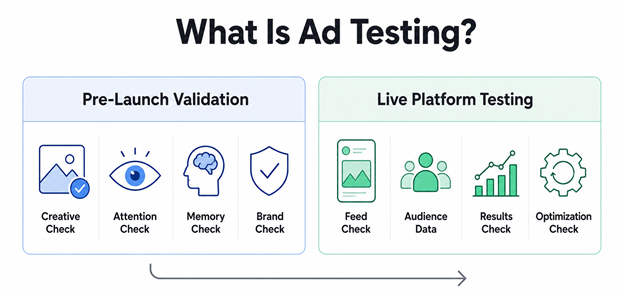
Ad testing is the evaluation of how an ad performs across creative, audience, placement, delivery, and campaign results. Creative testing focuses specifically on the hook, image, video, message, offer, format, and call to action.
Although the two terms are often used interchangeably, they are not the same. Creative testing falls under ad testing as creative quality shapes an ad's first response. For example, a Meta campaign can have accurate targeting, but a weak opening hook will still affect the overall performance.
There are two essential layers in ad testing for social media: pre-launch testing and live testing. Pre-launch testing checks creative quality before any media spend, helping teams identify weak ideas early. Live testing measures ad performance with real budget across major social platforms.
Social media requires both layers because weak ads lose attention quickly and wear out after repeated exposure. Pre-launch testing helps teams avoid obvious creative risks, while live testing confirms what works in the feed, auction, and audience environment.
Learn more about pre-launch and live ad testing methods
Why Is Ad Testing Relevant for Social Media?

Ad testing is relevant for social media because performance shifts quickly across social platforms. Factors like audience behavior, creative fatigue, and content trends affect results; hence, brands need a clear way to learn what works before scaling spend.
The key advantages of social media ad testing are outlined below.
- Reduction of Wasted Spend: Testing identifies weak hooks, visuals, messages, or offers before budget increases, reducing spend on creatives that attract clicks without action.
- Improvement of Creative Decisions: Testing gives teams evidence beyond internal opinions, so they can compare variations using attention, engagement, recall, or conversion signals.
- Faster Optimization: Test results show which version deserves more budget, needs revision, or should stop running, so teams can adjust creatives and spend faster.
- Protection of Long-Term Performance: Regular testing helps brands spot creative fatigue early, giving teams stronger variations before performance drops too far.
Ad testing is the discipline that separates profitable social media scaling from repeated budget waste due to guesswork.
Maximize your digital ad performance and ROI
How Do You Test Ads for Social Media?

To test ads for social media effectively, teams need a sequence that connects strategy, pre-launch validation, and disciplined live testing.
The eight-step process to follow is outlined below.
1. Develop Strong Creative Concepts
Successful ad testing for social media starts by developing high-quality creative concepts grounded in audience research. The first step is defining who the ad is for and what problem it addresses.
Audience research validates the problem using interviews, reviews, comments, competitor ads, and past campaign results. These sources reveal what the audience cares about, what objections they have, and what language best resonates with them.
Once the audience insight is clear, teams can shape the creative concept with neuromarketing principles. These principles help build ideas around attention, emotion, memory, and brand recall, giving each concept a stronger basis for testing.
A common mistake at this stage is developing concepts in isolation. When teams depend only on internal opinions, they risk testing ideas that do not match the audience’s needs, objections, or decision triggers.
For stronger creative development, teams should create several concept variations before choosing what to test. This approach gives the team multiple options to compare before moving into testing.
Improve your ad creatives and overcome stakeholder objections
2. Decide Key Elements To Test
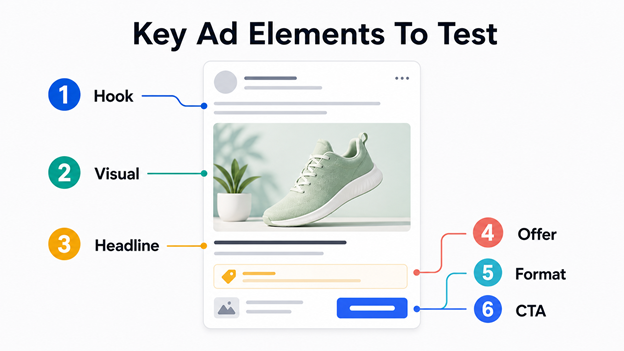
After developing the creative concept, the next step is deciding which part of the ad needs testing. Social media ads include many moving parts, but not every element has the same effect on performance.
The highest-impact elements are outlined below.
- The opening hook determines whether people stop scrolling long enough to notice the rest of the ad.
- The main visual shapes the first impression and helps people understand what the ad is about.
- The headline frames the message and gives the audience a reason to keep reading or watching.
- The offer explains the value people get if they take action.
- The format affects how well the ad fits the platform, feed, and audience behavior.
- The call to action (CTA) tells people what to do next after seeing the ad.
When deciding what to test, teams should prioritize based on the campaign goal. If the goal is awareness, test the hook, visual, brand placement, or message recall. For traffic, test the headline, offer, or CTA. For conversions, test the offer, product framing, proof points, or final action prompt.
A common mistake teams make is testing too many elements at once to save time. When the hook, visual, offer, and CTA all change together, the result becomes harder to interpret. Each test should focus on one key element so the team can understand what caused the result.
3. Define Clear Hypotheses and Success Metrics
Next, turn the creative assumption into a clear hypothesis. A hypothesis states what change is being tested, what result is expected, and why the result should happen.
A weak hypothesis sounds vague, such as “this ad will get better engagement.” A stronger version is, "Customer pain point messaging will increase click-through rate (CTR) by 20% because viewers see their problem earlier.” The stronger version gives the test a specific creative benchmark to measure.
The campaign’s success metric should also be clearly defined before the test starts. If the goal is awareness, teams should measure attention, reach, video completion, brand recall, or thumb-stop rate. For conversions, teams should track conversion rate, cost per acquisition (CPA), return on ad spend (ROAS), or purchase volume.
At this stage, a common mistake is setting vague goals without clearly defining what success looks like. A goal like “more interaction” does not explain whether success means more clicks, comments, shares, saves, or purchases. The hypothesis should be as clear and detailed as possible, so the final result is easier to judge.
4. Choose Your Testing Methodology

Once the hypothesis and success metric are clear, choose the method that answers the testing question. Pre-launch and live testing describe when the test happens, while the methods below show how teams run the test.
- Predictive AI Testing: Predictive AI testing evaluates creative quality before launch using attention, emotion, brand recall, and behavior data. Fast pre-spend feedback makes this method useful for teams with a limited testing budget. The main benefit is lower early creative risk, but strong ads still need live validation.
- A/B Testing: A/B testing compares two ad versions with one changed element, such as a hook, headline, visual, or CTA. Simple creative questions are the best fit for this method. However, results stay clear only when teams avoid changing several elements at once.
- Multivariate Testing: Multivariate testing compares several creative elements and combinations. Teams with enough traffic, budget, and variations get broader learning from this method. The limitation, however, is that each added variable increases the data needed for reliable results.
- Brand Lift Studies: Brand lift studies measure changes in awareness, consideration, favorability, or purchase intent. Brand-building campaigns are the best fit for this method. The benefit is useful perception data, but results usually take longer than standard performance tests.
- Incrementality Testing: Incrementality testing measures whether the campaign caused results that would not have happened anyway. Major budget increases are the best time to use this method. The value is stronger proof of impact, but reliable results need careful setup and enough audience data.
- In-Market Testing: In-market testing measures performance while the campaign is live. Real platform data across audiences, placements, or channels makes this method useful for live optimization. The drawback is that weak ads spend budget while the test gathers data.
- Surveys and Focus Groups: Surveys and focus groups collect direct audience feedback on clarity, trust, and response. Message research is the best fit for these methods. The benefit is useful context, but stated opinions do not always match real behavior.
The strongest approach combines methodologies under both stages. Pre-launch methods improve weak creatives before launch, while live methods confirm performance with real audiences, placements, and budgets.
Scale your A/B testing effectively with this proven framework
5. Validate Creatives Before Spending Money
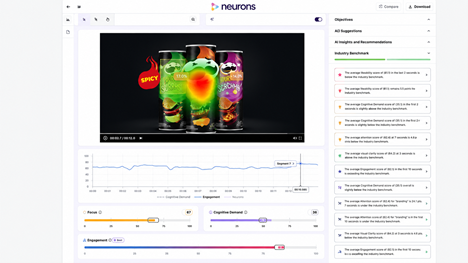
This step offers a high return on investment (ROI) because teams are able to identify weak ads while changes are still cheaper to make.
Traditional methods like surveys, focus groups, and interviews help teams understand opinions, message clarity, and perceived appeal. However, stated feedback does not always reflect how people respond in a fast-moving social feed.
Modern predictive AI tools offer a faster approach by exposing weak creative signals before launch, including low attention, unclear messaging, poor recall, or weak brand visibility.
Neurons AI supports this stage with fast neuroscience-based validation, delivering creative predictions in seconds with up to 95% accuracy. This gives teams a clearer view of which ads deserve media spend before they enter a live platform.
A common mistake at the validation stage is measuring audience preference instead of testing attention, emotional response, brand recall, and message clarity together.
See how Neurons AI predicts ad performance before you spend
6. Set Up and Run the Test
After validating the stronger creatives, the next step is setting up a live test inside the social platform. The test should align with the goal, selected variable, audience, budget, and success metric.
Meta works well with built-in A/B tests and experiments, while TikTok needs strong early creative signals because users scroll quickly. LinkedIn tests often need longer windows because business audiences are smaller and conversion cycles take more time.
Regardless of the platform, each test should focus on one main variable, such as the hook, visual, headline, offer, or CTA. If several elements change together, the team may not know which variable changed the performance.
Distribute the budget evenly across all variants to give each creative a fair opportunity to prove its performance. Otherwise, one version may seem like the winner simply because the platform allocated it more delivery.
The test should also be left to run long enough to collect reliable data, as early results can change as delivery stabilizes.
Another mistake is editing the test while it is still running. Changing the budget, audience, or creative mid-test can distort the result and make the data unreliable.
Master Instagram advertising and drive better results
7. Analyze the Result
After the live test has enough data, analyze the result against the original hypothesis and the success metric. The goal is not only to find the ad with the highest engagement but also to understand whether the creative caused the result the campaign needed.
When analyzing results, engagement and incrementality are often confused, but they are not the same. Engagement shows how people interacted with the ad through views, likes, clicks, comments, shares, or saves. Incrementality shows the extra result caused by the campaign, compared with what would have happened without it.
Native platform lift tools help teams measure incrementality more clearly. Meta conversion lift and TikTok brand lift use control groups to isolate campaign impact from results that would have occurred naturally.
Before increasing spend on a winning creative, teams should run an incrementality test to confirm that the ad caused the result. When the budget increase is large, confirming real impact costs less than scaling an ad that did not cause the result.
As you analyze the results, measure each outcome against the campaign's original goal to identify the most effective creative. For example, in conversion campaigns, sales, leads, or acquisition costs matter more than likes or comments.
A common mistake is treating the highest-engagement ad as the winner without checking whether it produced measurable lift. A stronger decision is to scale the creative that improves the metric tied to the campaign goal.
8. Scale Winners, Refresh Creatives, and Keep Iterating
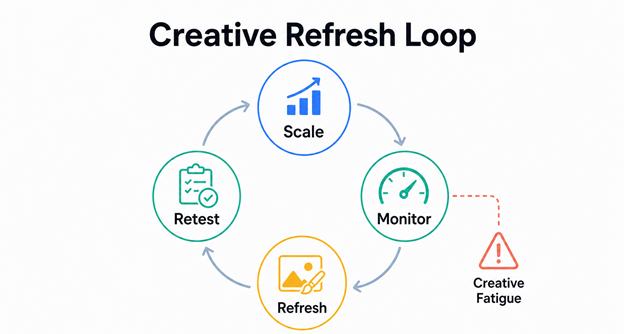
After analyzing the results, the next step is scaling the winning creative while watching for performance stability.
The budget should increase gradually, with more spend going toward the stronger ad and a smaller amount kept for new variations. As spend increases, teams should monitor CPA, CTR, and ROAS because repeated exposure reduces attention and response over time. This decline is known as creative fatigue.
Creative fatigue shows up in five ways:
- Rising costs
- Falling click-through rate
- Lower conversion rate
- Reduced watch time
- Weaker engagement quality
Together, these signs show that the creative is losing its ability to earn attention, interest, or action from the same audience.
Successful social media ad testing works as a continuous cycle: validate, test, measure, refresh, and repeat. This cycle helps teams scale winners and prepare new creatives before performance drops, separating profitable scaling from wasted spend on tired ads.
Track the right attention metrics to improve ad performance
How Does Neurons AI Help You Test Ads for Social Media?
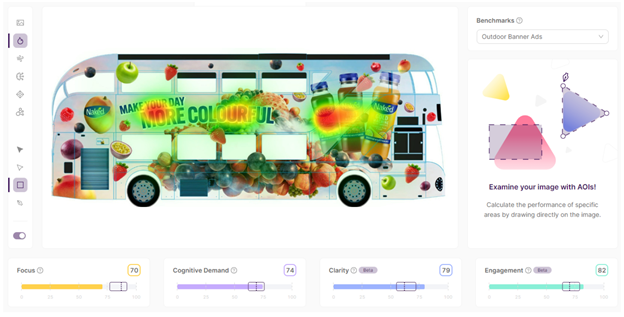
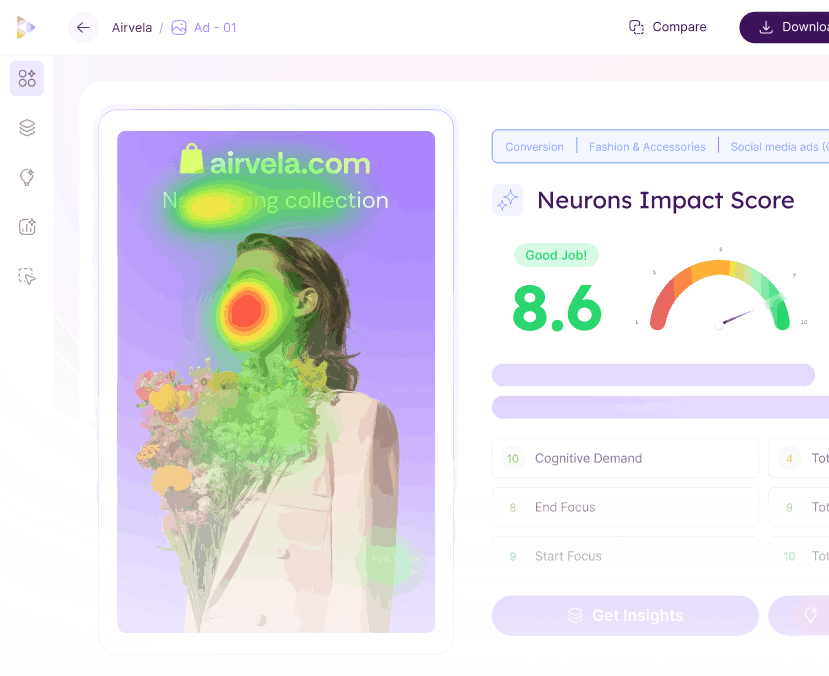
Neurons AI helps teams validate social media creatives before they spend money on live campaigns. Instead of relying only on surveys or internal opinions, the platform uses consumer neuroscience to predict how people are likely to notice, understand, and remember an ad.
This ability makes Neurons AI useful for social media since feeds move quickly. A creative that fails to earn attention, show the brand, or communicate the message early loses performance before the platform has enough data to optimize delivery.
Neurons AI gives teams a clearer way to check these issues before launch through the following features:
- Attention Heatmaps show where viewers are likely to look first, helping teams check whether the product, logo, or key message enters the attention path.
- Automatic Brand Tracking measures whether the brand appears clearly enough across the creative, revealing weak brand visibility before live testing.
- Memory Score predicts how likely people are to remember the creative after exposure, making recall easier to evaluate before launch.
- Visual Recommendation highlights creative elements that need improvement, including layout, message placement, and brand visibility.
- Overall Ad Score summarizes creative performance in one number, making version comparison faster.
- Compare View compares creative versions side by side, helping teams choose stronger ads before live testing begins.
Neurons AI improves the quality of creatives entering live tests, reduces wasted spend, shortens testing cycles, and helps teams scale stronger ads faster.
Book a free demo to see how Neurons AI helps brands test ads for social media