
Before a customer clicks "Buy Now," their brain processes several visual cues, emotions, and memories that influence the decision to purchase. Yet traditional marketing metrics, such as clicks and bounce rates, only reveal the final action, telling marketers what happened rather than why it happened.
Neuromarketing fills this gap by measuring the cognitive and emotional responses that shape attention, brand recall, and purchase intent.
As businesses look for better ways to understand consumer behavior, more are turning to neuroscience-based tools to gain deeper insights. Future Market Insights projects the neuromarketing solutions market to grow from US$1.9 billion in 2025 to US$4.2 billion by 2035.
This guide explores the six best neuromarketing tools, their core capabilities, and how to choose the right platform for your business in 2026.
Understand what neuromarketing is and how it shapes modern marketing decisions
What Are the Main Types of Neuromarketing Software?
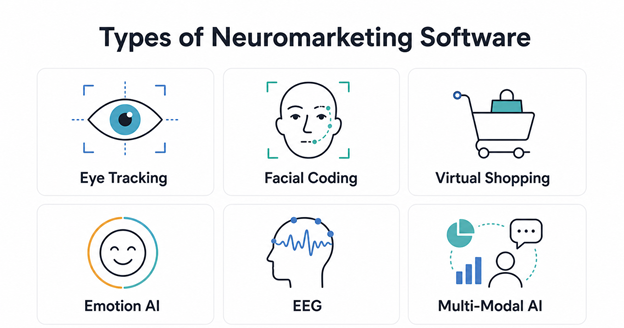
The main types of neuromarketing software include eye-tracking software, facial expression analysis software, virtual shopping, and behavioral research platforms, among others. These categories measure different aspects of consumer response and provide different types of marketing insights.
- Eye-tracking software tracks where people look, how long they focus on specific elements, and what captures or loses their visual attention. These insights help optimize layouts, packaging, websites, and advertising creatives. For example, marketers can verify whether a product, logo, or call to action attracts attention before users become distracted by other elements.
- Facial expression analysis software analyzes facial movements to identify emotional reactions such as happiness, surprise, confusion, or frustration. These insights help marketers understand how people emotionally respond to marketing content.
- Virtual shopping and behavioral research platforms simulate realistic shopping environments to observe how consumers browse, compare, and make purchasing decisions. These platforms reveal behavioral patterns that traditional surveys often miss. Brands use these simulations to evaluate shelf placement, packaging, pricing, and promotional displays before introducing products to the market.
- AI-powered emotion and sentiment analysis combines artificial intelligence with behavioral signals, text, voice, or video to measure emotional responses and consumer sentiment. Since the analysis is automated, teams can evaluate much larger datasets than traditional manual research methods.
- EEG and brain activity measurement software uses electroencephalography (EEG) to measure brain activity linked to attention, cognitive workload, memory, and emotional engagement during consumer experiences. These measurements help researchers understand subconscious attention and cognitive effort that consumers cannot accurately describe on their own.
- Comprehensive AI solutions (multi-modal) combine multiple neuromarketing techniques, such as eye tracking, attention prediction, emotion, and behavioral data, into one platform for broader consumer insights. This combination produces a more complete understanding of why creative assets perform well or fail.
Dive deeper into neuromarketing software features and applications
What Are the Top Neuromarketing Tools in 2026?
The top neuromarketing tools in 2026 are Neurons AI, Tobii, EyeSee, NIQ Bases, Smart Eye's Affectiva, and Bitbrain.
Recent advances in artificial intelligence have shifted neuromarketing from expensive lab-based research toward faster, more scalable, and more accessible software platforms. Today, the best neuromarketing tools reduce creative risk, improve marketing ROI, and build more effective campaigns by measuring consumer attention, emotion, and behavior.
These tools are reviewed below.
1. Neurons AI – Best Overall for Marketers and Agencies
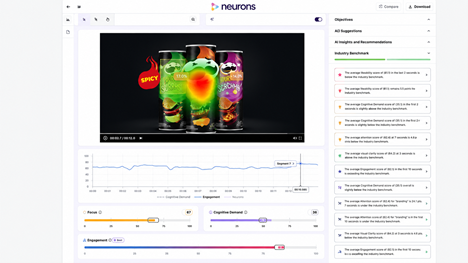
Neurons AI is the best neuromarketing tool for marketers, agencies, and creative teams that want fast, research-backed insights without running traditional neuroscience studies.
The platform uses artificial intelligence trained on the world's largest neuroscience database to predict how people respond to ads, websites, packaging, and other creative assets. Results are generated within minutes, allowing you to validate ideas before committing media budgets.
The platform’s key features are outlined below.
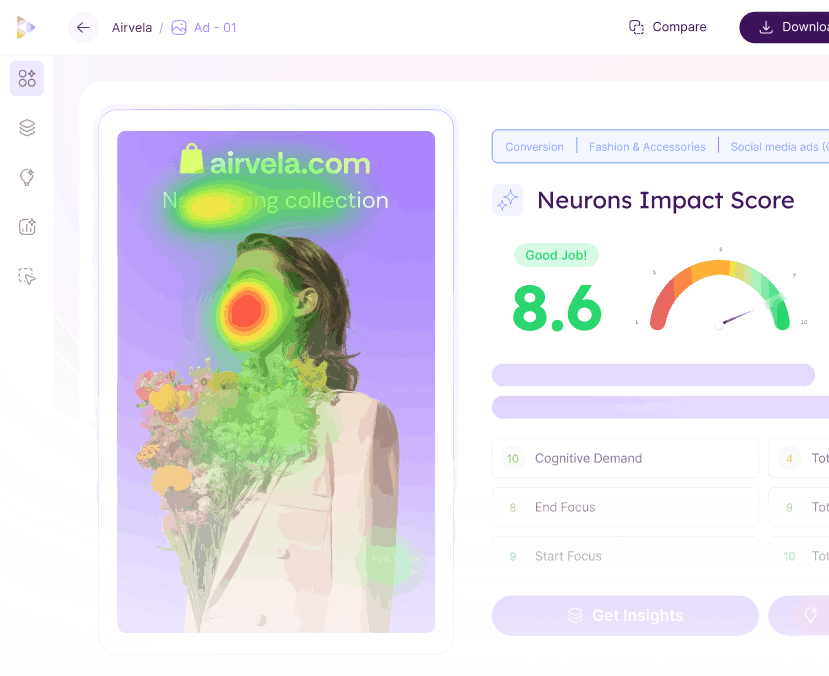
- Attention heatmaps identify the areas that attract the most visual attention using color-coded visualizations of viewer focus. Marketers use these insights to improve layouts, strengthen visual hierarchy, and ensure important messages gain enough attention.
- Memory and engagement scores predict how well a creative captures attention, stays memorable, and encourages audience engagement. Comparing these scores across creative variations identifies the strongest concepts before launch.
- Brand attention tracking measures how much visual attention branding elements receive within a creative. These insights help teams determine whether branding receives enough visibility and appears in the right place within the creative.
- Actionable recommendations identify specific improvements based on attention, memory, engagement, and brand visibility analysis. Applying these recommendations strengthens creative performance before launch and reduces creative risk before media investment.
Unlike traditional neuromarketing research, Neurons AI does not require specialized equipment or research expertise, making the platform accessible even to non-researchers. The platform's predictive model also achieves more than 95% accuracy against real eye-tracking studies.
In practice, the platform moves teams from subjective creative review to evidence-based decisions. Instead of debating which version looks stronger, brands can compare based on predicted attention, memory, and brand visibility before making a choice.
Neurons AI helps brands and agencies reduce creative risk, improve marketing ROI, and produce stronger campaigns before investing in media budgets.
Explore faster creative testing with Neurons AI
2. Tobii – Leading Eye-Tracking Hardware and Software

Tobii ranks among the best neuromarketing tools for precise eye-tracking. The platform combines hardware, including screen-based and wearable eye trackers, with software that maps visual attention across advertisements, websites, and packaging.
Using heatmaps, Tobii highlights the areas that receive the most visual attention, helping brands identify the elements that stand out first. The platform also uses gaze plots to show how viewers move their eyes across a design, revealing how attention shifts between different elements.
The platform’s fixation duration analysis measures how long viewers focus on specific elements before looking elsewhere. These metrics are especially useful when teams need to understand visual hierarchy. For example, a brand can see whether viewers notice the product first, move toward the message, and reach the call to action in the intended order.
Together, these insights help brands improve creative layouts, strengthen visual hierarchy, and optimize marketing assets before launch.
Experience precision eye tracking with Tobii
3. EyeSee – Virtual Shopping and Shopper Behavior Research

EyeSee is a behavioral research platform that helps brands understand real consumer shopping behavior. The platform combines webcam-based eye tracking, facial coding, and implicit response testing.
A standout feature of EyeSee is its proprietary virtual store replicas, which allow brands to observe how shoppers browse shelves and compare products. These immersive environments also reveal how consumers respond to pricing, promotions, packaging, and in-store displays before products reach the market.
EyeSee is particularly useful when purchase decisions depend on shelf context, product adjacency, or competitive comparison. Instead of testing a package in isolation, brands can see how it performs beside similar products, providing a more holistic view.
Unlike self-service AI platforms, EyeSee primarily operates as a full-service research agency. This approach delivers expert-led research and customized insights, but it typically involves a slower turnaround time than automated platforms.
Simulate shopper behavior with EyeSee
4. NIQ BASES – Established Enterprise Solution

NIQ BASES is a leading enterprise neuroscience platform developed by NielsenIQ (NIQ). The platform helps large organizations evaluate consumer responses through rigorous neuroscience and behavioral research.
NIQ BASES analyzes System 1 thinking (intuitive decision-making) by combining EEG, eye tracking, Implicit Reaction Time (IRT), and biometric measurements. This multi-method approach helps brands understand subconscious consumer responses, advertising effectiveness, and purchase intent.
The platform also integrates with NIQ’s broader consumer and retail data, allowing brands to combine neuroscience with large-scale market intelligence for more informed business decisions. This combination reduces reliance on self-reported opinions, which do not always accurately reflect actual purchase behavior.
NIQ BASES is well-suited to rigorous testing and large-scale research studies. The platform is particularly valuable for enterprise teams that need research depth, category context, and broader market data before making high-stakes product or campaign decisions.
However, it requires more time, higher investment, and specialist support than agile AI-powered platforms like Neurons AI. These limitations make it less practical for smaller teams or rapid creative testing cycles.
Evaluate consumer behavior at scale with NIQ BASES
5. Smart Eye’s Affectiva – Best for Emotion AI and Facial Coding

Smart Eye’s Affectiva is a leading emotion AI platform that helps brands understand emotional responses to marketing content. The platform analyzes facial expressions and vocal tone to identify emotions that influence consumer behavior, as many emotional responses occur without conscious awareness.
Webcam-based data collection and cloud-based processing allow brands to measure these responses across large audiences without requiring specialized equipment. This capability makes the platform well-suited for large-scale emotional response testing across multiple campaigns and audience segments.
The platform is useful for testing whether an ad creates the intended emotional response at key moments, such as the opening scene, product reveal, or final message. If emotional response drops during important scenes, teams can identify where the creative loses impact.
Smart Eye’s Affectiva also integrates with other research platforms and data sources, allowing emotional insights to be combined with broader consumer research. However, the platform focuses primarily on emotion analysis rather than providing the broader predictive metrics available in multi-modal platforms.
Capture real-time emotions with Affectiva
6. Bitbrain – Strong Wearable EEG and Biometrics

Bitbrain ranks among the best neuromarketing tools for wearable EEG and biometric research. The platform combines wearable EEG devices, including the Diadem headset, with integrated software that measures attention, emotion, memory, and cognitive activity.
This combination allows researchers to collect high-quality physiological data in natural testing environments, including retail stores, product interactions, and other real-world settings. Brands gain a better understanding of authentic consumer responses during advertising, product, and user experience research.
The platform also supports additional biometric measurements, allowing researchers to compare observed behavior with multiple physiological responses during the same study. This method provides a more complete picture of consumer behavior than relying on a single measurement alone.
Unlike AI-powered predictive platforms, Bitbrain relies on dedicated hardware to collect data. Testing is slower than with pure AI predictive tools, making the platform better suited for detailed neuroscience research than rapid creative testing.
Deploy wearable neuromarketing solutions with Bitbrain
Neuromarketing Tools Comparison: Features, Cost, and Best Use Cases
The table below compares the six best neuromarketing tools based on their key features, speed, pricing, ease of use, strengths, limitations, and ideal use cases.
How Do You Choose the Right Neuromarketing Tool for Your Needs?

To choose the right neuromarketing tool for your needs, consider your goals, budget, workflow, and research requirements.
Use the framework below to evaluate your options before making a decision.
Step 1. Define Your Goals:
Start by identifying what you want to measure. For example, choose a multi-modal AI platform like Neurons AI for broader creative evaluation, EEG for brain activity, or Emotion AI for emotional responses.
Step 2. Set Your Budget:
Determine how much you can invest. AI-powered platforms often provide faster insights at a lower cost, while enterprise platforms typically require larger budgets and custom pricing.
Step 3. Consider Your Team Size and Expertise:
Some platforms are designed for marketers and creative teams, while others require trained researchers or specialist support. Choose a solution that matches your team’s skills and available resources.
Step 4. Assess Your Speed Requirements:
If rapid creative validation is the priority, AI-powered platforms can deliver results within minutes. Hardware-based and agency-led studies typically require longer turnaround times.
Step 5. Decide Between an In-House Platform and a Managed Research Service:
Self-service platforms give teams greater control and faster testing. Managed research services provide expert guidance but may require longer project timelines.
After narrowing your options, evaluate these additional factors:
- Scalability: Ensure the platform can support larger studies, additional users, and your long-term business needs.
- Data Privacy: Confirm that the platform meets your organization’s data security, privacy, and compliance requirements.
- Integration: Choose a platform that integrates with your existing analytics, research, advertising, and creative tools to streamline workflows.
- Training and Support: Look for comprehensive onboarding, documentation, and customer support that match your team’s level of experience.
Before making a final decision, ask yourself the following questions:
- Which platform best aligns with my business and research goals?
- Will the insights it provides improve my marketing decisions?
- Does the platform offer enough value to justify the investment?
- Will it continue to meet my needs as my team or business grows?
- Am I choosing the platform that best fits my needs, or simply the one with the most features?
These questions help separate essential capabilities from advanced features that do not directly support your marketing decisions.
Equip your marketing team with proven ad success strategies
Conclusion
The best neuromarketing tools fall into different categories, each designed to measure specific aspects of consumer behavior. Some platforms specialize in AI-powered creative validation, while others focus on eye tracking, emotion analysis, shopper behavior, or neuroscience research. Choosing the right solution depends on your goals, budget, team, and workflow.
For teams looking to turn these insights into better creative decisions, AI-powered platforms offer one of the fastest and most accessible ways to validate campaigns before launch.
Ready to improve your creative performance? Book a demo with Neurons AI to see how its predictive AI helps you test creatives, reduce campaign risk, and make more confident marketing decisions before investing in media.